It's momentarily calm here, now that we’ve exhausted ourselves with several consecutive weekends of high adventure. Two weekends ago was our annual trip to Malheur, which you’ll see in a forthcoming series of posts once we come to terms with the ~4,100 photos we took. The more recent adventure was no less exhilarating, but perhaps less daunting to recap, so let’s start there and work backwards: The 2017 Dean Hale Woodpecker Festival was incredible!
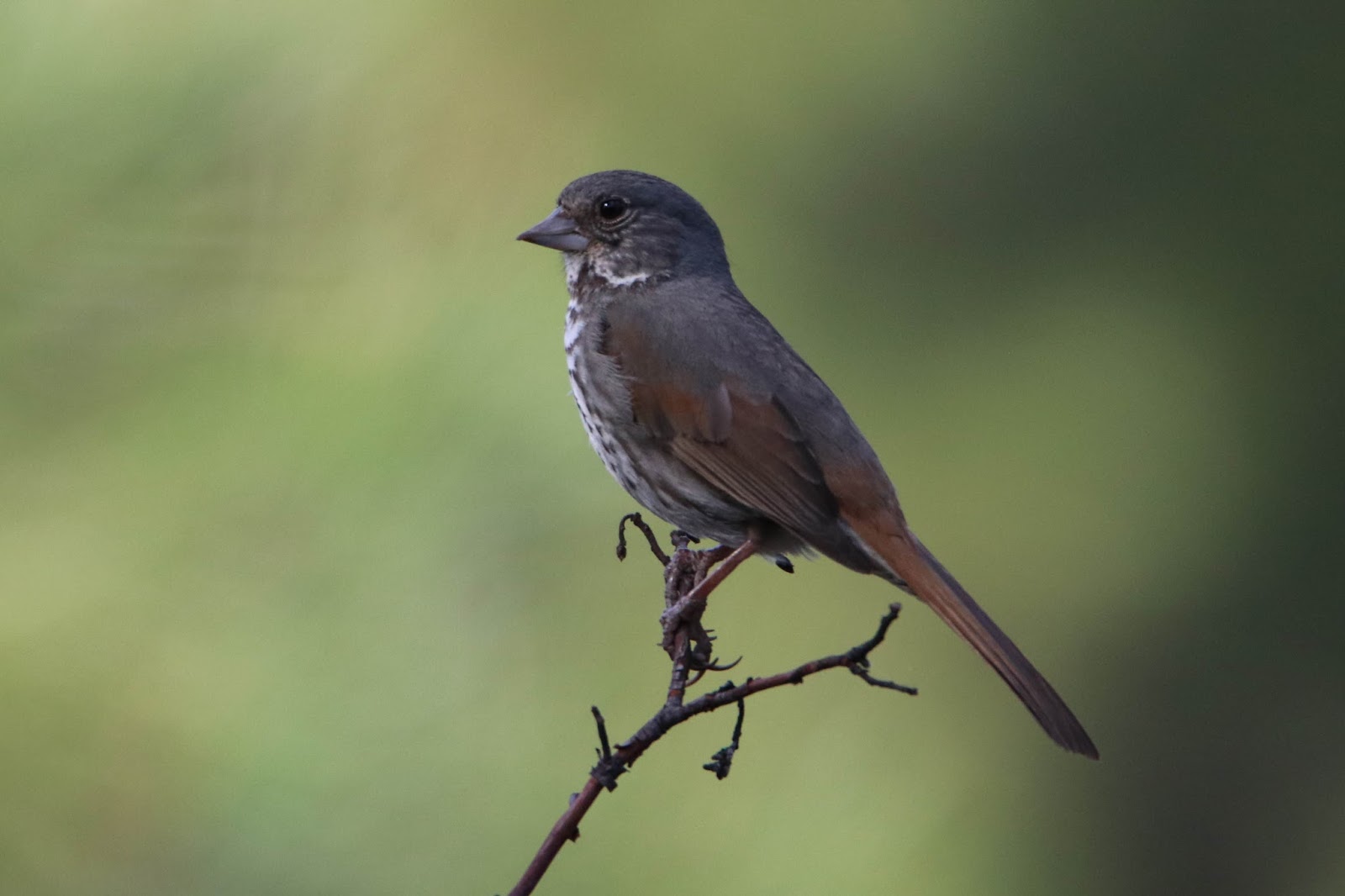
We set up camp Friday evening at Cold Springs Campground, which we’ve visited several times before to see nesting White-headed Woodpeckers, but this was our first stay. We set out immediately after setting up the tent and soon found ourselves surrounded by singing Thick-billed Fox Sparrows. Good butterflies, too.
 |
| Thick-billed Fox Sparrow |
 |
| Hammond's Flycatcher |
 |
| Western Tailed-blue |
After dinner we took another little excursion and were halted by a high-pitched raptor-y squeal. About halfway up a tall pine was the floofiest Great Horned owlet imaginable. Neither the nest nor its parents were anywhere in sight, but when it stretched, we could see how surprisingly well its wings were developed, and that it was more mobile than might be assumed from looking at this bundle of cotton balls. We were happy when, the next day, it had stayed put and we were able to share it with the rest of the crew from our field trip.
 |
| Great Horned Owlet |
The festival runs for four days, but we’d only booked one (full) day’s worth of trips, including our best chance of seeing Black-backed and American Three-toed Woodpeckers. Early in the morning the group was polled for their top-priority target, and we were surprised that about half the group said Pileated. After living in southeast U.S. where they’re abundant and in western Oregon, I hadn’t realized how many people are deprived of their awesomeness. Our first stop was at an older burn where we hoped for Lewis’s Woodpeckers and Williamson’s Sapsuckers.
 |
| Lewis's Woodpecker and Williamson's Sapsucker habitat |
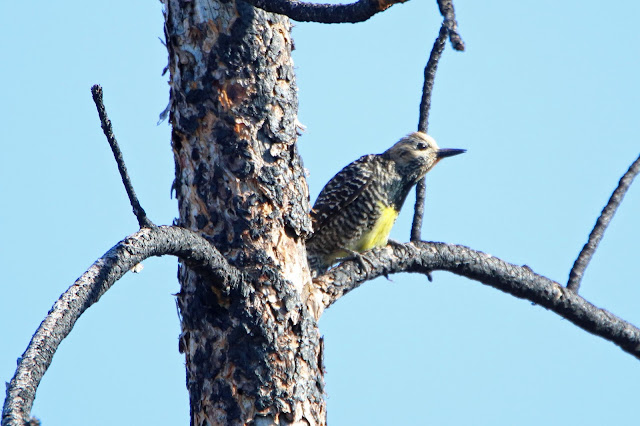 |
| Female Williamson's Sapsucker |
This was an older burn, no longer used by Black-backed or Three-toed, who depend on the insects (bark and wood-boring beetles) that invade forests after they’ve been devastated by fire. We found our first Williamson’s Sapsuckers sometime last year, a female. Since the male and female were once thought to represent different species, the male that our guides had staked out at his nest cavity was a semi-lifer, of sorts. He had been inside incubating and after about an hour of waiting, the female flew in to relieve him and we watched them switch places.
 |
| Getting ready for the switcharoo |
At Calliope Crossing there was, appropriately enough, a gorgeous male Calliope Hummingbird perched at the top of some short, dead willows. We couldn’t have asked for a better warm-up act as we waited, looking past the hummingbird, for activity at a Red-naped Sapsucker nest. Sisters, OR is right in the Red-naped x Red-breasted Sapsucker hybrid zone, and one of the nesting pair did look a little questionable to us, while the other seemed, at least from a distance, to be pure Red-naped. We had good luck with flycatchers at this stop, also, with both Dusky and Gray Flycatchers vocalizing, and a Western Wood-pewee who’s nest Maureen spotted.
 |
| Calliope Hummingbird |
 |
| Western Wood-pewee nest |
From there it was on to a White-headed Woodpecker pair making frequent visits to a cavity to feed their nestling(s). As we would learn, nests with hatched young are far less trouble (for us, the group) than those with birds still incubating eggs.
 |
| White-headed Woodpecker |
 |
| Townsend's Solitaire |
Next, we headed out to a recent burn (~5 years) where our guides had staked out an American Three-toed Woodpecker nesting cavity. We had a long time waiting, and one of the guides expressed some anxiety that they may have abandoned their nest. After close to an hour I noticed the female sticking her head out slightly – either to scrutinize us interlopers, or to try an spy her tardy partner. I called it out, but she pulled herself back inside before most of the group could get on her, including Maureen. The brief encounter was enough to bolster our guides’ hopes, who decided to stay another 30 minutes.
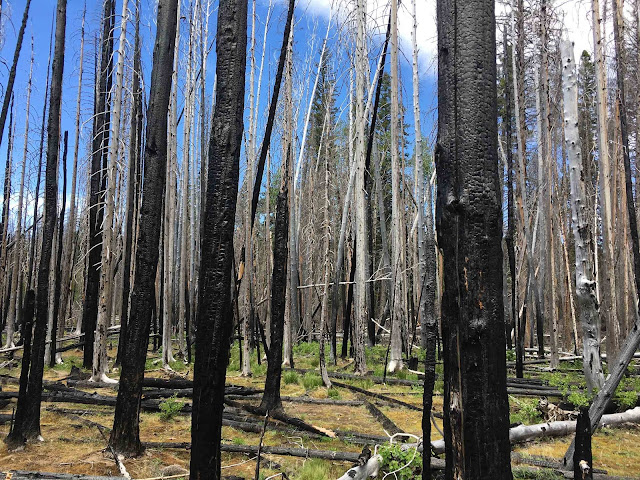 |
| American Three-toed Woodpecker habitat |
 |
| California Tortoiseshells were everywhere in this habitat, including landing on people's hats and fingers |
That extra 30 turned into 60, and still no luck. At the two-hour mark the guides polled the group on our next move, and there was near-unanimous support for pushing on to the Black-backed site. I should note that for the past hour Maureen, determined not to miss another chance, had been GLUED to the scope. I mean she had not moved an inch. She couldn’t leave empty-handed now! I appealed to the group that it was only a matter of time, and (thank goodness) a mere five minutes later the male flew in to feed the incubating, and probably famished female. This was definitely the longest we’ve ever waited in one place for a bird. What a wait; what a payoff!
 |
| American Three-toed Woodpecker |
In contrast to the last stop, the Black-backed Woodpecker was comparatively quick and easy. Our guides had us on a female within 20 minutes. Against the black char of the scorched tree trunks, she was nearly invisible. All around us the trees bore signs of the woodpeckers having ravaged the blackened bark for beetles, which will be a useful clue in the future when we venture to find Black-backs on our own.
 |
| "Black-backed Woodpecker wuz here" |
 |
| Black-backed Woodpecker |
With 11 woodpecker species possible in Deschutes County, our field trip turned up all 11 (I think it may have been the only one to do so this weekend – at least up through Saturday). Obviously we were riding a woodpecker high, and anything else we found that day was gravy. With an owl prowl scheduled for that evening, we were about to have some of the richest, fattiest bird gravy you can imagine. Obviously, the light was not conducive to photography, but I’ll give a brief rundown of the evening. Early on we had Northern Pygmy-owl and Common Nighthawks before venturing into Deschutes National Forest where we had a Flammulated Owl respond to playback. We would also had two separate stops with Northern Saw-whet Owl, and at least a couple of Common Poorwills that were heard, but never seen despite our guide’s best efforts. So yeah, good gravy.
 |
| Our sunset view while Northern Pygmy-owl was calling nearby |
We were on our own the next day and decided we wouldn’t mind another look at a Black-backed Woodpecker, so we returned to the burns. No woodpeckers this time, but a booming Sooty Grouse kept luring us farther into the forest. Afterward we drove to Shevelin Park in Bend, where we’d heard about four woodpecker species nesting right in the parking lot. We weren’t so lucky (we were probably in the wrong parking lot), but were able to find a pair of Lewis’s Woodpeckers who looked as if they were investigating various nest cavities like prospective homebuyers.
 |
| Lewis's Woodpecker |
One last stop on the way out of Sisters is the Best Western in town, which is among the most reliable places anywhere for White-headed Woodpecker, not to mention Pinyon Jay, and other mountain specialties. This time the area just over the fence (which becomes Deschutes National Forest) was chockablock with deer. The preponderance of them were just chilling in the shade in a ring. We paid our respects to the Mountain Chickadees and Pygmy Nuthatches one last time and then headed the rest of the way home.
 |
| Black-tailed Deer |
 |
| Mountain Chickadee |
 |
| Pygmy Nuthatch |
 |
| Silver-spotted Skipper |