After fruit and coffee, during which we were hypnotized by
swarms of hummingbirds, we set out on the first hike of the day. Normally we like a big breakfast to get us started, but we were so anxious not to waste a second that couldn't wait to hit the trails. It didn't take long before German started turning up crazy neotropical gems, not least of which was an adorable male Red-capped Manakin.
 |
| Red-capped Manakin |
 |
| Green-celled Cattleheart |
Next we headed over to Toucan Tower, an observation deck that gave incredible, expansive views of the rainforest of Pico Bonito National Park. Within just a few minutes we would score Purple-crowned Fairy, Stripe-throated Hummingbird, Black-cheeked Woodpecker, Collared Aracari, Olive-throated Parakeets and White-crowned Parrots. Keel-billed Toucans gathered together in a single, distant tree - the most we would ever see at one time, making the name "Toucan Tower" seem quite apt.
 |
| Collared Aracari |
German spotted the electric blue and purple colors of a male Lovely Cotinga against the green forest canopy. Then I scoped a female, much less conspicuous in her drab gray, with a dark, speckled breast; she was so different-looking that I wasn't even sure what I was looking at! The birds were both too far for photos, but we were happy to meet a target bird from any distance. The recent Birder's Guide to Travel named the Lodge at Pico Bonito as the best place to find this "avian unicorn," and the Cotinga is even depicted in the lodge's logo. It might seem like we were destined to see this species here, but we would only see Lovely Cotinga one other time, again right near the observation tower.
 |
| Pico Bonito National Park |
 |
| Yellow-winged Tanager |
Another visitor settled into view, giving the male Cotinga all the reason in the world to excuse himself quickly. He might have been proud enough of his gaudy plumage with no predators around, but it was a different story with a White Hawk nearby. We would have unbelievable luck with raptors throughout our entire time in Honduras, and it all started with this one. Even though he had his back to us the whole time, it was like he was showing off, wings and tail fanned out for us to inspect and admire every feather.
 |
| White Hawk |
The sky threatened to rain, establishing a theme for the week, and we headed back down toward the lodge. We didn't get very far before we added our first trogon and our first motmot of the morning. German used playback of a Broad-billed Motmot and turned up a Blue-crowned instead -- not so surprising since they sound nearly identical. We'd seen a Turquoise-browed Motmot silhouetted against an overcast sky the evening before as we shuttled in from the airport. Even in silhouette it was an awesome sight, since we could make out that distinctive tail shape; it was even more amazing now that we could see a motmot in all it's technicolor glory.
 |
| Blue-crowned Motmot |
 |
| Brown Jay |
The trogon was a Slaty-tailed. Trogons seem almost mythical, being so completely unlike any birds we've seen in the U.S., and given how elusive Elegant Trogons can apparently be even when they show up within their limited corner of Arizona. This bird represented an entirely new taxonomic order on our life lists (one of three we would add), adding punctuation to the fact that we were birding in the tropics. It shares a color scheme with Elegant Trogon (green/blue above, red below), but was quite distinct from the other trogons we would find around the lodge. We finished the short trek back to the restaurant and grabbed some breakfast to fuel another round of power-birding.
 |
| Slaty-tailed Trogon |
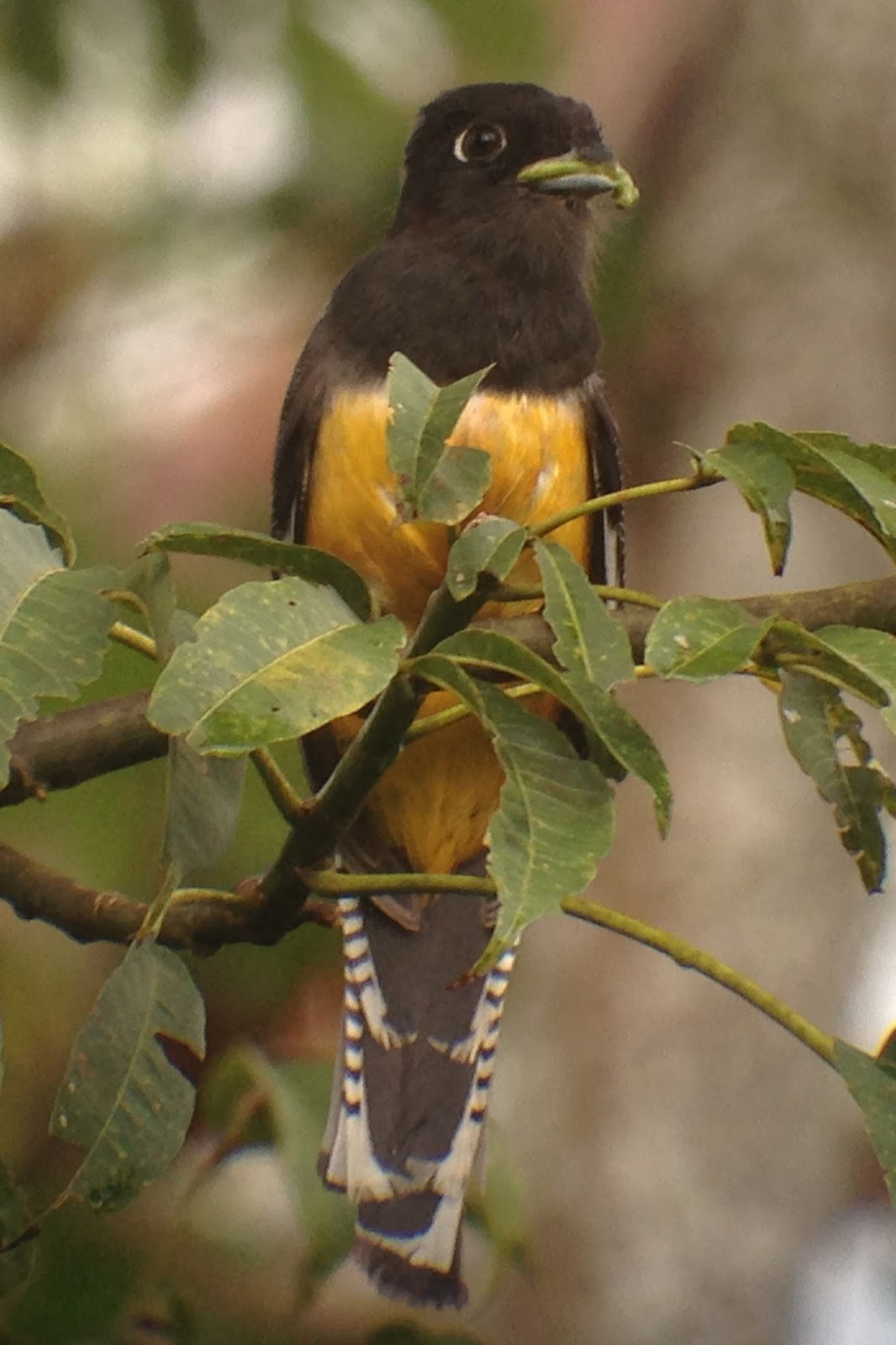
Now we picked up Gartered Trogon over by the "Serpentarium," where there was both a male and a female. Unlike the Slaty-tailed, these had yellow underparts -- as did the Black-headed Trogons that were also common around here. Along the way, Red-billed Pigeons called from treetops, and Brown Jays were every bit as raucous as you'd expect a jay to be, no matter what color they are. Although the jays were one of the more common birds around the lodge, they were never out in the open for long - more than once I noticed them with nesting material, so they obviously had better things to do.
 |
| Gartered Trogon (male) |
 |
| Gartered Trogon (female) |
The real show was up in the sky, anyway. A Common Black Hawk flew low overhead. And then another and another. Even higher up the swifts were swirling and hawking. Huge swifts, much bigger than Vaux's or Chimney. These were White-collared Swfits. The collar could be difficult to make out sometimes, even in silhouette they were unmistakable, especially compared with the few Vaux's sprinkled among them. Back to the lodge for lunch and a siesta.
 |
White-collared Swifts
|
 |
| Carolina Satyrs |
 |
| Facilis Skipper (Eutocus facilis)? |

The afternoon began with a drizzle. "Ha! as if that's going to stop us", we thought, right before it started to downpour. We took refuge under the roof of a guard station and waited out the worst of the weather. We would learn that one of the best times to bird was be right after a hard rain, and we picked up Buff-throated and Black-headed Saltators, and Masked Tityra in quick succession. Something big kept flushing along the road behind some low vegetation. It would fly up and suddenly vanish the moment it hit the ground. Eventually, it settled in a clearing, but it still took German's sharp eyes to spot the Common Paraque's camouflage among the rocks and leaves.
 |
| Masked Tityra |
 |
| Common Pauraque |
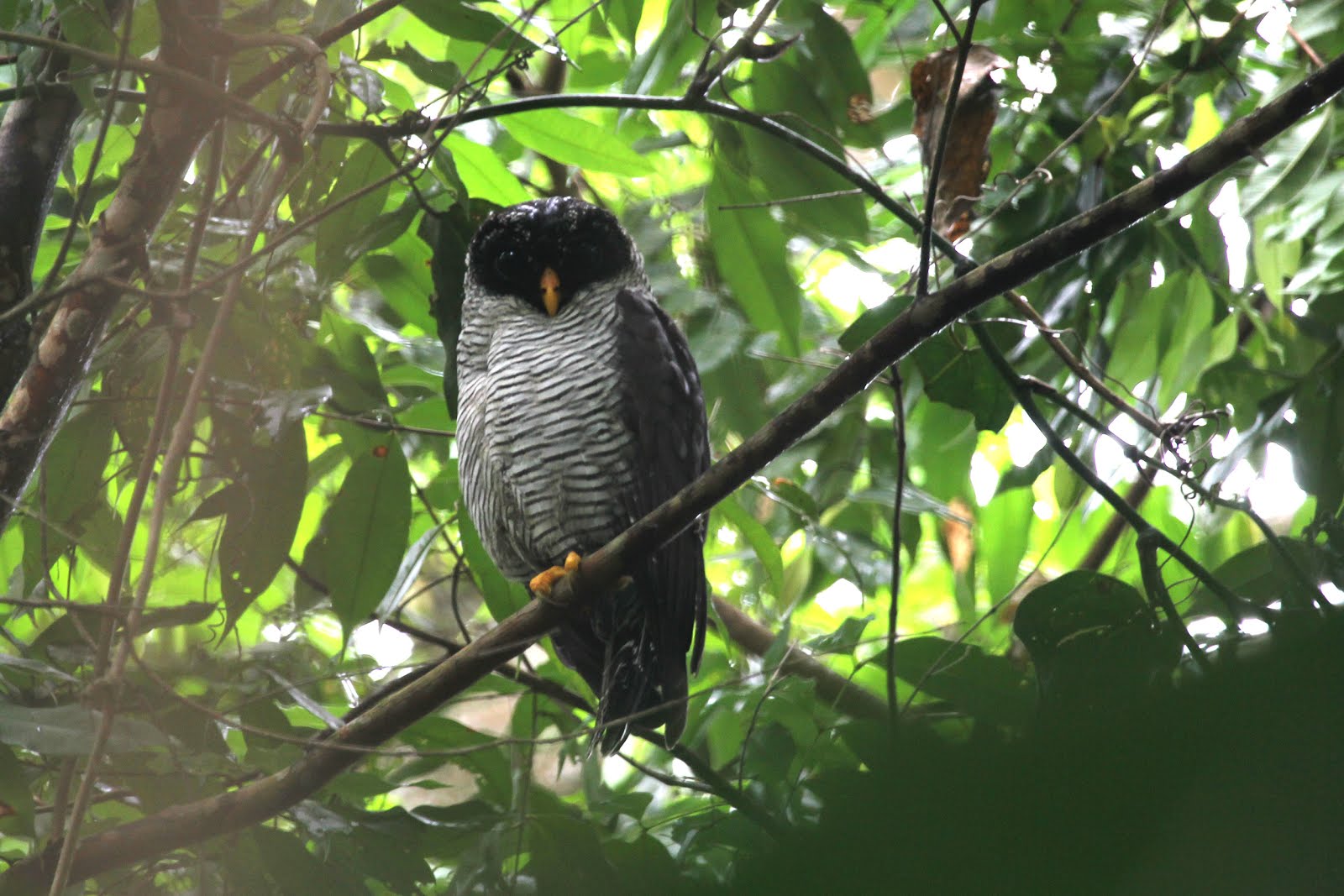
Next, German showed us a bird that makes even the Paraque look ostentatious by comparison. He set his scope on it, knowing exactly where it would be, and had us look at a pale extension growing out of a tree branch - except it wasn't a tree branch, but a juvenile Great Potoo. There are two kinds of potoo around Pico Bonito, but we set our expectations super low, knowing their mastery of arboreal disguises. Little did we know that German would put us on a Northern Potoo the very next day.
 |
| Great Potoo |
 |
| Cocoa pod |
 |
| Plain Satyr (Cissia pompilia) |
A little farther along we heard a terrible cacophony, like a dog fighting a rooster. Somewhere on the other side of these trees was a Plain Chachalaca. Strangely enough, we could have seen this species when we lived in Georgia, where there's an established population on Sapelo Island, about two hours south of our apartment in Savannah. Even though we had to strain to see it, I'm glad our lifer was a wild bird in its native range, instead of an introduced game bird. On the way back to the lodge, German led us down a narrow trail through dense vegetation, where, behind us, a stocky ground bird flew in and quickly disappeared inside the forest. It all happened quickly, but that was the glimpse of a Little Tinamou represented one of the most primitive and ancient bird groups. In that flash, we could barely distinguish it from a large pigeon, and yet it something altogether different from the any other type bird we've seen.
 |
| Chestnut-colored Woodpecker |
 |
| Melodious Blackbird |
 |
| Blue Morpho - a large and glorious butterfly in flight, shown here with its less-than-dazzling underside |
We would "only" see 46 species on our first full day in Honduras, but it seemed like hundreds. And the day felt like it stretched into three. We were exhausted but giddy, and excited to do it all over again the next day. Not that we were ready to give up exploring once the sun set -- nighttime is moth-ing time, which deserves a post of its very own.