Showing posts with label Pomarine Jaeger. Show all posts

Sunday, July 22, 2012

Jaeger Shots!

Just this past week, an out-of-town birder who visited the Savannah area reported seeing an odd bird on the shore of North Beach of Tybee Island that he didn't figure out what it was until after he had returned home. And lo and behold, he had found a most unusual bird indeed - a Pomarine Jaeger!

Pomarine Jaeger with his foot sticking out

Pomarine Jaeger on Tybee Island


This bird isn't odd to find in this part of the country. However, it is extremely odd to find it on shore! These hefty birds are almost always found offshore, flying powerfully out over the ocean waters. What probably brought this bird inland was a problem with its left eye which was clearly injured and/ or infected somehow.
 
A close-up view of the injured/infected left eye

Left eye can't open

Another look at his left eye

Knowing that we'd probably never see a Pomarine Jaeger, or any jaeger for that matter, this up-close, we went over to re-locate it on Tybee in the early evening after I got off of work as we knew that most beach-goers would be gone for the day on this summer weekend. We trekked through the sand as we have many times before, and just at the bend of the shore where we have found many shorebirds, gulls and terns, there lay the lone jaeger, so sweet and peaceful.

Pomarine Jaeger preening

A look at the twisted tail

Pomarine Jaeger


We watched him as we inched up ever so slowly and cautiously towards him. "Regular" beach-goers (those not outfitted with binoculars, a camera, and a scope) walked right past him and he didn't flinch, so we decided to move in closer and get some better looks and shots of him. He seemed as calm as a cucumber and didn't seem to mind our presence. We figured he must have gotten used to it with all of the beach visitors that come and go. And he probably figured no one was really interested in him, except for these odd creatures approaching him with large black lenses.


As we gazed upon him, we relished admiringly over its mighty bill and beautiful face and physique. As we came around the side of him, we saw that very distinctive long and twisted central tail feather, clinching its identity along with its dark malar and lack of pale crescent at the base of its bill as in the Parasitic Jaeger. On his other side, his beauty was slightly blemished only by his wonky left eye which you could see was not able to open entirely. The poor thing had to turn the right side of his face upward in order to see what was going on above him.


Pomarine Jaeger had an itch, so he turned over on his side to scratch it!

Jaeger looking up with his good right eye


We had heard from other local birders that had previously re-located the bird that it could fly. And after about an hour at the beach, Nick witnessed the jaeger take a short burst of flight to move about 100 feet from where we originally spotted it. So although the bird is able to fly, his eye is keeping him grounded. We know that one other birder has contacted a rehabber to try to pick up the bird, but they did not have success in re-locating him. We, too, are trying to reach out to see if anyone can try to come back and get him. We've been told that rehabbing ocean birds can be very difficult, so the fate of this awesome bird is unknown at this time. But we have hope for him yet.

Farewell and good luck to you, Mr. Jaeger

Tuesday, November 16, 2010

Pelagic Trip Out of Central Florida

This past Sunday, Maureen and I took a pelagic trip out of Ponce de Leon Inlet in Central Florida, which was organized by Michael Brothers of the Marine Science Center. This is the same inlet that we took our first pelagic trip out of in February, and was, in fact, on the same boat, The Pastime Princess.

We headed out of the inlet at 6:00 am, and quickly picked up an escort of gulls trailing behind us. These consisted mainly of Laughing, Herring, and Ring-billed Gulls, although there were a few Greater and Lesser Black-backed Gulls in the mix, and Brown Pelicans were flying and diving alongside the jetty.

A very obliging Greater Shearwater
It took a little while but eventually we had our first really good pelagic bird – a Greater Shearwater. When we came up on it, it was sitting on the water, and it seemed not to mind at all as we approached for a better look.. The shearwater appeared to be bathing itself – dipping its head down, before raising its body up and shimmying a bit. It went on like this for several minutes before giving us a view of itself in flight.


While we were watching the shearwater bathe, a juvenile Magnificent Frigatebird flew overhead. I love watching these birds. They’re imposing, yet elegant, and they cruise by like nothing could possibly disturb them. Later on we would also have a female and then a male Frigatebird pass through. None of them did anything very active, like fish or chase down smaller birds – more like they stopped over to see what was happening before going on their way.


Juvenile Magnificent Frigatebird 

As we came up on a weed line, we crept alongside looking for Phalaropes. There were none there, but a Green Sea Turtle passed us by on our starboard, as a Loggerhead Sea Turtle passed us on our port side. The Green stayed submerged and didn’t offer a very good look, but the Loggerhead was more obliging, keeping its head and large portions of its carapace exposed, as it slowly paddled along its way in the opposite direction from where we were headed.


Loggerhead Sea Turtle

Cory’s Shearwaters didn’t arrive for some time, but once they did, they became abundant throughout the rest of the day. The official trip tally estimated 150-200, but I saw significantly fewer – maybe 30-40. Flying fish fled the boat in every direction, staying airborne for sometimes 5 or 6 seconds at a time – an incredible feat for a fish, which the shearwaters exploited as best they could, swooping down and feeding on the wing.


Cory's Shearwater


In addition to the Greater and Cory’s, we also had a few smaller shearwaters as well. At first, nobody could quite decide whether we had an Audubon’s or a Manx, and it wasn’t until they were gone and everybody started reviewing their pictures that everyone concluded it was a Manx. In the pictures below, for instance, you can make out the white undertail coverts, and the thin white crescent behind the auriculars. 


Manx Shearwater

The big controversy of the trip began when somebody spotted amongst the Herring Gulls, a gull that looked almost exactly like a Herring, except for being slightly paler. The leaders were divided on whether it was just another Herring Gull, or whether it was a vagrant Thayer’s. The evidence in favor of Thayer’s included the white edging on the primaries, but others voiced reservations because of the bill color.


Thayer's or Herring Gull hybrid?


Afterwards, the trip organizer sent photos out to gull experts throughout North America, and the consensus appears to be that it’s a Herring Gull hybrid. Likely Herring x Thayer’s, Herring x Glaucous (second generation), or Herring x Kumlien’s. If anybody has an opinion, please leave a comment and let us know so we can pass it along.

We also had a pod of Atlantic Spotted Dolphins come right up beside us and put on a little bit of a show. As they swam to keep up with us, some of them would jump out of the water, or race ahead of another dolphin and cut over. They even had a calf with them, who was just as capable a swimmer as any of the others. I included a video below, which gives an idea of how ingratiating they were with us.


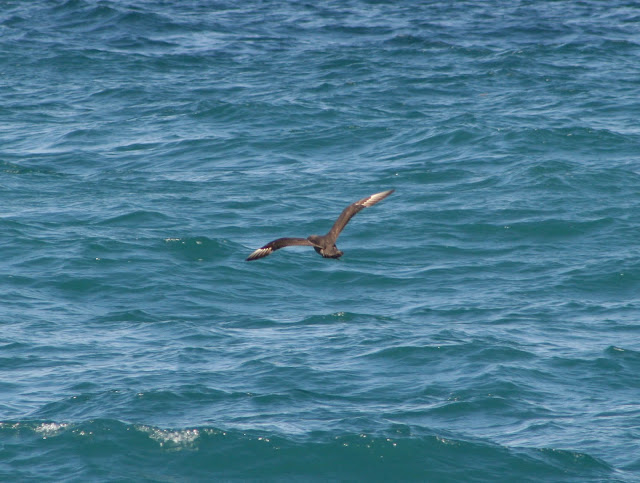
At separate times, we had two Parasitic Jaegers, both dark morph. When we took a pelagic trip in February, we got to see a Parasitic Jaeger chase down a small gull until it was forced to give up its meal from exhaustion. No such luck this time, although one of them did give a much better opportunity to study the Jaeger’s appearance than we’d had previously. It rested on the water for a short time, before flying off and giving a good view of its outstretched wings. We’re no gull experts, but we were informed that the presence of 5 or 6 or 7 primaries showing white was diagnostic of Parasitic, as opposed to Pomarine, which has fewer.


Parasitic Jaeger


Parasitic Jaeger in flight. Note the number of white-tinged primaries

A good number of Pomarine Jaegers, both dark and light morph, came very close to the boat, although we still had to rely on our trip leaders to distinguish between species. One individual did afford a fairly careful examination of its tail, though, and we could clearly make out that the central tail feathers were twisted, which is characteristic of Pomarine. Those who were at the stern of the boat sighted a single Long-tailed Jaeger, as well, but we weren’t so lucky.


Pomarine Jaeger


Pomarine Jaeger. Note number of white-tinged primaries, relative to Parasitic


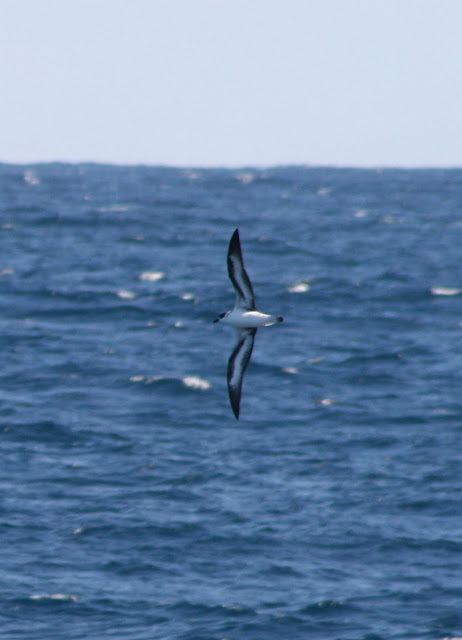
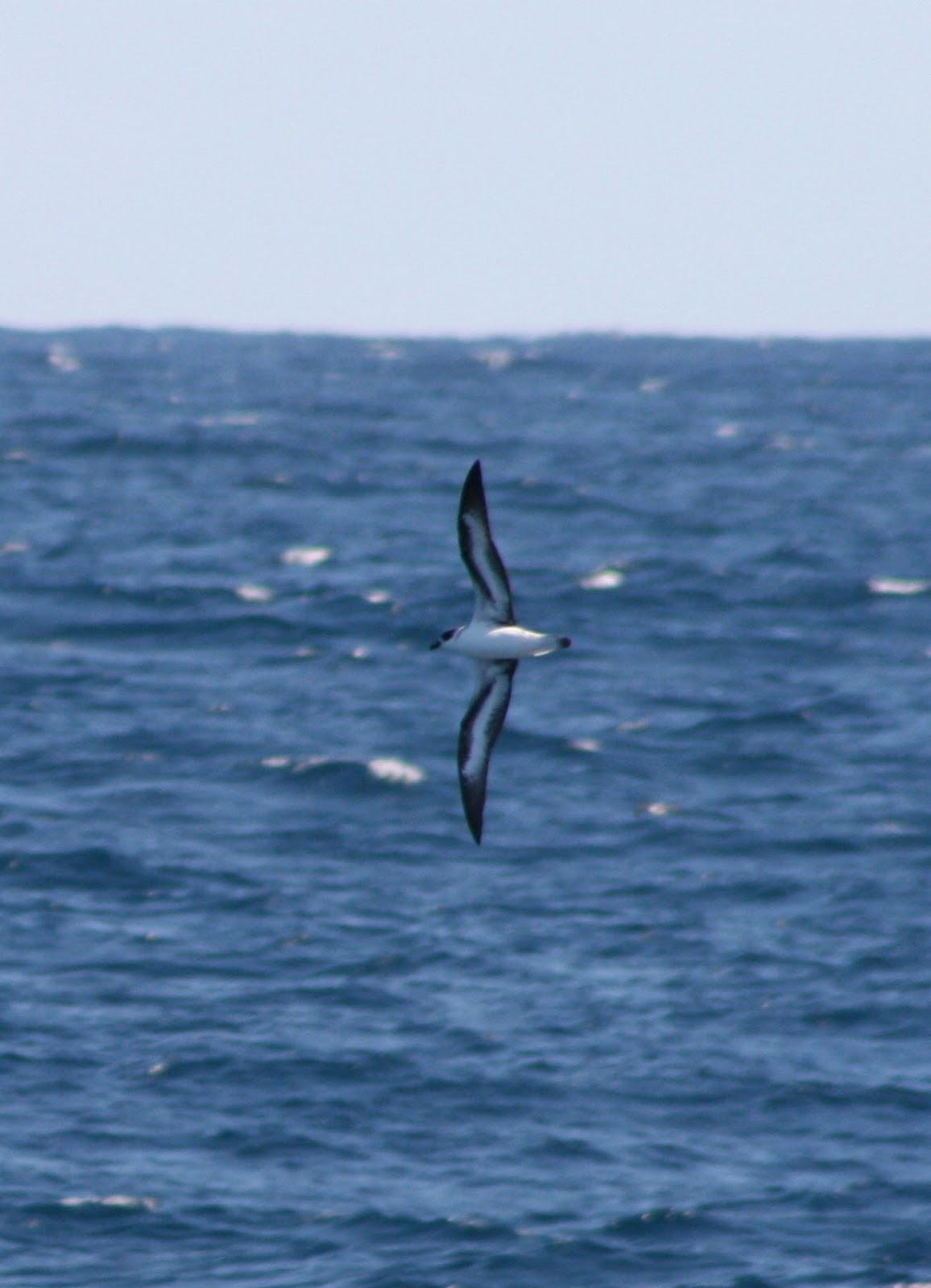
Absolutely, the best sighting of the trip was a Black-capped Petrel off the bow of the boat. This endangered seabird was a surprise for this time of year, but there it was, gliding and banking among several Cory’s Shearwater. The most obvious feature right away was the white patch on the rump, but as it came closer, the black cap and the black bar on the underwing coverts also became evident.


Black-capped Petrel


At various times during the day, Common Terns flew by, including one flock of at least 20. We also had our first Bridled Tern for North America as we headed back toward the inlet. It was sitting on, what first looked like a buoy, but turned out to be a cooler. What was obvious to us at first was the dark gray mantle, but in the picture below, you can also make out that the white on the forehead extends back past the eye into a short supercilium.


Bridled Tern atop a misplaced cooler

Overall, it was an amazing day. In contrast to our trip in February, the weather was perfect, and we had birds everywhere for almost the entire time. We also had several life birds, and for many of the species that we saw last time, we had much better looks at them than previously. Also, much credit to the trip leaders, who were all impressively knowledgeable and helped to make the trip much more rewarding for us landlubbers who don’t often have the opportunity to study pelagic species.