In July we took our first trip to the Goondocks, where we'd follow in the famous footsteps of Chester Copperpot (Goonies), Det. John Kimble (Kindergarten Cop), Johnny Utah (Point Break), and Johnny 5 (Short Circuit) -- (why so many Johns?). Believe it or not, there's actually more to do in Astoria than visiting the sets of '80s movies.
We camped at Fort Stevens State Park, which was loaded with historical artifacts like a WWII battery, and the 110-year old remains of the Peter Iredale shipwreck. It's also got some pretty righteous birding opportunities. We started our morning by heading over to South Jetty, hoping to wrack up shorebirds and gulls. Auspiciously, an Elk walked across the road ahead of us on the drive over, and when we pulled into the jetty, three bull Elk feeding along the edge of the parking lot. We were no longer thinking about gulls.
 |
| An elusive Two-headed Elk! |
The Elk casually grazed and paid us little attention, other than occasionally looking in our direction. We only had our first, brief, Elk encounter earlier this year, and had hoped we'd get a chance to see and enjoy them like this. Eventually we went up the observation tower that looks out over the jetty. We couldn't find much out to sea, we did see a gull harassing a Common Murre that somehow found it's way on shore. It wasn't a great sight, so here are more Elk shots instead.
On the observation tower itself, Barn Swallows had built several nests, and were periodically returning to feed their little ones, nestled right up against the stairs.
 |
| Barn Swallow |
Over at the insipidly-named Parking Lot D, Caspian Terns flew past with some regularity. We counted ourselves fortunate when a handful swooped and dove not far off from us, along the river. After several minutes, we crossed the parking lot and walked a short path and found ourselves surrounded by that tearing call of theirs. Spread out over the mudflats where close to 50 terns along with a good number of Semipalmated Plovers and some peeps.
 |
| Caspian Tern |
The conventional wisdom is that if you want to see Tufted Puffins, you go to Haystack Rock. Since we've found puffins at other spots along the coast we didn't think about it too much. Our mistake for being so dismissive. As soon as we set up the scope, we were staring at groups of 3 or 4 puffins at a time, and close. Occasionally one would dive off its ledge and circle over our heads before heading out to sea. If you want to see Tufted Puffins, you go to Haystack Rock. Got it.
 |
| Tufted Puffin and Common Murres. You can see a nesting burrow center-left |
 |
| Diving off Haystack Rock |
The puffins were joined on Haystack by countless other seabirds, mostly cormorants and gulls, but also decent numbers of Pigeon Guillemots. A male Harlequin Duck came in closer than I'm used to, and I almost got stranded taking snapping photos as the tide kept creeping in around me.
 |
| Haystack Rock |
 |
| Pigeon Guillemots |
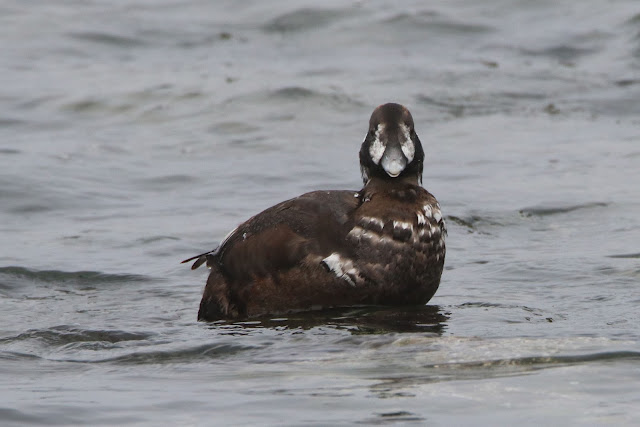 |
| Harlequin Duck |
At low tide, this is a good spot for tide-pooling, and several volunteer naturalists were showing off the anemones and keeping people from climbing where they aren't supposed to.
 |
| Anemone |
I'd wanted to swing by Del Rey Beach after checking out eBird reports, but it was pretty quiet when we got there. But we did pick up a lifer moth in the parking lot, where Red-shouldered Ctenuchas had swarmed all over the ragwort and the dune tansy. We pushed onward to Ft. Clatsop to visit a recreation of Lewis and Clark's winter camp (1805-6) and picked out some Red Crossbills kip-kip-kipping high overhead. I guess we lucked out -- of all the animals Meriwether Lewis described along their journey, Red Crossbill wasn't one of them.
 |
| Red-shouldered Ctenuchas |
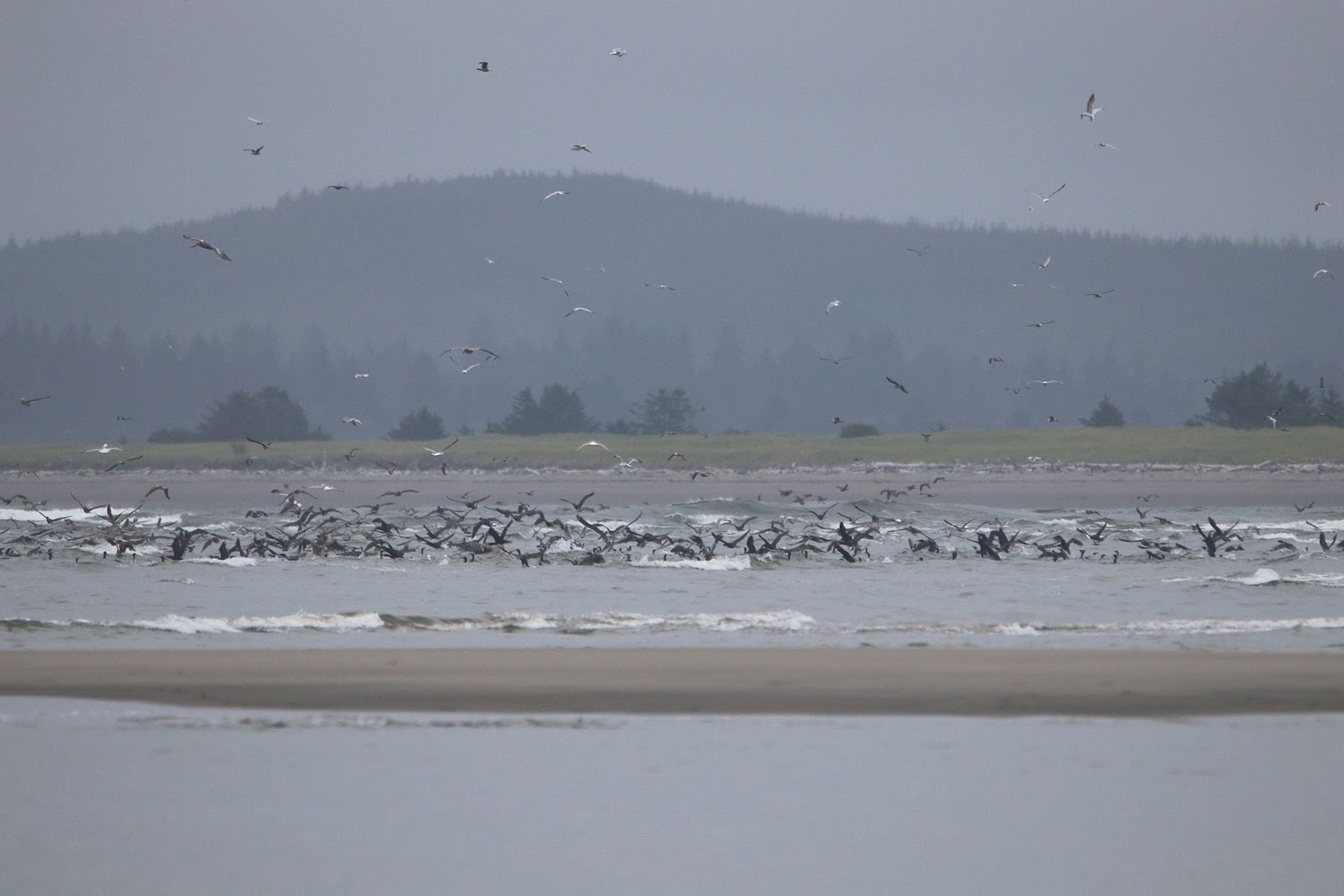
We started the next day back at South Jetty, but only saw one Elk this time. We took the trail that leads to the beach and came across hundreds of Heermann's Gulls congregating on a sandbar. Farther off was a massive mixed flock in the midst of a feeding frenzy. Assorted pelicans, cormorants, gulls, and terns were gathering up whatever they could find, and there must have been plenty of it, whatever it was. On the way out, an Elk family crossed the road just ahead of us, and we got our fist glimpse of an Elk baby!
 |
| Heermann's Gulls |
 |
| Baby Elk!! |
We'd heard that Seaside Cove was worth checking out, and it was indeed. Right along the shore were several adult and first-summer Heermann's Gulls -- the closest we've managed to get to these handsome larids. The water was relatively calm, and we were able to pick out a lone Marbled Murrelet and a good 80 or so Western Grebes.
 |
| Heermann's Gull |
While we were there some guy asked us if we'd seen any Harbor Seals or sea lions anywhere at Seaside Cove (we hadn't). Then he asked if we'd seen the Walruses back in Astoria. He obviously knew the difference between seals and sea lions, so I wanted to believe he knew what he was talking about while also remaining cautiously skeptical. PRO TIP: there are no Walruses in Oregon. But we were heading into town anyway, and there might have been something good -- Maureen suspects he meant Elephant Seals, which would have been great, but instead there was nothing.
 |
| Great Blue Heron |