Here's a familiar bird, the good ol' Barn Swallow. No matter how often we drove through a group of Barn Swallows in France, we kept getting our hopes up for something different - we couldn't wrap our heads around the European population being so damn white underneath! Also notice how much more pronounced the breast band is than on an American Barn Swallow. We wouldn't see another swallow species until we arrived in the Pyrenees, but that didn't stop me replaying Monty Python and the Holy Grail over and over in my head.
 |
| (Eurasian) Barn Swallow |
 |
| Is it just me, or does this swallow look like it's whistling? |
Maureen's Aunt and Uncle have a beautiful, lush yard with lots of lovely botanical and horticultural projects that attract birds and other pollinators. Even with persistent rains our first day in Boudrac, it was active nearly the entire time. We tallied Blackcaps, Blue Tits, Great Tits, and Chaffinches without any trouble. We struggled to turn some uncooperative birds into Greenfinches or Siskins, but the sky was too overcast and our lenses too dappled with rain for confident IDs.
 |
| Blue Tit |
Even the butterflies didn't let the rain keep them down. I always struggle with blues - one of these is a Polyommatus sp., and the other remains a mystery. Another garden species, Map, is a sharp-looking fella. The bottom lep is a rare look at a perched Hummingbird Hawk-moth - a common garden visitor that we saw frequently, but usually hovering and feeding like its namesake.
 |
| Polyommatus sp. |
 |
| Unidentified blue |
 |
| Long-tailed Blue |
 |
| Map |
 |
| Hummingbird Hawk-moth |
Meanwhile, with all the excitement of being swarmed by lifers, we shrugged off the magpies to our later chagrin. I'd mistakenly thought these were the same as "our" magpies, thanks to iBird, which lists the scientific name for Black-billed Magpie as
Pica pica, instead of
Pica hudsonia. Bah! Oh well, it's still an armchair tick of sorts.
 |
| Unfortunately, our best look at a Willow Warbler |
 |
| Red-veined Darter |
We met with a friend of the family who had a sign for the Ligue pour la Protectio des Oiseaux (LPO) in his yard. He had banned hunting on his property and boasted how he's been ostracized from the townspeople in consequence. The sign featured a European Robin, coincidentally, not far from one of the best-showing Robins we found all trip, and posed in exact mirror image to the sign.
 |
| European Robin |
Both nights we spent in Boudrac we were serenaded by a Tawny Owl at 4:30 in the morning. If something absolutely insists on waking me up at 4:30, it's best if that something is a lifer. Tawny was our only owl of the trip, but we started getting good looks at some diurnal raptors a few hours later, starting with Common Buzzard (a
Buteo, like Red-tailed Hawk), and followed by a flyover Honey Buzzard (which is not a
Buteo).
 |
| Common Buzzard |
 |
| Honey Buzzard |
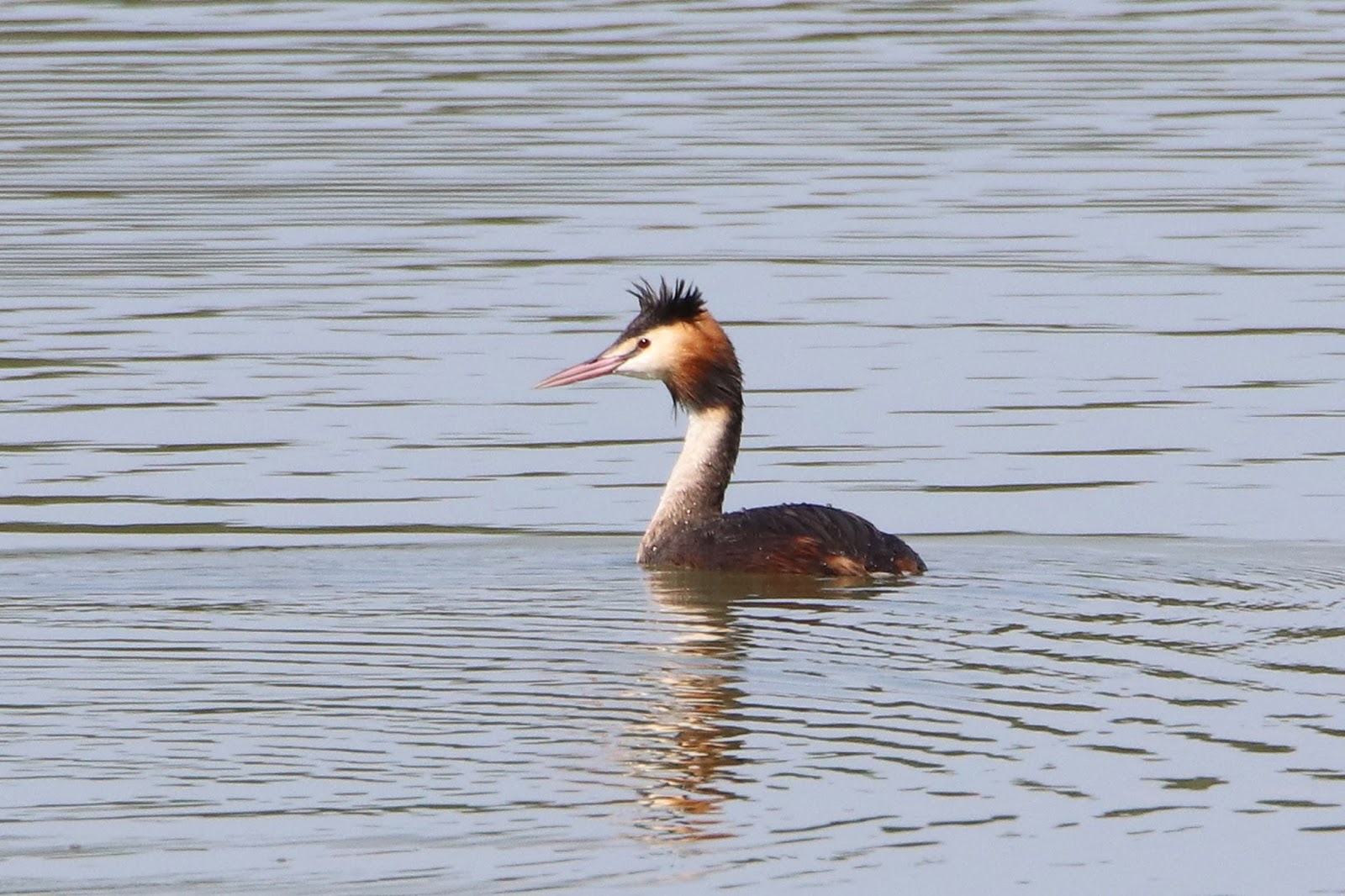
The next day we had to pack up and head to the mountains, but first we took a quick trip out to Réservoir de Magnoac to pick up some water birds. Right off the bat, among the Great and Cattle Egrets -- a Little Egret! All over the surface of the reservoir in one and twos were a few dozen Great Crested Grebes, and the shores were lined with Common Sandpipers and Northern Lapwings.
 |
| Great and Little Egrets |
 |
| Little Egret |
 |
| Great Crested Grebes |
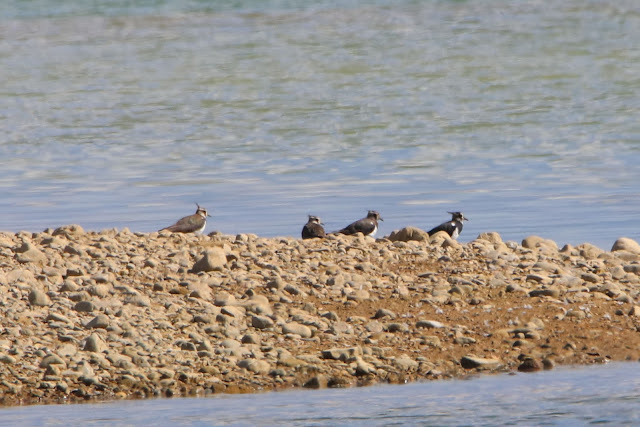 |
| Northern Lapwings |
We were in the midst of a Euro bonanza. As we hiked closer to the water for better views, we had our introductory looks at White Wagtail, which would be one of the most common birds of our trip.
 |
| Flying out of a tree -- not where I would have expected to find a White Wagtail |
On our way back to the car, we stopped to admire some more butterflies, including Painted Lady -- the same Painted Lady that's found all throughout the United States and Canada.
 |
| Painted Lady |
 |
| Clouded Yellow sp. |
 |
| Speckled Wood |
 |
| Meadow Brown sp. |
One last stop brought us to Lac de Puydarrieux. We expected we'd see pretty much the same stuff as at the reservoir, and for the most part we were right, except this time the nearly two dozen lapwings were mixed in with with three dozen Eurasian Curlews! But we were really in for a treat once we spotted three terns - an adult and two juveniles - flying around and plunge-diving. They were clearly
Chlidonias terns of some kind, but based on range and time of year, I hadn't really counted on seeing any. It was a while before they came closer and the dark gray underparts proved they were Whiskered Terns. Really an awesome surprise.
 |
| Great Cormorants |
 |
| adult Whiskered Tern |
 |
| juvenile Whiskered Tern |
Stay tuned for some genuine bucket-list birds in our next post!