Showing posts with label Dragonfly. Show all posts

Monday, August 31, 2015

THIS WILL NEVER HAPPEN AGAIN! An Unlikely Duo Goes Head-to-Head

The weather works in mysterious ways. Oregon is certainly in no shape for me to be rooting against a much-needed bout of rain, but with ambitious camping plans we booked for this weekend our fingers were crossed that the worst of it would hold off just a little bit longer. It was not to be; Oregon's southern coast will have to wait. We tried to find a last-minute alternative, but between the storms to the west of us, and the wildfires to the east, we decided it best to sit tight. The skies mostly cleared up in the afternoon, so we were able to fit our shorebirding in after all -- just much closer to home.

Shorebird flock - Western and Pectoral Sandpipers

The sweet lovers' embrace of a couple of star-crossed orthopterans

Damselfly glamour shot

We spent parts of Friday, Saturday, and Sunday at Ankeny NWR reveling in migrant Pectoral Sandpipers, Semipalmated Plovers, and assorted peeps. Practically everything else we tried to turn into a Baird's Sandpiper, but we just couldn't make the name fit convincingly. The real highlight of the weekend, though, was a collaboration between two birds you'd never imagine seeing together, even while they share a home.

Semipalmated Plover


Pectoral and Western Sandpipers

Pectoral Sandpiper

I was crouched down inspecting a bug, when I noticed a form out on a muddy patch of shoreline that hadn't been there a minute earlier. "Rail… rail… Virginia Rail" I sputtered. We manage to (rarely) see these from time to time, but like any rail, they're more often heard than seen, and this was the most open we've caught one yet. A few seconds later and it was joined by another super secretive species, a Sora.


It's uncommon enough to see one of these skulkers out from behind their usual dense cover, but to see both side by side is practically unfathomable, like bigfoot sidling up to a unicorn. The two lingered together for nearly a minute, picking at the substrate like old friends. The Sora left first, and then came back shortly after for an encore. For all I know this was one in a long series of regular inter-rail check-ins, but truly it seemed like something that will NEVER HAPPEN AGAIN. In fact, I did hear from one researcher on Twitter who studies rails, and she told me that she's never seen a Sora commingle with a Virginia Rail. So there you go.


Sunday, July 27, 2014

Flying Without Feathers

“Flying without feathers is not easy; my wings have no feathers.” — Plautus

The Roman playwright Titus Maccius Plautus surely thought he was being clever when he rattled off the above epigram for his work, The Carthaginian, but featherless flight evolved several times independently, and is the rule throughout the aerial animal kingdom, rather than the exception. (In fairness to our friend Plautus, the latter part of the quote is sometimes translated as, “my wings are not yet fledg’d,” which makes much more sense).

I’m sitting down to write this in late July, when the birding is slow, and Moth Week is winding down, so this seemed like a good opportunity to highlight some featherless flyers. I’ve been on a bit of a butterfly tear lately, and even signed up for eBird’s Leppy cousin, e-Butterfly (it’s still going through its growing pains, but definitely give it a try). Two National Wildlife Refuges in the Willamette Valley region are particularly rich with butterflying opportunities, and have gone a fair way toward advancing our nascent Oregon lists. One of these, Baskett Slough NWR, is among the few remaining strongholds for Fender’s Blue, an endangered subspecies of Boisduval’s Blue. The other, William L. Finley NWR, has just had Fender’s reintroduced earlier this year, hopefully helping bolster the local population.

"Fender's" Blue


Western Tiger Swallowtail is our largest butterfly in the Willamette region (Two-tailed Swallowtail is larger, but it only occurs east of the Cascades in northern Oregon). It’s so big, in fact, that its wingspan can equal four Fender’s Blues from tip to tip. It’s also among our most common butterflies, so we’ve been crossing paths pretty frequently over the past month.

Western Tiger Swallowtail


Speaking of “common” butterflies, here are two more. Common Ringlet is a hugely variable species that we find in grassy habitats. Most populations have a dark submarginal eyespot, which ours lack. Common Wood-nymph is a similarly drab butterfly, but loaded with plenty of eyespots to spare. These two must have waged a winner-take-all gamble for the entire pot, and the Wood-nymph came away with the king’s ransom of eyespots.

Common Ringlet

Common Wood-nymph


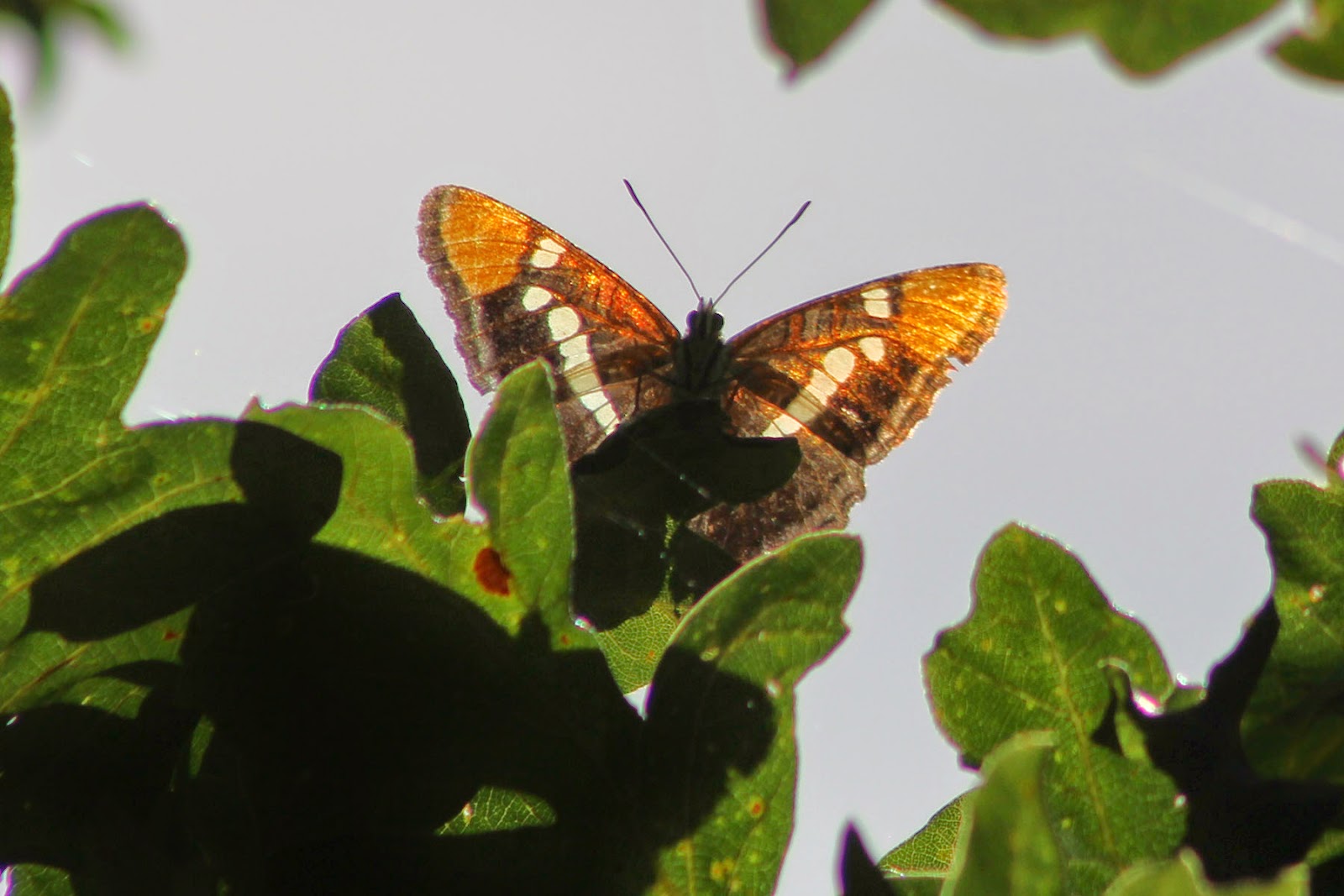
California Sister is a subtly beautiful butterfly, with stained glass patterning along the leading part of the forewing. The group name “Sister” refers to their white stripes, supposed to resemble a nun’s habit. It’s not an entirely convincing resemblance, nor is it quite fair, as they’ve got a good deal more pizzaz than even Julie Andrews as Maria.

California Sister


From nuns to goddesses, we have the Mylitta Crescent. Mylitta was the Babylonian counterpart to Aphrodite, goddess of love and fertility. I don’t know the etymology of the species name, but these tiny bursts of orange were quite active when we found them at Finley NWR. Finley is the only place we’ve seen them so far, and only along a limited stretch of our trail. They’re common throughout much of the West, so I’m sure we’ll get plenty familiar with them in time.

Mylitta Crescent


Since it’s Moth Week, there’d be no excuse for my neglecting the butterfly’s less celebrated cousins. This odd-looking T-shape of a bug is actually a Morning-glory Plume Moth. It’s got spindly, plume-covered hindwings wrapped up inside narrow forewings. It’s completely bizarre, and not at all what people picture when they think of moths. If I hadn’t seen this one fly and then land when we crossed paths at Baskett Slough, there’s no way I would have seen it. We’ve had some other pretty good moths since we’ve moved to Oregon, but so far nothing like large and charismatic moths like we’d grown used to in Savannah.

Morning-glory Plume Moth


A couple of posts ago, I included a picture of an Eight-spotted Skimmer. Well, here’s a Twelve-spotted Skimmer. The Eight-spotted Skimmer spends it’s days muttering, “You think you’re better than me? You’re not better than me.” Deep down it knows that the Twelve-spotted is indeed better… by four.

Twelve-spotted Skimmer

Dragonfly mating never ceases to baffle and astound

Spreadwing sp.
Blue Dasher

Saturday, June 28, 2014

Finding Some of Everything at Ankeny NWR

Everyone should live this close to a National Wildlife Refuge. From our apartment in south Salem, we’re a mere 8 minutes’ drive from Ankeny NWR, one of the crown jewels of the Willamette Valley National Wildlife Complex, and a top spot for wintering waterfowl. We arrived in Oregon too late for wintering birds, but there are have been good numbers of Canada and Cackling Geese, Cinnamon Teal, and Ruddy and Ring-necked Ducks to enjoy into the summer. The Ruddy Ducks, in particular, are looking mighty handsome and we’ve been able to watch males perform their bizarre mating display, bouncing their bills off of their chests with increasing rapidity.

Cackling Geese


Ruddy Duck

Black-headed Grosbeak


I don't have any idea what this is, but it's incredible

There's an emu on the farm across from one of the main trails at Ankeny.
I wouldn't be terribly surprised if somebody tried to eBird it.

Right in the parking lot, Maureen spotted a gorgeous pink and gray moth. It was super tame, crawling over the ground right in front of us without flushing. Maureen was so taken with it that she almost would have preferred it’s colors to the navy and coral she chose as our wedding colors! It was a Cinnabar Moth, which isn’t native, but was introduced intentionally to help combat invasive ragwort, its host plant. Once we got started on the trail, we started noticing golden beetles clustered together on the tops of certain plants. Given that we’d just seen a Cinnabar Moth, I thought they could have been Ragwort Flea Beetles — another introduced species that’s also partial to ragwort, which happens to be a metallic gold — but now I'm leaning toward some kind of leaf beetle in the Chrysolina genus.

Cinnabar Moth


Chrysolina sp.

Recently, I was taking a stroll around our neighborhood and stumbled across a huge number of ragwort plants, each one totally covered in Cinnabar Moth caterpillars. Instead of the pink and gray of the adults, the caterpillars wear a striking orange and black striped pattern. With all of these Cinnabars consuming the ragwort, I’m surprised there’s still any ragwort left. If/when it is finally eradicated, I wonder what happens to the moths? The idea of introducing a species to help fight another introduced species is amusing and absurd, and I can’t help but think of an episode of The Simpsons: Bart cares for a pair of Bolivian Tree Lizards that eventually escape and decimate the Springfield’s pigeon population. To address the lizard problem, Skinner proposes “unleash wave after wave of Chinese needle snakes”.
Lisa: But aren’t the snakes even worse?
Skinner: Yes, but we’re prepared for that. We’ve lined up a fabulous type of gorilla that thrives on snake meat.
Lisa: But then we’re stuck with gorillas!
Skinner: No, that’s the beautiful part. When wintertime rolls around, the gorillas simply freeze to death.
An army of Cinnabar Moth caterpillars


Our other exciting Lep. find of the day was a beautiful Lorquin’s Admiral. We haven’t been chasing down West coast butterflies with quite the same gusto as we have the birds, but this was one that caught our attention. It makes me wonder what else we might have been missing while butterflies flit about in our periphery. We might just have to work on building up our Oregon butterfly list a bit.

Lorquin's Admiral


We also had some interesting Odes that morning. The damselflies were in fine form, mating every which way we looked. Actually, I shouldn’t speculate on whether they were in fine form or not because damselfly sex doesn’t make a whole lot of sense to me. As I understand it, below, the male’s terminal appendages (cerci and paraprocts) are clasped onto the female’s prothorax, which helps them determine whether they’re the same species or not. This step precedes copulation. Either that or he’s a zombie damselfly, vacuuming out her brains in an futile attempt to sate his unquenchable, ceaseless hunger for damselfly brains. We also had a nice look at some Eight-spotted Skimmers.

Zombie damselfly courtship


Spreadwing damselfly (Lestes sp.)

Female Eight-spotted Skimmer

Male Eight-spotted Skimmer

During our last trip to Ankeny we also found a motherlode of Pacific Tree Frogs. These little guys were all huddled together along blades of tall grasses, as well as dodging and diving around our feet while we walked the trails. Some groups preferred to take refuge in the wider leaves of blackberry plants (which are everywhere, and should be ripe in another a couple of weeks!). The frogs show astonishing diversity in color and pattern, but they all share dark striping that runs from their noses, through their eyes, and down their flanks.


Along the same trail as where we found the frogs, we came across a Northern Flicker doing some excavating. I rather prefer the bright red mustaches of these fellows to the black mustaches of the Yellow-shafted Flickers back East, but this is only quibbling: any bird unabashedly sporting statement-making facial hair has my respect (here's looking at you, Black-throated Sparrow).


The past several times we’ve gone there’s been a 2nd-year Bald Eagle perched up in a snag, just off the path. He stayed put for good, long stretches, giving us ample time to admire and photograph him, before he would take off over the water to terrify the ducks and geese.

2nd-year Bald Eagle


The highlight of our Ankeny birding, though, was an epic back-and-forth battle supreme between a female Tree Swallow and the Cliff Swallow whose nest she was trying to usurp. A dozen or so Cliff Swallow nests were built underneath the roof of the observation gazebo, and swallows were flying in and out almost continuously, alternately hunting and homemaking. One nest in particular was intensely coveted by an interloping Tree Swallow, who tried repeatedly to annex these other birds’ territory. We watched as, time and time again, the Cliff ejected the female Tree Swallow by force. The Tree clung on for dear life, despite being relentlessly bitten in the face and legs. Somehow, inevitably, she would shove herself back inside again. We watched this brutal war of attrition for nearly ten minutes, but it still wasn’t long enough to see the outcome. We were able to record some of the action, though:


Cliff Swallow in a Cliff Swallow nest

Tree Swallow in a Cliff Swallow nest


This Tree Swallow asserts his dominance by issuing a furious bellow. No Cliff Swallow will ever feel safe as long as this rage-machine and his brutish kin patrol the otherwise placid shores of Ankeny. Aye, this may be a designated NWR, but the designation serves merely as a bitter and ironic reminder there can be no refuge for weary Cliff Swallows.