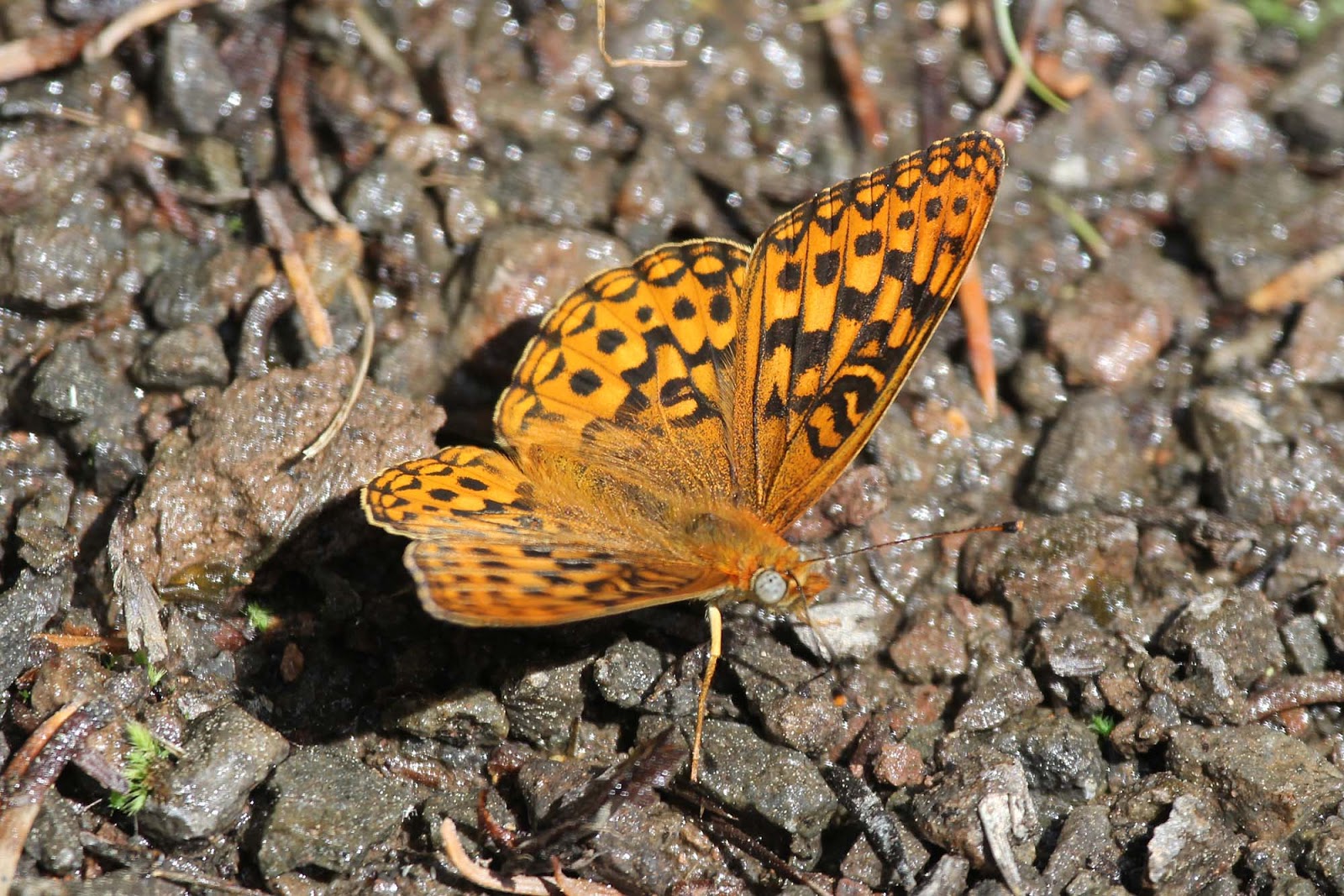
Showing posts with label Lorquin's Admiral. Show all posts

Sunday, April 23, 2017

Everything That's Old is New, Part 1

Well, it looks like we've got quite the backlog of photos that haven't made it onto the blog yet. In the interest of playing catch-up I thought it'd be good to unload some of our favorite un-shared photos from 2016 over three or four posts. Not every outing becomes a grand adventure, and so we end up collecting a photo here, a photo there. You know how it goes. Also, this week marks three years in Oregon! So by happy coincidence we get to use this opportunity to take you on a mini-tour of our favorite spots around the Pacific Northwest. The photos in this post were all taken around Salem.


What's the only thing better than a Bushtit? Two Bushtits! Or better still, cuddling Bushtits.


We're fortunate that we live pretty near to a couple of excellent National Wildlife Refuges, including our go-to wetland, Ankeny NWR. There have been some extraordinary rarities in the few years we've lived here, including a Tufted Duck this winter, and a Ruff the year before.

American White Pelicans are annual at Ankeny, but never seem to stick around for long

Lincoln's Sparrow


Aside from the birds, Ankeny is still one of my favorite places for the sheer number and variety of arthropods it hosts. It's always worth stooping to closely inspect the grasses or the rails along the boardwalk trails. And it's taught me that it's always worth have a macro lens on hand, even if it's just my handy iPhone clip that I carry everywhere.

Forest Tent Caterpillar
Bush-katydid nymph, cutest of all insects.

Jumping spider


Tundra Swans are a highlight every winter when they gather at Ankeny by the dozens, sometimes numbering nearly 100. I know it's cliché to associate swans with grace, so I won't. I'll just show this series Maureen shot and defy you come up with a better, more apt word.


Ankeny isn't the only place in town to find swans, since Minto-Brown Island Park is home to a pair of their Mute cousins. Yeah, they're invasive and pose a huge menace to wetland ecosystems by aggressively driving out the competition, unsustainably devouring native vegetation, and choking waterways with their waste... but there's no arguing with those good looks.


One of the coolest finds at Minto-Brown last year was this mating pair of dagger flies. The male brings her a nuptial gift in an attempt to win her over. If he's successful she goes to work on the gift while the male starts going to work on her. 


The same pair dagger flies, as seen from above

There are so many active raptor nests in spring that even the non-birders realize how great the park is for birds, regularly stopping us to tell us where they saw this or that. Just in the past few weeks we've seen nests for Osprey, Red-tailed Hawks, and Northern Harriers. This harrier from last year was in the process of getting nest material together.


Lorquin's Admiral

Townsend's Chipmunk is the default chipmunk here in the Willamette Valley. I still haven't figured out how to tell it apart from Oregon's four other chipmunk species other than by range, but since I think Townsend's is all we get in the valley...

Sunday, November 8, 2015

Butterflies of Crater Lake National Park

For July 4th weekend this summer, we took advantage of the long weekend to do some camping at Crater Lake with my cousin and his wife. Crater Lake is the deepest lake in the U.S., and the site was the first of several National Parks established under T.R.'s tenure as President. Any fears that the scenery wouldn't live up to all the hype were quickly blown to smithereens, much as Mount Mazama itself -- the volcano whose massive eruption left the caldera where the lake sits. The water was an indescribably deep crystalline blue, placed amid a vast and sprawling rocky landscape. 


We had our hopes set on some close encounters with high elevation birds, and maybe a few different mammals than we see in Salem (like the fleeting glimpse of Snowshoe Hare at our campground). Our first hike of the trip was up to Plaikni Falls. It wasn't particularly birdy aside from a handful of Townsend's Solitaires, Brown Creepers, and Mountain Chickadees. As we neared the falls, though, the path crowded with more and more butterflies. Patches gravel and mud had soaked with spray, which drew isolated groups of assorted fritillaries and blues. It was a bonafide puddle party -- the kind we'd read about, but had never seen quite like this.

Plaikni Falls


I'm no Vladimir Nabokov, but its clear that were a variety of blues in our midst (the Lolita author was a noted lepidopterist, who specialized in blues). One photo below has (as far I can tell) at least four species: Boisduval's, Anna's, and Acmon/Lupine Blue, and at least one representative of the "Buckwheat" Blues in the Dotted-blue and/or Square-spotted Blue complexes. You can imagine how incredible a sight it was, notwithstanding this neophyte Lep-lover's frustration in trying to come to terms with some of the most difficult ID challenges around.


Euphilotes sp.


The fritillaries gave excellent looks, but I still can't say whether they're Zerene or Hydaspe. Ah, well…Speyeria sp. it is. The most tame butterfly of all was a beautiful Lorquin's Admiral (fortunately, there's no mistaking that one), which landed on my cousin, before getting passed around and posing for close-ups.

Speyeria sp.


Lorquin's Admiral


Closer to the falls were more puddles, and even greater diversity. Painted Lady, Hoary Comma, Hoffmann's Checkerspot, and immense swarms of more blues than I've seen in one place. I've been meaning to step-up my butterfly game, but Plaikni Falls caught me off-guard. I have my work cut out for me trying to key these mystery Leps, but at least we know where to go once I have a better handle on things. Crater Lake provided plenty more "wow" moments over the weekend, but I'll save the others for a future post.

Painted Lady

Hoffmann's Checkerspot

Hoffmann's Checkerspot

Hoary Comma

Hoary Comma

Saturday, June 28, 2014

Finding Some of Everything at Ankeny NWR

Everyone should live this close to a National Wildlife Refuge. From our apartment in south Salem, we’re a mere 8 minutes’ drive from Ankeny NWR, one of the crown jewels of the Willamette Valley National Wildlife Complex, and a top spot for wintering waterfowl. We arrived in Oregon too late for wintering birds, but there are have been good numbers of Canada and Cackling Geese, Cinnamon Teal, and Ruddy and Ring-necked Ducks to enjoy into the summer. The Ruddy Ducks, in particular, are looking mighty handsome and we’ve been able to watch males perform their bizarre mating display, bouncing their bills off of their chests with increasing rapidity.

Cackling Geese


Ruddy Duck

Black-headed Grosbeak


I don't have any idea what this is, but it's incredible

There's an emu on the farm across from one of the main trails at Ankeny.
I wouldn't be terribly surprised if somebody tried to eBird it.

Right in the parking lot, Maureen spotted a gorgeous pink and gray moth. It was super tame, crawling over the ground right in front of us without flushing. Maureen was so taken with it that she almost would have preferred it’s colors to the navy and coral she chose as our wedding colors! It was a Cinnabar Moth, which isn’t native, but was introduced intentionally to help combat invasive ragwort, its host plant. Once we got started on the trail, we started noticing golden beetles clustered together on the tops of certain plants. Given that we’d just seen a Cinnabar Moth, I thought they could have been Ragwort Flea Beetles — another introduced species that’s also partial to ragwort, which happens to be a metallic gold — but now I'm leaning toward some kind of leaf beetle in the Chrysolina genus.

Cinnabar Moth


Chrysolina sp.

Recently, I was taking a stroll around our neighborhood and stumbled across a huge number of ragwort plants, each one totally covered in Cinnabar Moth caterpillars. Instead of the pink and gray of the adults, the caterpillars wear a striking orange and black striped pattern. With all of these Cinnabars consuming the ragwort, I’m surprised there’s still any ragwort left. If/when it is finally eradicated, I wonder what happens to the moths? The idea of introducing a species to help fight another introduced species is amusing and absurd, and I can’t help but think of an episode of The Simpsons: Bart cares for a pair of Bolivian Tree Lizards that eventually escape and decimate the Springfield’s pigeon population. To address the lizard problem, Skinner proposes “unleash wave after wave of Chinese needle snakes”.
Lisa: But aren’t the snakes even worse?
Skinner: Yes, but we’re prepared for that. We’ve lined up a fabulous type of gorilla that thrives on snake meat.
Lisa: But then we’re stuck with gorillas!
Skinner: No, that’s the beautiful part. When wintertime rolls around, the gorillas simply freeze to death.
An army of Cinnabar Moth caterpillars


Our other exciting Lep. find of the day was a beautiful Lorquin’s Admiral. We haven’t been chasing down West coast butterflies with quite the same gusto as we have the birds, but this was one that caught our attention. It makes me wonder what else we might have been missing while butterflies flit about in our periphery. We might just have to work on building up our Oregon butterfly list a bit.

Lorquin's Admiral


We also had some interesting Odes that morning. The damselflies were in fine form, mating every which way we looked. Actually, I shouldn’t speculate on whether they were in fine form or not because damselfly sex doesn’t make a whole lot of sense to me. As I understand it, below, the male’s terminal appendages (cerci and paraprocts) are clasped onto the female’s prothorax, which helps them determine whether they’re the same species or not. This step precedes copulation. Either that or he’s a zombie damselfly, vacuuming out her brains in an futile attempt to sate his unquenchable, ceaseless hunger for damselfly brains. We also had a nice look at some Eight-spotted Skimmers.

Zombie damselfly courtship


Spreadwing damselfly (Lestes sp.)

Female Eight-spotted Skimmer

Male Eight-spotted Skimmer

During our last trip to Ankeny we also found a motherlode of Pacific Tree Frogs. These little guys were all huddled together along blades of tall grasses, as well as dodging and diving around our feet while we walked the trails. Some groups preferred to take refuge in the wider leaves of blackberry plants (which are everywhere, and should be ripe in another a couple of weeks!). The frogs show astonishing diversity in color and pattern, but they all share dark striping that runs from their noses, through their eyes, and down their flanks.


Along the same trail as where we found the frogs, we came across a Northern Flicker doing some excavating. I rather prefer the bright red mustaches of these fellows to the black mustaches of the Yellow-shafted Flickers back East, but this is only quibbling: any bird unabashedly sporting statement-making facial hair has my respect (here's looking at you, Black-throated Sparrow).


The past several times we’ve gone there’s been a 2nd-year Bald Eagle perched up in a snag, just off the path. He stayed put for good, long stretches, giving us ample time to admire and photograph him, before he would take off over the water to terrify the ducks and geese.

2nd-year Bald Eagle


The highlight of our Ankeny birding, though, was an epic back-and-forth battle supreme between a female Tree Swallow and the Cliff Swallow whose nest she was trying to usurp. A dozen or so Cliff Swallow nests were built underneath the roof of the observation gazebo, and swallows were flying in and out almost continuously, alternately hunting and homemaking. One nest in particular was intensely coveted by an interloping Tree Swallow, who tried repeatedly to annex these other birds’ territory. We watched as, time and time again, the Cliff ejected the female Tree Swallow by force. The Tree clung on for dear life, despite being relentlessly bitten in the face and legs. Somehow, inevitably, she would shove herself back inside again. We watched this brutal war of attrition for nearly ten minutes, but it still wasn’t long enough to see the outcome. We were able to record some of the action, though:


Cliff Swallow in a Cliff Swallow nest

Tree Swallow in a Cliff Swallow nest


This Tree Swallow asserts his dominance by issuing a furious bellow. No Cliff Swallow will ever feel safe as long as this rage-machine and his brutish kin patrol the otherwise placid shores of Ankeny. Aye, this may be a designated NWR, but the designation serves merely as a bitter and ironic reminder there can be no refuge for weary Cliff Swallows.