After our first full day in the Wallowas, we drove out to Hells Canyon, along the Oregon-Idaho border. It's billed as the deepest river gorge in North America, beating out the even the Grand Canyon. That doesn't seem quite right to me, but I'm not the one standing out there with a tape measure, so I'll let it slide.
 |
| View of Hells Canyon from the Overlook |
 |
| A Columbian Ground Squirrel is at full attention to greet us |
 |
| Common camas (Camassia quamash) |
 |
| Big headed clover (Trifolium macrocephalum) |
 |
| Mix with creeping oregon grape |
From the overlook, we had gorgeous views out towards the canyon. And there were wildflowers galore! This seemed to be the peak time for all these mountain blooms. There were carpets of violet, yellow, white, red, and pink. It was the quintessential moment of spring on this mountain top.
 |
| Penstemon species |
 |
| Western peony (Paeonia brownii) |
 |
| Harsh Indian Paintbrush (Castilleja hispida) |
 |
| Penstemon species |
From the overlook we hit a dirt road warning that it wasn't recommended for passenger vehicles. I interpreted as a personal challenge, and after an interminably rough ride, we ended up at the Buck Creek NRA trailhead. This was a fun hike to the top, also revealing beautiful wildflowers along the way. There wasn't a whole lot of activity out there, but from the top of the trail, we did get exceptional looks at the Wallowas off to the west of us, and the Seven Devils to our east.
 |
| The Wallowa Mountains |
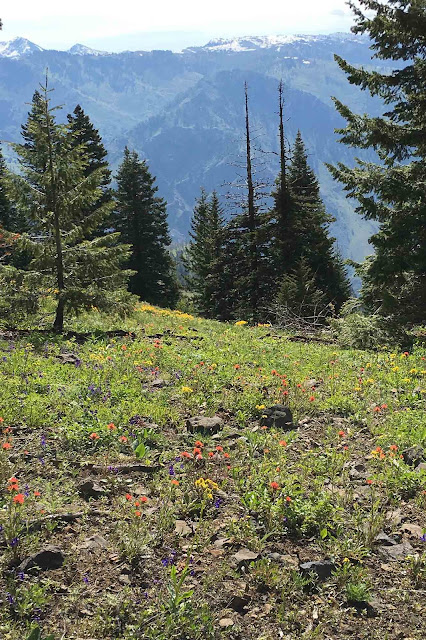 |
| Top of Buck Creek NRA Trail |
 |
| Fairy Slipper (Calypso bulbosa) |
 |
| Wallowa Mountains to the West |
 |
| Seven Devils to the East |
 |
| Upland larkspur (Delphinium nuttallianum) |
 |
| Western Dutchman's Breeches (Dicentra cucullaria) |
As if that weren't ambitious enough for one day, we drove back to Wallowa Lake to take the aerial tram up Mt. Howard. The tram travels 3,700 ft. up and deposits you at the summit, 8,150 above sea level. Upon arriving at the top, we were greeted by loads of Clark's Nutcrackers, but not much else.
 |
| A LONG 13 minute ride up the tram |
 |
| View from the tram looking down |
We found ourselves trudging through quite a lot of snow, as we hiked around for stunning views of the other mountains nearby. Some mammals that we'd seen around the campgrounds, we'd wanted better looks at. Now we were the beneficiaries of desensitized animals who have been fed and overfed by multitudes of tourists. We couldn't beat these looks at Columbian Ground Squirrel and Yellow-pine Chipmunk.
 |
| That face |
And what's cuter than a Golden-mantled Squirrel nibbling at a sunflower seed? Watching all of these squirrels, chipmunks, and squawking Clark's Nutrcrackers along with the fantastic head-on views of these peaks were well worth the scary tram ride.
 |
| Such a cute belly |
Back at camp for the evening, we strolled around the trails behind our campsite after our camping neighbors had found a few very large morels right at their campsite! If only we had known to look for them. We were on a mission to find some of our own, and after over an hour, we had found plenty of other cool fungi, but no morels. Just as we were about to give up and walk back, Maureen finally found one tiny, almost shriveled one. We did end up cooking it and savored every tiny bite.
 |
| Hammond's Flycatcher back at the camp |
 |
| Coral Fungus |
 |
| Violet crown-cup or Violet star cup (Sarcosphaera sp) Fungus (about 5 in at widest point) |
 |
| Morel |
Early the next morning we braved the near-freezing temperatures to get back to McCully Creek. This time we took another trail up and soon found ourselves face-to-face with a Spruce Grouse. It was out in the open, 150 ft ahead. We stayed as still and quiet as two people can who are vibrating with excitement. We didn't want to spook it, but this bold bird wasn't going to be spooked anyway. Soon after we spotted it, it spotted us, too, and instead of flying off, it made a beeline right for us.
 |
| Echo Azure |
 |
| Male Spruce Grouse |
I've seen enough videos of grouse hopped up on hormones to consider that we might want to take a defensive stance. Closer and closer it came, mostly walking, sometimes running short distances. Most of the photos I digiscoped are blurry because it just kept coming at us. It got within 20 feet and then casually hopped off to the side, and disappeared into the undergrowth. We also stalked a Ruffed Grouse for some time, which we never saw, but we could feel the drumming in our chests.
 |
| Caught that moment of his bright red eyecomb glowing in the tiny spot of sunlight |
The Spruce Grouse was just the cherry on top of this absolutely amazing trip. The views were awe-inspiring, the flowers were gorgeous, the animals were very friendly, and the birds were awesome.
 |
| Wallowas in evening light |
 |
| Common Alpine |
 |
| View from "Little Alps" |


