Tim Birkhead is an English ornithologist and author, about whose books on bird biology and behavior I’ve written enthusiastically in the past. Now he’s back with something a little different – a biography of an underappreciated genius, Francis Willughby, whose contributions to bird study at the dawn of the Scientific Revolution helped to create a more reliable and empirical framework for studying and understanding birds than anything that had existed up to that time.
In The Wonderful Mr Willughby: The First True Ornithologist, Birkhead makes the case for reevaluating Willughby’s role within the history of natural history. Because he died at such an early age, 36, before he was able to publish his own findings his legacy was left in the hands of his friend and collaborator, John Ray, who typically receives the lion’s share of credit for the groundbreaking work, Ornithology, written after Willughby’s death. But much, if not most, of the new ground broken in Ornithology came from Willughby’s insights.
Because Willughby’s journals have been lost over the centuries, there’s less firsthand information available than one would hope. But Birkhead does a really excellent job of setting the scene: what was the state of knowledge during the middle of the 17th Century? How was science developing mere decades after Francis Bacon formulated his vision for experimental method? How did the English Civil War impact the universities and leading scholars? We’re also introduced to key figures in and around the orbit of the Royal Society, including a series of brief biographies included in an appendix.
Not to say that some additional context wouldn’t have been helpful. When Willughby and Ray embarked on a three-year collecting expedition through Europe, they were joined by Nathaniel Bacon. Bacon’s brief biography states simply that he was a Virginia colonist. In fact, he was the ringleader behind Bacon’s Rebellion, one of the most important events in colonial American history. But mostly, Birkhead connects the dots in really exciting ways. Like when he singles out certain items from Willughby’s cabinet of curiosities (including a collection of glass eyes), and traces where in his travels he was likely to have picked them up.
Even more impressive is that Birkhead was apparently able to work out what species Willughby and Ray were writing about, despite the local, now largely archaic, names they picked up along their journey. It’s a problem not dissimilar to what Willughby and Ray faced themselves when pouring over the manuscripts and artwork they collected over the course of their joint project, trying to match their own observations with those of earlier scholars.
Despite the title, Willughby wasn’t single-mindedly consumed by birds; he had energetic and wide-ranging interests and made significant contributions in a number of areas, including to the study of fish, insects, mathematics, and even games. He’s a fascinating figure, and this book is a window into a time when one person, albeit an exceptional person, could generalize across many different subjects and realistically claim expertise in all of them. Throughout The Wonderful Mr Willughby, it’s clear that his death at an early age was a huge loss for science as a whole, and for ornithology in particular.
Showing posts with label Reviews. Show all posts
Wednesday, August 29, 2018
Review: The Wonderful Mr Willughby
Monday, July 9, 2018
Review: WUNDERBIRD Birdwatching Clothing
Recently, the company Wunderbird approached us about their new line of clothing geared for birders. They offered to give us a couple of items in exchange for an unbiased review. We were intrigued and obliged to see if these items could really be useful for birders. We checked out their website and saw they have three basic items: a short sleeved shirt, a long-sleeved shirt, and a pullover hoodie sweatshirt. They have them for both men and women. And they have cool names: Kestrel, Peregrine, and Gyrfalcon (respectively).
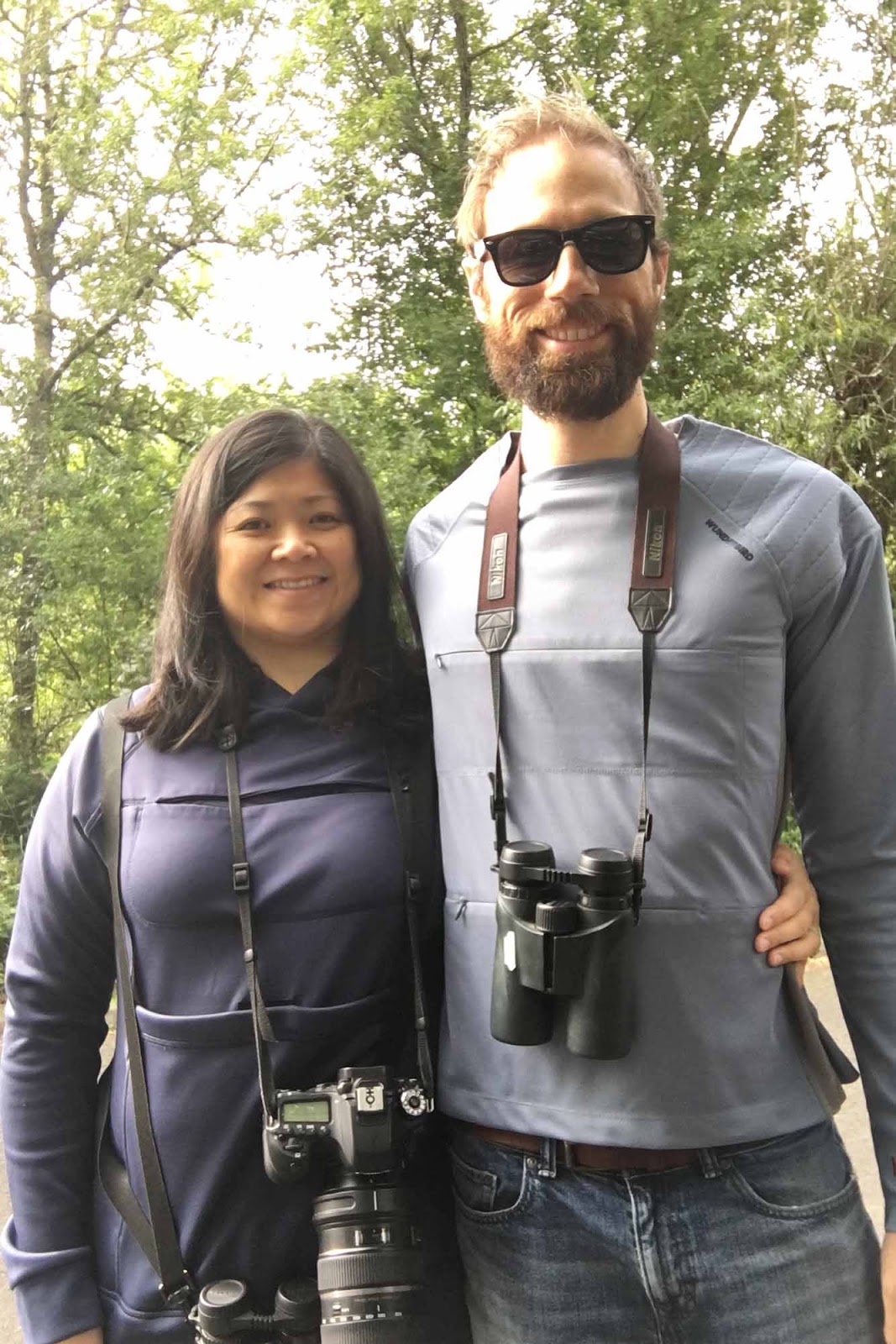
Nick is actually in the market for a new sweatshirt, so we were excited about that prospect for him. We reviewed their size chart and found that the men’s sweatshirt sizes would not quite work for this long-armed guy. However, the sweatshirt dimensions worked great for me, so I (Maureen) ordered the women’s navy blue sweatshirt (Gyrfalcon), and Nick ordered the long-sleeved shirt (Peregrine) in blue/gray. The picture online looked like a light and dark blue combination, but it is really a light blue with gray sides.
Maureen’s Point of view: The hoodie is a really nice, sturdy fabric. It’s thick and soft and would definitely keep you warm. I tested it out on a cool morning for only a little while as it was not quite cold enough to really wear it around for long. The hoodie, like the other items, has two sets of zipper pockets – one across the chest and one lower in the belly area. But it also has the additional pouch to put your hands in (like a muff).
The lower zipper could hold your binoculars in case of rain, even if you’re wearing a harness, or at least for me since I wear my bins pretty low on my harness to be able to hold my camera the way I want. I’m not very… ahem… well-endowed, so the top zipper pocket didn’t really bother me, but I could see that if you had more up top, this may render the pocket useless. I did have a bit of fun using it to hold my coffee mug. Otherwise, I do love having pockets since women’s clothing are notorious for not having any/enough/deep enough pockets. You could store small gadgets or snacks.
There is extra padding in the shoulders to give a bit of extra comfort for carrying heavy gear, like a tripod with a scope, or in my case, a heavier camera with a telephoto lens. I’m sure this could provide some relief, but since I did not wear the hoodie very long, I couldn’t tell you if there was a significant difference. Another feature is an adjustable cord in the back of the hood part to modify the hood to whatever level you like. This feature is common in good raincoats (living in the Pacific Northwest, I know what that is now), and I like it as it is helpful when you don’t want to really block your whole view with the hood, but still want to keep the hood on.
Nick is actually in the market for a new sweatshirt, so we were excited about that prospect for him. We reviewed their size chart and found that the men’s sweatshirt sizes would not quite work for this long-armed guy. However, the sweatshirt dimensions worked great for me, so I (Maureen) ordered the women’s navy blue sweatshirt (Gyrfalcon), and Nick ordered the long-sleeved shirt (Peregrine) in blue/gray. The picture online looked like a light and dark blue combination, but it is really a light blue with gray sides.
Maureen’s Point of view: The hoodie is a really nice, sturdy fabric. It’s thick and soft and would definitely keep you warm. I tested it out on a cool morning for only a little while as it was not quite cold enough to really wear it around for long. The hoodie, like the other items, has two sets of zipper pockets – one across the chest and one lower in the belly area. But it also has the additional pouch to put your hands in (like a muff).
The lower zipper could hold your binoculars in case of rain, even if you’re wearing a harness, or at least for me since I wear my bins pretty low on my harness to be able to hold my camera the way I want. I’m not very… ahem… well-endowed, so the top zipper pocket didn’t really bother me, but I could see that if you had more up top, this may render the pocket useless. I did have a bit of fun using it to hold my coffee mug. Otherwise, I do love having pockets since women’s clothing are notorious for not having any/enough/deep enough pockets. You could store small gadgets or snacks.
There is extra padding in the shoulders to give a bit of extra comfort for carrying heavy gear, like a tripod with a scope, or in my case, a heavier camera with a telephoto lens. I’m sure this could provide some relief, but since I did not wear the hoodie very long, I couldn’t tell you if there was a significant difference. Another feature is an adjustable cord in the back of the hood part to modify the hood to whatever level you like. This feature is common in good raincoats (living in the Pacific Northwest, I know what that is now), and I like it as it is helpful when you don’t want to really block your whole view with the hood, but still want to keep the hood on.
Nick’s Point of View: My preference would have been for getting a hooded sweatshirt, but I ran into a problem once we consulted the sizing chart. While I’m rather slender, I have long arms. Oddly (and this makes no sense) the sleeve length for the “XLL” hoodie is shorterthan on the “S” long-sleeved tee. On top of that, the sleeve lengths for the Men’s hoodies are even shorter than on the Women’s hoodies! So I ended up getting a long-sleeved tee instead purely because the measurements worked out.
It was comfortable enough when I tried it on, but the main problem is that the padded shoulders don’t conform to one’s contours. In my case, it caused the neck to ride high and wonky. The material is fairly light, but the pockets make it look stiff as it hangs, as if I were draped in Kevlar. Maureen said it looks like a Star Trek uniform. She’s not wrong.
I haven’t used the pockets yet, and I’m still trying to figure out how best to. The stated purpose is for “Quick Draw binocular support”. But if quickly drawing your binoculars is important, then don’t put them in a pocket. Personally, I think they’d get more use storing our water bottle. Sometimes when we’re getting ready to hike we end up bringing a backpack with us, if only to hold water. If the water can fit comfortably in a pocket that would simplify things for us by reducing the total number of straps criscrossing our torsos.
The padded shoulders are meant to help keep your tripod from grating against your bones while lugging your scope around. While they do provide more protection than an ordinary long-sleeved tee, the padding is less substantial than I expected – maybe about as much padding as you’d get from the average hoodie? When I switched from tripod to camera strap, it tugged the shirt to the side, making me acutely aware of the seam near the armpits, and chafed as I walked. Other features, such as the ventillating side panels will be great to wear once the temperature peaks, and it’s advertised as being mosquito repellant.
Thank you to Wunderbird for letting us sample their line of clothes. Quibbles aside, it’s great to know that manufacturers are paying attention to the unique problems faced by birders. We hope to see their product line expand in the future to accommodate birders of different proportions and styles. But kudos to Wunderbird for seeing an opportunity to help birders do what they do more comfortably.
SaveSave
It was comfortable enough when I tried it on, but the main problem is that the padded shoulders don’t conform to one’s contours. In my case, it caused the neck to ride high and wonky. The material is fairly light, but the pockets make it look stiff as it hangs, as if I were draped in Kevlar. Maureen said it looks like a Star Trek uniform. She’s not wrong.
![]() |
| Who wore it best? |
I haven’t used the pockets yet, and I’m still trying to figure out how best to. The stated purpose is for “Quick Draw binocular support”. But if quickly drawing your binoculars is important, then don’t put them in a pocket. Personally, I think they’d get more use storing our water bottle. Sometimes when we’re getting ready to hike we end up bringing a backpack with us, if only to hold water. If the water can fit comfortably in a pocket that would simplify things for us by reducing the total number of straps criscrossing our torsos.
![]() |
| Binoculars in their "Quick Draw" pouch |
The padded shoulders are meant to help keep your tripod from grating against your bones while lugging your scope around. While they do provide more protection than an ordinary long-sleeved tee, the padding is less substantial than I expected – maybe about as much padding as you’d get from the average hoodie? When I switched from tripod to camera strap, it tugged the shirt to the side, making me acutely aware of the seam near the armpits, and chafed as I walked. Other features, such as the ventillating side panels will be great to wear once the temperature peaks, and it’s advertised as being mosquito repellant.
Thank you to Wunderbird for letting us sample their line of clothes. Quibbles aside, it’s great to know that manufacturers are paying attention to the unique problems faced by birders. We hope to see their product line expand in the future to accommodate birders of different proportions and styles. But kudos to Wunderbird for seeing an opportunity to help birders do what they do more comfortably.
Monday, July 2, 2018
Review: Far From Land
Some of the most indelible and exciting moments in our ten years of birding involve seeing groups of seabirds for the first time, particularly our first alcids and our first albatrosses. They’re so unlike anything found between the coasts, and they’re often away at sea, just out of reach unless you take the effort (and anti-nausea meds) needed to find them. Even in Oregon, where massive colonies render certain murres, guillemots, and puffins reliable for at least part of the year their lives at sea are shrouded in mystery. And that’s precisely the sort mystery that Michael Brooke wants to elucidate in Far From Land.

Far From Land is about how seabirds make their living when they’re not ashore, and crucially, how we know what we know. Brooke, who has spent his career studying seabirds, is fascinated by the technologies that have opened up all sorts of new research areas over the past 20 years. As such, this book is as much about the suite of devices that researchers use to interrogate every aspect of a seabird’s life at sea as it is about the birds themselves.
And some of those devices are very cool. Many birders will be at least passingly familiar with the geolocators, GPS, etc. used to track birds’ journeys. But you might not be aware of the devices that measure how deeply a bird dives; the temperature inside a bird’s stomach; whether the bird is in contact with water; or how widely a bird opens its beak. Each new device has helped researchers gain insight into the unique ways seabirds navigate, detect food, or catch prey.
In many ways, this book will help bring readers up to speed on the current state of research into seabirds’ lives at sea. However, this shouldn’t be mistaken for a general overview. This isn’t where you’re going to learn much about seabird physiology, courtship, nesting, or rearing young. Frustratingly, even seemingly relevant information is omitted if it happens not to be cutting-edge. For instance, here Brooke poses a problem and then chooses not to explain the solution:
But what you will learn is often astounding. Take Wandering Albatrosses, for example. By fitting them with magnetometers, researchers have discovered that they frequently spin in tight circles at night. It’s thought that they use their feet to stir up bioluminescent plankton, thereby attracting squid close enough to pluck out and eat. Because “seabird” is defined broadly, readers will learn about a diverse cast of birds, and it’s interesting to compare and contrast the strategies used by such divergent species as albatrosses, cormorants, and penguins.
Far From Land isn’t for everybody. Readers will want to have some prior familiarity with how seabirds live their lives before tackling it. But for anyone prepared for an in-depth treatment of how technology has transformed seabird study over the past 20 years, there is a wealth of information here to advance your understanding, and often, to prompt new questions about how a mysterious group of birds make their living at sea.

Far From Land is about how seabirds make their living when they’re not ashore, and crucially, how we know what we know. Brooke, who has spent his career studying seabirds, is fascinated by the technologies that have opened up all sorts of new research areas over the past 20 years. As such, this book is as much about the suite of devices that researchers use to interrogate every aspect of a seabird’s life at sea as it is about the birds themselves.
And some of those devices are very cool. Many birders will be at least passingly familiar with the geolocators, GPS, etc. used to track birds’ journeys. But you might not be aware of the devices that measure how deeply a bird dives; the temperature inside a bird’s stomach; whether the bird is in contact with water; or how widely a bird opens its beak. Each new device has helped researchers gain insight into the unique ways seabirds navigate, detect food, or catch prey.
In many ways, this book will help bring readers up to speed on the current state of research into seabirds’ lives at sea. However, this shouldn’t be mistaken for a general overview. This isn’t where you’re going to learn much about seabird physiology, courtship, nesting, or rearing young. Frustratingly, even seemingly relevant information is omitted if it happens not to be cutting-edge. For instance, here Brooke poses a problem and then chooses not to explain the solution:
“And who has not wondered how a tern copes with the flickering reflections bouncing off a sparkling sea as it plunged into the water to emerge from a spray of drips with a small sand eel? However, this variety of feeding techniques has been known from well before the advent of modern technology.” (p. 165)This assumes a great deal of prior knowledge on the part of the reader. Far from being a popular treatment of seabirds’ lives, it’s more of a survey of the latest research within a particular range of topics. Typically this reads as a litany of findings from individual studies, rather than as a cohesive narrative.
But what you will learn is often astounding. Take Wandering Albatrosses, for example. By fitting them with magnetometers, researchers have discovered that they frequently spin in tight circles at night. It’s thought that they use their feet to stir up bioluminescent plankton, thereby attracting squid close enough to pluck out and eat. Because “seabird” is defined broadly, readers will learn about a diverse cast of birds, and it’s interesting to compare and contrast the strategies used by such divergent species as albatrosses, cormorants, and penguins.
Far From Land isn’t for everybody. Readers will want to have some prior familiarity with how seabirds live their lives before tackling it. But for anyone prepared for an in-depth treatment of how technology has transformed seabird study over the past 20 years, there is a wealth of information here to advance your understanding, and often, to prompt new questions about how a mysterious group of birds make their living at sea.
Tuesday, January 23, 2018
Review: Mariposas Nocturnas, by Emmet Gowin
In June 2015 Maureen and I took a belated honeymoon vacation in Honduras, spending an exhausting and immensely rewarding week at the Lodge at Pico Bonito. Although technically the “off-season” we planned the trip with birds in mind and our days were filled with hiking steep, muddy slopes through saturated rainforest air in addition to various day-trips into dry forest, river, and botanical garden habitats. While the high points of our trip were certainly the many charismatic birds and mammals we’d craved, one my most enduring memories is of our nightly visits to the mothing station. Beneath the lodge’s mercury vapor lighting we meticulously photographed each and every species we encountered, hundreds of individuals. Knowing nothing about their taxonomy, life history, status or distribution, we were merely captivated by the wild and wide-ranging diversity of colors and forms.For weeks afterward I’d tried to put names to each moth, despite the lack of a really good, comprehensive reference. But those attempts at cataloging were beside the point for me. What it really boiled down to was an excuse to carefully study our photos again and again, to organize and reorganize them. Which brings me to Emmet Gowin’s Mariposas Nocturas: Moths of Central and South America, A Study in Beauty and Diversity. This coffee table book is a celebration of everything that so captivated us during our hours at the mothing station in Honduras. It provides a showcase for hundreds of these nocturnal Neotropical Lepidoptera; moths of every size, shade, posture, texture.
Each page is laid out in a grid, 25 photos to a grid. Unlike a field guide, this book is presented with an almost entirely aesthetic approach to organization; the arrangement was determined by whatever photos happened to work well together (though, generally, each grid represents the time and place in which the photographs were taken). The moths themselves are living subjects that Gowin manually oriented against a background of his choosing – backgrounds often selected from art history, including works by Degas, Matisse, William Blake – thus setting up spectacular color contrasts between the moth and its background, producing a work that is visually stunning, page after page.
Of course the main attractions of the book are the Neotropical moths themselves, in their near-infinite variety. Sphinx moths, geometers, flannel moths, wasp-mimics, saturniids – they’re all so different from one another, and all marvelous in their own way! Gowin’s artistic eye captures this diversity wonderfully. To reiterate, this isn’t a field guide. In fact, the only information you will find about each moth is its scientific binomial, along with family and subfamily names, the year it was first described to science, and the person who described it. Moths that are arranged near one another on the page are probably not closely related, and may not even be found in nature together. Instead, this book is about appreciating moths as natural works of art, something you’re bound to start doing from the moment you first look inside.
The book’s introduction by author and activist Terry Tempest Williams is…odd. Williams has an impressive resume, and I admire her advocacy on behalf of public lands in particular. But her interest in moths verges on the mystical. At various points she invokes priests, spiritualists, prayer, the Virgin Mary, and sacred texts, all of which I found entirely unncessary, even distracting. Much more interesting is Gowin’s afterward. Here the photographer chronicles how this project developed in partnership with the Smithsonian Tropical Research Institute, and how his vision of it evolved over 15 years of gathering material, providing behind-the-scenes insight for this labor of love.
For me, this book will always remind me of that mothing station in Honduras where we first stood transfixed by the overwhelming beauty and diversity of Neotropical moths. Hopefully Mariposas Nocturnas will be the beginning of a journey for others, helping foster a passion for these insects that are too often and unfairly overlooked or maligned. Or, if nothing else, Emmet Gowin’s book looks great on a coffee table.
Saturday, July 8, 2017
Review: A Swift Guide to Butterflies of North America
Earlier this year I decided to step up my butterfly game, honing my ID skills and seeking out new species more deliberately. For the most part, I’d call myself a casual enthusiast, in that, for as long we we’ve been birding, I’ve been keen to get photos of butterflies as well, but as a secondary activity – something to focus on when the birds are quiet. And even when I managed a decent photo, I hadn’t always doggedly worked out difficult IDs or learned what diagnostic features I should key in on next time.
Firstly, this is a photo-based field guide, and the photos are stunning. Each species entry has a large primary image, with supporting images surrounding it. Notably, the butterflies haven’t been isolated by cropping out non-essential details, but are left in the context of their immediate environment. Field guides often remove these to help make more direct comparisons between species, but Swift Guide selected images, and oriented them, in such a way that similar species are usually shown in comparable poses. Species entries typically take about a half-page, but sometimes run multiple pages, meaning that a lot of variation is shown, and in nearly every case the photos are larger than those shown in Kaufman, allowing you to see more detail.
But a field guide is more than just images. As for the supporting information in Swift Guide… well, there’s a lot to unpack. Before checking out the book’s introductory text, I flipped through the species accounts to get a first impression, and really didn’t know what to make of it. In order to conserve space and keep the text as close to the images as possible, the layout ends up hiding some details in plain sight. To illustrate, here’s the sample entry for Hawaiian Blue. Without scrolling ahead, try and determine on your own how large this butterfly is.
Now look directly above the name, Hawaiian Blue, and you’ll see a short white line. That line represents the size of the butterfly’s forewing, from its base to the apex. Not only is this not intuitive, it’s difficult to use in practice. But in the field you’re going to see an entire individual, comprised of more than one dimension. Contrast this with Kaufman, which shows you the life-size silhouette of one species per page, and keeps all species on that page in proportion to one another. This gives me a much clearer picture of what to expect when I actually see a butterfly. A line is too abstract, too far removed from the actual, living butterfly, and for species that commonly hold their wings out to the sides, doesn’t convey how large it will appear to you when you encounter it.
I wanted to put this field guide to the test so I looked back at some photos of butterflies I haven't been able to ID yet, including difficult groups such greater fritillaries, and buckwheat blues. To be clear, it may not even be possible to ID some of these species without examining them in hand, so it's not a reflection on the field guide where I haven't been successful, but I was able to narrow down my options based on the information provided, including features that aren’t discussed in the Kaufman guide.
For the Dotted Blue complex, Swift Guide very helpfully provides a separate range map for each subtype, allowing you to see which varieties appear in different regions. Throughout the field guide, I was able to find lots of other examples where subtypes received their own entries (and with their own range maps), too.
While, on the whole, it’s super helpful to have separate entries for different subtypes, it does create some confusion where the book’s organization is concerned. For instance, there’s an entry for Aphrodite Fritillary on p. 165. At first glance you wouldn’t know that there are other entries for the same species: the page before and the page after are both for Great Spangled Fritillary! If you live in the west you’ll have to flip ahead to p. 171 to see what “your” Aphrodite looks like.
Although this book is difficult to navigate at times, it’s an absolutely lovely field guide. If you’re looking for a photo-based reference, with lots of large, high-resolution photos, Swift Guide is for you. This is a wonderful addition to our library, and has already proved a handy resource.
Monday, June 20, 2016
Review: Lost Among the Birds
In 2013, Neil Hayward did the improbable and broke Sandy Komito's longstanding Big Year record, tallying 749 bird species in the ABA area. It was a year of dramatic and memorable sightings, like the Rufous-necked Wood-rail at Bosque del Apache, which Hayward made even more dramatic and memorable when it became clear his "accidental" Big Year attempt might actually pay off.
Given the vast distances, astronomical expenses, and huge stretches of time involved, you might expect that anyone hoping to make history along these lines would start planning well in advance of January 1. Part of what makes Hayward's story unique and compelling is that he hadn't begun 2013 with a Big Year in mind; in fact, several months had already passed before he would even admit to himself that he was pursuing any goal at all. In his new memoir, Lost Among the Birds, readers can follow along as the idea slowly takes shape, and the idea becomes reality.
As much as this is the story of Neil Hayward's Big Year, it's also the story of his trying to find himself. By 2013 he had quit his job, was reeling from past relationship woes, and about to turn 40. While I was expecting and hoping for a real-life adventure story revolving around birds, the birds are interspersed with riffs about how his commitment fears weigh on his present relationship, how his depression colors his worldview before and after medication, and the need to get his life in order, generally. Personally, I found these bits, particularly about his relationship worries, tiresome. As Hayward himself admits, he hates "pretending to be interested" in the minutiae of other people's lives; I won't pretend these parts were any more enjoyable for me to get through.
But the birding tales are are very good -- exactly the kind you want from a book like this. Certain difficult, highly localized species like Colima Warbler, or Five-striped Sparrow, are birds that most American birders dream about, but are unlikely to see themselves. Hayward traveled everywhere, recounting how he traveled there, what steps he took to locate the bird, and the experience of being in the bird's presence. No less enjoyable is seeing the camaraderie between Hayward and the other birders who play a big part in his Big Year, as they share in their pursuit of each new rarity, often in inaccessible locales, with primitive conditions. Following along with him on these adventures is vicarious birding at its best.
If you've read other Big Year accounts, like Kenn Kauffman's Kingbird Highway, or Mark Obmascik's The Big Year, you already have an idea of how extreme an undertaking this was. Hayward repeatedly criss-crosses the country, often hopping on a return flight soon after landing (you can see his itinerary here). It's hardly a sensible thing to do, what with the ecological footprint (which can't be overstated), constant exhaustion, discomfort, and expense. It's a grueling endeavor, however you look at it, but not without it's joys. Hayward is honest about it all, and by the end, still manages to see birds as more than just a tick in a checkbox. Most of us will never attempt a Big Year; Lost Among the Birds will make you glad that Neil Hayward did.
SaveSave
Given the vast distances, astronomical expenses, and huge stretches of time involved, you might expect that anyone hoping to make history along these lines would start planning well in advance of January 1. Part of what makes Hayward's story unique and compelling is that he hadn't begun 2013 with a Big Year in mind; in fact, several months had already passed before he would even admit to himself that he was pursuing any goal at all. In his new memoir, Lost Among the Birds, readers can follow along as the idea slowly takes shape, and the idea becomes reality.As much as this is the story of Neil Hayward's Big Year, it's also the story of his trying to find himself. By 2013 he had quit his job, was reeling from past relationship woes, and about to turn 40. While I was expecting and hoping for a real-life adventure story revolving around birds, the birds are interspersed with riffs about how his commitment fears weigh on his present relationship, how his depression colors his worldview before and after medication, and the need to get his life in order, generally. Personally, I found these bits, particularly about his relationship worries, tiresome. As Hayward himself admits, he hates "pretending to be interested" in the minutiae of other people's lives; I won't pretend these parts were any more enjoyable for me to get through.
But the birding tales are are very good -- exactly the kind you want from a book like this. Certain difficult, highly localized species like Colima Warbler, or Five-striped Sparrow, are birds that most American birders dream about, but are unlikely to see themselves. Hayward traveled everywhere, recounting how he traveled there, what steps he took to locate the bird, and the experience of being in the bird's presence. No less enjoyable is seeing the camaraderie between Hayward and the other birders who play a big part in his Big Year, as they share in their pursuit of each new rarity, often in inaccessible locales, with primitive conditions. Following along with him on these adventures is vicarious birding at its best.
If you've read other Big Year accounts, like Kenn Kauffman's Kingbird Highway, or Mark Obmascik's The Big Year, you already have an idea of how extreme an undertaking this was. Hayward repeatedly criss-crosses the country, often hopping on a return flight soon after landing (you can see his itinerary here). It's hardly a sensible thing to do, what with the ecological footprint (which can't be overstated), constant exhaustion, discomfort, and expense. It's a grueling endeavor, however you look at it, but not without it's joys. Hayward is honest about it all, and by the end, still manages to see birds as more than just a tick in a checkbox. Most of us will never attempt a Big Year; Lost Among the Birds will make you glad that Neil Hayward did.
Labels:
Bird Books,
Birding Books,
Bloomsbury Publishing,
Books,
Reviews
Sunday, April 10, 2016
Review: The Most Perfect Thing
If you watch enough bird documentaries you're bound to run across video of a Common Murre egg rolling around and around a central point (check the gif here for an example). Common Murres (aka Common Guillemot in Great Britain) don't build nests, but instead lay their eggs on bare rock, often on narrow cliff ledges, where a disturbance could easily displace the egg into the sea -- a loss of both effort and opportunity for the parents. The prevailing wisdom of why Murre eggs evolved their pyriform shape is that instead of rolling out into oblivion, they remain right where they should. It's an intuitive explanation, and we can see the evidence with our own eyes.
Open Tim Birkhead's newest book "The Most Perfect Thing: Inside (and Outside) a Bird's Egg" and the first thing you'll read is that the prevailing wisdom is bunk (for one thing, the eggs you see in documentaries are empty shells; eggs full of yolk and albumen don't move the same way). Easy explanations are boring anyway, and Birkhead - whose specialty is Common Murres at their breeding grounds - guides us through the ornithological literature and his own field studies to reveal how the truth about eggs is far more complex and interesting than we might suppose at first blush.
Like his earlier writing ("Bird Sense" is an excellent example), Birkhead goes deep into the history of early speculations, practices, and research and uncovers how these changed over time until we arrive at our current scientific understanding. Surprisingly - until you stop and think about it - is how much of what's known is due in large part to the poultry industry. Even so, the ingenuity of both nature and the ornithologists struggling to uncover nature's secrets are fascinating. You'll read about how Egyptian Plovers, to protect their eggs from intense desert heat, bury their eggs in sand and keep them cool with water dripped from their soaking bellies. And how Goldcrests, fighting near-freezing temperatures stir their eggs with their feet, which they keep warm by pumping blood to their extremities.
Although the book doesn't dwell extensively on the eggs of non-birds, we do see some commonalities, like how egg-laying mammals are hatched with an egg-tooth. And we see some differences: for example that birds' eggs have a hard shell, unlike reptile eggs, which poses a unique set of challenges, like how to store enough water to support an embryo from the time the egg is laid to the time the chick emerges.
But the solutions that evolution has generated aren't foolproof, by any means, and hatching success is highly variable. Birkhead was, of course, aware of this when he chose his title "The Most Perfect Thing." The number of things that can possibly go wrong for an egg are legion, and attempts to combat one problem often create trade-offs that make the egg more vulnerable in some other respect. As Birkhead explores these trade-offs it becomes clear that eggs really are the perfect compromise between myriad different selection pressures.
We think of eggs as having a small number of very uniform elements: shell, albumen, and yolk. But each layer is more complex and finely tuned to solve specific problems than we might realize. We tend to think of eggs as examples of extreme fragility, but after reading this book I came away with a much greater appreciation for their resilience. With "The Most Perfect Thing" Tim Birkhead proves he's one of ornithology's greatest popularizers. Through the passion he has for his subject and the clarity of his writing, he'll have you wondering how you ever managed to take eggs for granted.
Open Tim Birkhead's newest book "The Most Perfect Thing: Inside (and Outside) a Bird's Egg" and the first thing you'll read is that the prevailing wisdom is bunk (for one thing, the eggs you see in documentaries are empty shells; eggs full of yolk and albumen don't move the same way). Easy explanations are boring anyway, and Birkhead - whose specialty is Common Murres at their breeding grounds - guides us through the ornithological literature and his own field studies to reveal how the truth about eggs is far more complex and interesting than we might suppose at first blush.
Like his earlier writing ("Bird Sense" is an excellent example), Birkhead goes deep into the history of early speculations, practices, and research and uncovers how these changed over time until we arrive at our current scientific understanding. Surprisingly - until you stop and think about it - is how much of what's known is due in large part to the poultry industry. Even so, the ingenuity of both nature and the ornithologists struggling to uncover nature's secrets are fascinating. You'll read about how Egyptian Plovers, to protect their eggs from intense desert heat, bury their eggs in sand and keep them cool with water dripped from their soaking bellies. And how Goldcrests, fighting near-freezing temperatures stir their eggs with their feet, which they keep warm by pumping blood to their extremities.Although the book doesn't dwell extensively on the eggs of non-birds, we do see some commonalities, like how egg-laying mammals are hatched with an egg-tooth. And we see some differences: for example that birds' eggs have a hard shell, unlike reptile eggs, which poses a unique set of challenges, like how to store enough water to support an embryo from the time the egg is laid to the time the chick emerges.
But the solutions that evolution has generated aren't foolproof, by any means, and hatching success is highly variable. Birkhead was, of course, aware of this when he chose his title "The Most Perfect Thing." The number of things that can possibly go wrong for an egg are legion, and attempts to combat one problem often create trade-offs that make the egg more vulnerable in some other respect. As Birkhead explores these trade-offs it becomes clear that eggs really are the perfect compromise between myriad different selection pressures.
We think of eggs as having a small number of very uniform elements: shell, albumen, and yolk. But each layer is more complex and finely tuned to solve specific problems than we might realize. We tend to think of eggs as examples of extreme fragility, but after reading this book I came away with a much greater appreciation for their resilience. With "The Most Perfect Thing" Tim Birkhead proves he's one of ornithology's greatest popularizers. Through the passion he has for his subject and the clarity of his writing, he'll have you wondering how you ever managed to take eggs for granted.
Wednesday, July 15, 2015
Review: Urban Peregrines
There are certain birds that everybody seems to love, or at least have a fascination of. One of those birds is the Peregrine Falcon. Known for its speed and hunting prowess, it brings awe to just about anyone who is fortunate to encounter one.
The book Urban Peregrines by Ed Drewitt takes a look into the lives of these fascinating birds in an alternative habitat – the urban (and suburban) areas of Europe. Drewitt does also touch upon other areas, including the United States, but the examples and anecdotes are primarily from Europe, and mostly Great Britain.
Overall the book is well written and has a good flow as if Drewitt were having a personal, but well-informed, conversation with you about Peregrine Falcons. He has years of experience researching these incredible birds, and he is very enthused to share that knowledge with you. Plus, there are plenty of gorgeous (and sometimes gory for the sake of telling the truth) photos included to keep you visually stimulated.
He starts by giving you the basics of the Peregrine – explaining its features and characteristics that make it well suited to high speed pursuits of prey. The overall adaptability of these birds have allowed them to thrive not only on wild landscapes and cliffs where it occurs naturally, but also in cities and towns that are populated by more people than wildlife. In some regions, there are extremely high percentages of peregrines nesting in urban areas, like Germany. This benefits the peregrines and researchers alike as the researchers can more easily monitor these birds, which then means deterring predators.

Drewitt takes you through the lifecycle of the peregrine in detail, going over some interesting facts about breeding behavior, including cooperative breeding in which older male offspring sometimes stay with the parents to help rear newer chicks. He also goes over their hunting behaviors, which surprisingly includes nocturnal hunts. Also, the author makes the reader aware of the conflict between some individuals, such as pigeon fanciers (those that breed and raise racing pigeons) and peregrines.
Although I found much of what Drewitt had to say as very interesting and informative, as a general audience reader, I also found that there was a lot of details in the many anecdotes that didn’t really didn’t add to my understanding. It was sometimes a bit distracting. I think if I were a budding peregrine researcher or environmental educator, then this information would have been more relevant to me. The section on learning how to set up a peregrine watch and ringing (banding) them would be great for anyone who wants to start up research on peregrines or other birds of prey.
Overall, I think the author’s enthusiasm and dedication for these magnificent creatures shines through. He highlights a bird that is fascinating, sharp, and handsome, and makes the science of them accessible to the public. And I’m always for revealing behaviors and attitudes that that we can work on in order to make more conscientious decisions that affect conservation. Generally, it seems most people embrace the peregrine falcon for the awesomeness that it is, and Urban Peregrines teaches us more about them and how we can live in harmony with them.
The book Urban Peregrines by Ed Drewitt takes a look into the lives of these fascinating birds in an alternative habitat – the urban (and suburban) areas of Europe. Drewitt does also touch upon other areas, including the United States, but the examples and anecdotes are primarily from Europe, and mostly Great Britain.
Overall the book is well written and has a good flow as if Drewitt were having a personal, but well-informed, conversation with you about Peregrine Falcons. He has years of experience researching these incredible birds, and he is very enthused to share that knowledge with you. Plus, there are plenty of gorgeous (and sometimes gory for the sake of telling the truth) photos included to keep you visually stimulated.
He starts by giving you the basics of the Peregrine – explaining its features and characteristics that make it well suited to high speed pursuits of prey. The overall adaptability of these birds have allowed them to thrive not only on wild landscapes and cliffs where it occurs naturally, but also in cities and towns that are populated by more people than wildlife. In some regions, there are extremely high percentages of peregrines nesting in urban areas, like Germany. This benefits the peregrines and researchers alike as the researchers can more easily monitor these birds, which then means deterring predators.

Drewitt takes you through the lifecycle of the peregrine in detail, going over some interesting facts about breeding behavior, including cooperative breeding in which older male offspring sometimes stay with the parents to help rear newer chicks. He also goes over their hunting behaviors, which surprisingly includes nocturnal hunts. Also, the author makes the reader aware of the conflict between some individuals, such as pigeon fanciers (those that breed and raise racing pigeons) and peregrines.
Although I found much of what Drewitt had to say as very interesting and informative, as a general audience reader, I also found that there was a lot of details in the many anecdotes that didn’t really didn’t add to my understanding. It was sometimes a bit distracting. I think if I were a budding peregrine researcher or environmental educator, then this information would have been more relevant to me. The section on learning how to set up a peregrine watch and ringing (banding) them would be great for anyone who wants to start up research on peregrines or other birds of prey.
![]() |
| A male and female (larger) sitting on a cathedral |
Monday, May 18, 2015
Review: Tales of Remarkable Birds

The avian world abounds with examples of remarkable species. For many of us, our spark bird was visually remarkable - one whose appearance caught us off guard, whose bright colors, size or shape lingered in our thoughts long after that first encounter. But no less compelling are the stories of how birds make their living. Their mastery of flight, their complex social structures, and the myriad other physiological and behavioral adaptations for solving problems of survival and reproduction are absolute wonders in their own right.
In Tales of Remarkable Birds, Dominic Couzens takes it all on, relaying stories of the bizarre and extraordinary birds from around the world. Couzens' engaging volume relates aspects of 40 species or families, with selections covering a range of behaviors related to mating, breeding, foraging, navigation, and competition from within and between species. Some entries highlight iconic, no-brainer choices for inclusion; others are compelling precisely because you have to read on to find out what's so remarkable about them.
And these birds are truly remarkable. As in, I would literally remark on them to Maureen: "Apparently bowerbirds are the only non-human instance of giving forced perspective" or "Did you know that swiftlets can echolocate, but only use it to navigate in caves?" This book is filled with trivia that you'll want to share with other birders, or possibly harass your non-birder friends with. Although birds' appearances aren't the principle focus of this book, it's chockablock with gorgeous photographs that are every bit as worth sharing as the stories.

Tales samples birds from across the globe, with five entries for every continent. North America is represented by such species as Cliff Swallow, Black-capped Chickadee, and White-throated Sparrow. While these will be familiar to many U.S. readers, the book is an opportunity to dig below the surface and learn something new about their backyard visitors. For instance, while I was familiar with "tan-striped" vs. "white-striped" White-throated Sparrows and the behavioral differences expressed by the two color morphs, I hadn't realized that the alleles responsible for the differences have been around for ~2.2 million years - even before White-throated Sparrow even split from its parent species!
The entries are all very accessible for a wide audience, including beginning and young birders, and Couzens is an engaging storyteller. His tongue-in-cheek style helps make the birds relatable, although this does occasionally veer toward anthropomorphism (e.g. "courageous" jacanas), and even moralizing about bird behavior (e.g. "good" vs. "bad" cuckoos, or "sinister" or "repellent" birds). While it's true that I've joked about "sinister" birds on this very blog, it seems a questionable direction to take for a reference book, even one that doesn't take itself too seriously.
Still, we might forgive these solecisms because his enthusiasm for his subjects is so evident. As Couzens notes in his introduction:
"It would not be an exaggeration to suggest that almost every bird in the world has the capacity to amaze and surprise scientists. It just depends what species and aspects are chosen for study. You could write a book with exactly the same title and premise, and choose 40 completely different stories to the ones chosen here." (p. 13)He'll get no argument from me. And while there are certainly avian characteristics that outshine some of the ones described in the book, there's no question that there's something remarkable about each of the 40 he discusses.
Tales of Remarkable Birds is perfect for kindling a nascent passion for birds (I can easily imagine an eager youngster reading it under the covers with a flashlight). However, it's no less suited for long-time birders keen to learn more about how far birds can stretch the limits of diversity and adaptability. The global focus of the book will make you want to grab your passport to visit some of these wonders, while at the same time helping gain an appreciation for one's hometown birds, each remarkable in it's own way.
Thursday, April 9, 2015
Review: A Rant of Ravens (A Birdwatcher's Mystery)
Besides birding, the other pastime that looms large in my leisure time is reading, and mystery novels, in particular, feature heavily in the latter. Being so familiar in the genre's tropes and style, I'd been eager to get my hands on one of the birding mystery novels I'd heard about and find out how they stack up against less esoteric titles. You can imagine my excitement when Astor + Blue asked us to review Christine Goff's A Rant of Ravens, the first in her "Birdwatcher Mystery Series." I wish I could say that that excitement survived the first chapters, but I'm afraid it simply didn't work particularly well for me, either as a mystery novel or as a work of birding literature.
Firstly, for a novel explicitly appealing to birders, the dialogue comes off as stilted and over-explanatory. Rachel Stanhope, the story's heroine, is a non-birder going through a difficult time in her marriage and seeking consolation from her Aunt Miriam. Miriam, who runs a bird rehabilitation center, as well as hosting weekly meetings of her local birding group, invites Rachel to come visit and take over for her while she travels abroad (we're given a convoluted explanation for why someone more qualified can't do this). The premise allows uninitiated readers to learn along with Rachel as she encounters the argot and the norms of a birding community, including what a life list is, and how to abide by the ABA's Code of Ethics.
That's all fine, in theory; in practice something just seems off. After news breaks that a vagrant Le Conte's Sparrow was spotted nearby, we find the group asking the questions you might expect before going off to chase a rare bird: has the ID been confirmed, has the hotline been notified, etc. The actual discussion just sounds too deliberate or wooden, especially for a bird that's just a few minutes' drive away. And now that the bird's been called into the hotline?
This is a particular shame, because the mystery at the heart of the story is actually quite a good one. After a dead body turns up and her aunt goes missing, Rachel has to plunge into a decades-old bird trafficking scheme, as well as understand how different factions of the early conservation movement could have contributed to a whole new round of crimes. Sadly, the author doesn't seem to have been up to the task and the story's resolution ultimately rests upon assorted leaps of logic, lucky guesses, and plot holes.
I truly wanted to enjoy this novel, but it just wasn't for me. There are a number of "cute" bird references throughout the book that I think older readers would enjoy, and a lot of the story could easily appeal to a wide swath of novice or beginning birders. There's even the occasional thrilling scene told grippingly, but on the whole it's not enough to overcome a cavalcade of one-dimensional characters, and a thoroughly unsatisfying resolution. A Rant of Ravens is a nice try to integrate birding into the mystery genre, but in a number of important ways, it simply falls short.
Firstly, for a novel explicitly appealing to birders, the dialogue comes off as stilted and over-explanatory. Rachel Stanhope, the story's heroine, is a non-birder going through a difficult time in her marriage and seeking consolation from her Aunt Miriam. Miriam, who runs a bird rehabilitation center, as well as hosting weekly meetings of her local birding group, invites Rachel to come visit and take over for her while she travels abroad (we're given a convoluted explanation for why someone more qualified can't do this). The premise allows uninitiated readers to learn along with Rachel as she encounters the argot and the norms of a birding community, including what a life list is, and how to abide by the ABA's Code of Ethics.
That's all fine, in theory; in practice something just seems off. After news breaks that a vagrant Le Conte's Sparrow was spotted nearby, we find the group asking the questions you might expect before going off to chase a rare bird: has the ID been confirmed, has the hotline been notified, etc. The actual discussion just sounds too deliberate or wooden, especially for a bird that's just a few minutes' drive away. And now that the bird's been called into the hotline?
"That means Elk Park is under an official rare bird alert," Gertie said, her shrill voice rising to a shriek.
Birding aside, interactions between characters are unnatural-seeming: they don't assign the proper weight to events that unfold in the novel, and the words used to describe their actions often don't seem to fit the situations they find themselves in. Add to this the fact that the novel was first published 15 years ago, and describes how "Rachel connected her laptop computer to the kitchen telephone line, clicked the Internet icon, and asked the driver to search for PETE." This would have been a cumbersome description even if it didn't date itself.
This is a particular shame, because the mystery at the heart of the story is actually quite a good one. After a dead body turns up and her aunt goes missing, Rachel has to plunge into a decades-old bird trafficking scheme, as well as understand how different factions of the early conservation movement could have contributed to a whole new round of crimes. Sadly, the author doesn't seem to have been up to the task and the story's resolution ultimately rests upon assorted leaps of logic, lucky guesses, and plot holes.
I truly wanted to enjoy this novel, but it just wasn't for me. There are a number of "cute" bird references throughout the book that I think older readers would enjoy, and a lot of the story could easily appeal to a wide swath of novice or beginning birders. There's even the occasional thrilling scene told grippingly, but on the whole it's not enough to overcome a cavalcade of one-dimensional characters, and a thoroughly unsatisfying resolution. A Rant of Ravens is a nice try to integrate birding into the mystery genre, but in a number of important ways, it simply falls short.
Friday, February 13, 2015
Review: The Eponym Dictionary of Birds
Birders are familiar with a lot of names. We have to be: we're obsessed with identification, classification, distribution, and every other conceivable manner of parsing and juxtaposing all 10,000 extant bird species, and we need to know what to call each separate type. While some birds' names clue you in to a field mark or a characteristic behavior, thousands(!) of them bear the name of an actual historical person. This latter group includes homages to such titans of ornithology as John James Audubon and Alexander Wilson. Many more contain references to lesser known figures, whose names are so unfamiliar to us that we rarely, if ever, stop to think about the person behind the name.
But I'm happy to report that this particular form of apathy now has a cure. Bloomsbury has published an excellent and comprehensive new resource for anyone who has ever wondered about some of our most familiar birds' namesakes: The Eponym Dictionary of Birds. Over the more than 4,100 entries, you can find information on everyone who's been immortalized in this way, whether in a bird's common name, genus, species, or subspecies. For all of those names we use so often, this is the go-to reference for getting to know the "who" and "why" of the people that birds have been named for.
The entries are short (they have to be, with 4,100 of them), but they almost always contain the person's occupation, contributions, and/or an anecdote or two. This book is filled with fascinating historical footnotes, like Queen Victoria's contribution to bird conservation; the connection between Darius Couch (Couch's Kingbird) and the Gettysburg Address; and the occupational hazard that killed both John Cassin and John Townsend. To me, this all adds another layer of appreciation for the birds, by understanding more about the context of their discovery, and the relationships between the great naturalist-explorers of the 19th century.
We might be tempted to assume that the names behind our common birds all came from accomplished ornithologists, or intrepid collectors. One surprise for me was in finding how often this isn't the case. Anna's Hummingbird, for instance, is named for the wife of the son of one of Napoleon's marshals (her husband, Prince Victor Massena, owned a bird collection that contained the specimen used to describe the species). Then there's La Sagra, Bullock, and Wurdemann, who were an economist, goldsmith, and a meteorologist, respectively. A further surprise was learning that Ross's Gull and Ross's Goose are named for different people; ditto (probably) for Le Conte's Sparrow and Le Conte's Thrasher.
It's not always clear when reading this book quite what the connection is between the bird and an individual (in the introduction the authors state that this information simply isn't available in some cases). For example, the entry for William Swainson demonstrates beyond doubt that he had an adventurous and accomplished life (among other things, he served as Australia's first Attorney General, and his contributions to ornithology were many). It's wonderful to learn more more about a man whose name is so familiar, and no one can doubt that he deserves to have had birds named for him, but unfortunately we're not told why the Swainson's Warbler (named by Audubon) or the Swainson's Thrush (named by Nuttal), in particular, bear his name, nor do we learn what his relationship to these other great men was.
Still, I had so much fun flipping through these pages. Keeping a Sibley guide next to me to feed me suggestions of who I should look up next, I excitedly made my way through our ABA-area birds, before venturing into unknown territory. The characters and the stories behind birds' names are engrossing, and the brevity of the entries will keep you buzzing from entry to entry like one of Louis Marie Panteleon Costa's namesake hummingbirds.
The retail price ($86.00; currently $55.55 on Amazon) is steep, and is sure to dissuade plenty of would-be buyers. Not everyone will be able to squeeze that much value out of a reference book of this sort, but there are certainly others who will come back to it again and again. The Eponym Dictionary of Birds is an indispensable resource for anyone interested in the history of natural history. It's a book I had wanted to see published for a long time and one that is sure to give new significance to familiar names that I use nearly every day.
It's not always clear when reading this book quite what the connection is between the bird and an individual (in the introduction the authors state that this information simply isn't available in some cases). For example, the entry for William Swainson demonstrates beyond doubt that he had an adventurous and accomplished life (among other things, he served as Australia's first Attorney General, and his contributions to ornithology were many). It's wonderful to learn more more about a man whose name is so familiar, and no one can doubt that he deserves to have had birds named for him, but unfortunately we're not told why the Swainson's Warbler (named by Audubon) or the Swainson's Thrush (named by Nuttal), in particular, bear his name, nor do we learn what his relationship to these other great men was.
Still, I had so much fun flipping through these pages. Keeping a Sibley guide next to me to feed me suggestions of who I should look up next, I excitedly made my way through our ABA-area birds, before venturing into unknown territory. The characters and the stories behind birds' names are engrossing, and the brevity of the entries will keep you buzzing from entry to entry like one of Louis Marie Panteleon Costa's namesake hummingbirds.
The retail price ($86.00; currently $55.55 on Amazon) is steep, and is sure to dissuade plenty of would-be buyers. Not everyone will be able to squeeze that much value out of a reference book of this sort, but there are certainly others who will come back to it again and again. The Eponym Dictionary of Birds is an indispensable resource for anyone interested in the history of natural history. It's a book I had wanted to see published for a long time and one that is sure to give new significance to familiar names that I use nearly every day.
Tuesday, January 13, 2015
Review: Hummingbirds
As recent transplants from the Southeast, we've been mostly bereft of hummingbirds for the duration of our lives as birders. Our one consolation was the Ruby-throated Hummingbird, a gorgeous member of the "bee" group whose fiery gorgets gleam a radiant red in the sunlight when viewed head on. If you're limited to only one hummingbird species it's not a bad one to have, but hummingbirds are so varied, so specialized, and so brilliant that they practically compel us to seek them out. Even having added three new species to our life lists since heading west last Spring, it still feels like we're only just getting started.
Fortunately, for those of us who need more hummingbird in our lives, Firefly Books recently published a well-researched treatment of the family, chockablock with incredible photos. The aptly named Hummingbirds explores everything from their evolution and their uniqueness, to the impressive amount of diversity they exhibit in appearance and in their ways of making a living. The book's text was written by zoologist Ronald Orenstein, and includes chapters titled "How Hummingbirds Fly," "How Hummingbirds Refuel," and "How Hummingbirds Glow." These short, readable entries explore those aspects of hummingbird biology that set them apart from the rest of the bird world.
The rest of the book (and most of the book's bulk) is a portfolio of hummingbird photographs contributed by Michael and Patricia Fogden. This collection features some really spectacular shots of gorgeous birds. The more bizarre-looking speciesm like the Booted Racket-tail and the Wire-crested Thorntail, are some of my favorites, but overall we see a decent sample of the variation exhibited among hummingbirds. While a few photographs are mixed in with Orenstein's text, the portfolio is essentially a second book within the same volume, although many of the pictures do have informative captions reinforcing points Orenstein had made earlier.
Along the way readers are treated to illustrative examples of how some species make their living. Not surprisingly the section on courtship displays details some of the more unusual behaviors, like how the male Sombre Hummingbird clenches his prospective mate's vent feathers in his bill, and then sways back and forth, hanging on all the while. Equally amusing is a brief section on how hummingbirds feature in Native American mythology, and early European attempts to describe them scientifically.
While Orenstein successfully stoked my interest in hummingbirds, I wish that some of the sections were longer. The text is broken into seven chapters, with the shortest at only two or three pages. The author obviously knows his subject extremely well, and I definitely got the sense that he could have developed each topic more fully without sacrificing the book's readability.
With regard to the Fogdens' portfolio, the photographs seems to be organized for maximum aesthetic appeal. This isn't a criticism, obviously, but it may not appeal to everyone's tastes. Species aren't grouped taxonomically, nor do photographs of the same species necessarily appear near each other, as you would expect them to be if the organization were driven by scientific considerations. More importantly, while the photographs are beautiful, the species represented in the book are only a small fraction of the world's existing species. The vast majority of species are omitted from the portfolio, while some, such as White-necked Jacobin and Violet Sabrewing, appear again and again.The photographers live in Costa Rica, and so the birds from this region are likely overrepresented -- unfortunately, this is never made explicit, as the location of the photographs is not provided.
If you're looking for a primer on hummingbirds, or a collection of (200+) beautiful hummingbird photographs, Hummingbirds should be definitely be near the top of your list. Anybody fascinated by this family is sure to find that fascination grow after exploring these pages. It makes for a great introduction to the versatility and uniqueness of these tiny, charismatic birds, and is sure to stir a strong sense of wanderlust for those more adventurous readers who will want to chase down as many of these species as they can.
Fortunately, for those of us who need more hummingbird in our lives, Firefly Books recently published a well-researched treatment of the family, chockablock with incredible photos. The aptly named Hummingbirds explores everything from their evolution and their uniqueness, to the impressive amount of diversity they exhibit in appearance and in their ways of making a living. The book's text was written by zoologist Ronald Orenstein, and includes chapters titled "How Hummingbirds Fly," "How Hummingbirds Refuel," and "How Hummingbirds Glow." These short, readable entries explore those aspects of hummingbird biology that set them apart from the rest of the bird world.The rest of the book (and most of the book's bulk) is a portfolio of hummingbird photographs contributed by Michael and Patricia Fogden. This collection features some really spectacular shots of gorgeous birds. The more bizarre-looking speciesm like the Booted Racket-tail and the Wire-crested Thorntail, are some of my favorites, but overall we see a decent sample of the variation exhibited among hummingbirds. While a few photographs are mixed in with Orenstein's text, the portfolio is essentially a second book within the same volume, although many of the pictures do have informative captions reinforcing points Orenstein had made earlier.
One of the themes reinforced throughout the book is the interrelationship between hummingbirds and their environments. Everything from territory size, to foraging strategy, to bill size and shape is influenced by the abundance and nutritional profile of the flowering plants each species co-evolved with. Additionally, hummingbird brains have had to evolve a specialized set of information processing mechanisms that allow it to "calculate how long it will take for an empty flower to restore its nectar supply, and to time their visits accordingly" (p. 33). Orenstein does a great job of driving this theme home throughout his text, which really helps explain the *why* of hummingbirds: not just that they're unique, but that their uniqueness is in response to the particular adaptive problems they have had to solve.
Along the way readers are treated to illustrative examples of how some species make their living. Not surprisingly the section on courtship displays details some of the more unusual behaviors, like how the male Sombre Hummingbird clenches his prospective mate's vent feathers in his bill, and then sways back and forth, hanging on all the while. Equally amusing is a brief section on how hummingbirds feature in Native American mythology, and early European attempts to describe them scientifically.
While Orenstein successfully stoked my interest in hummingbirds, I wish that some of the sections were longer. The text is broken into seven chapters, with the shortest at only two or three pages. The author obviously knows his subject extremely well, and I definitely got the sense that he could have developed each topic more fully without sacrificing the book's readability.
With regard to the Fogdens' portfolio, the photographs seems to be organized for maximum aesthetic appeal. This isn't a criticism, obviously, but it may not appeal to everyone's tastes. Species aren't grouped taxonomically, nor do photographs of the same species necessarily appear near each other, as you would expect them to be if the organization were driven by scientific considerations. More importantly, while the photographs are beautiful, the species represented in the book are only a small fraction of the world's existing species. The vast majority of species are omitted from the portfolio, while some, such as White-necked Jacobin and Violet Sabrewing, appear again and again.The photographers live in Costa Rica, and so the birds from this region are likely overrepresented -- unfortunately, this is never made explicit, as the location of the photographs is not provided.
If you're looking for a primer on hummingbirds, or a collection of (200+) beautiful hummingbird photographs, Hummingbirds should be definitely be near the top of your list. Anybody fascinated by this family is sure to find that fascination grow after exploring these pages. It makes for a great introduction to the versatility and uniqueness of these tiny, charismatic birds, and is sure to stir a strong sense of wanderlust for those more adventurous readers who will want to chase down as many of these species as they can.
Monday, November 3, 2014
Review: A History of Birdwatching in 100 Objects

A History of Birdwatching in 100 Objects by David Callahan takes you through time, starting with early depictions of birds in ancient artwork to the development of modern-age technology. This is a delightful read as you peruse through the history of birdwatching through 100 objects selected for their significant contributions to the birding world. It has a hybrid feel of a charming coffee table book mixed with a series of quick, thought-provoking history lessons. I could picture this as being a great museum display in a timeline form, yet here it is readily available at your fingertips.
The book provides quick 1.5 to 2 page snippets of interesting information and photos of objects related to birding in some way. One hundred objects is a lot to go through, but Callahan does a great job of giving you the “elevator speech” version of the history and description of an object to make you feel generally satisfied and well-informed with the fun facts you learn, yet piquing your interest to encourage you to possibly seek out even more information should you so desire. Although the book was published in England and has a few objects more related to British birding, it definitely has cross-cultural appeal and is relatable to birding audiences around the globe.
Some of the objects listed are not directly related to birding, but represent a symbol of a person or thing that led to the advancement of birding. Inevitably, the book highlights the co-evolution of birding and technology – showing how advancements in technology have really brought birding into its current state. Technology, including seemingly simple things now, like the telephone and the answering machine, has made birding more accessible and gave twitchers and chasers the edge in getting the info they need to find that golden bird. The airplane, the television, and the newspaper made birds more tangible and people took notice. The telephone and bird alert pagers jump started the modern era of reporting bird sighting information quickly, but the internet exponentially increased visibility and awareness – from birding organizations’ websites and bird blogs like this one to sites like eBird to input sightings and keep track of citizen science data. And MP3 players and the iPhone made bird songs and data portable and instantly available.There are some items that may make you cringe with discomfort or shake your head – like the swiftlet’s nest which has been overharvested as a Asian delicacy or the bird-nesting pots with “robber holes” to snatch the eggs and chicks of oblivious sparrows and starlings, again, for delicacy consumption. But as the book notes, it’s items like these and trendy items like an egret plume hat that really brought upon the conservation movement to protect the very birds that humans put in danger of extinction. And then there are other objects are just so wildly bizarre and fascinating, like the “Hummingbird cabinet of curiosities,” which sounds more like something you’d find in a Lemony Snicket story.
The scientist in me appreciated the objects demonstrating the use of high tech methods for bird identification, such as using a mass spectrometer to determine the abundance of certain isotopes to indicate the origin of a sample, figuring out if a bird is a natural vagrant or perhaps an escapee. Tools for DNA analysis can take seemingly identical birds and allow us to distinguish them as distinct species.
With the shift from the shotgun to the binoculars and camera, A History of Birdwatching in 100 Objects shows you how birdwatching has transformed to be not just a sport, but a hobby that encourages scientific exploration and artistic expression. To be able to condense birdwatching history was probably not an easy feat, but it was done in a fun yet informative way. This is definitely a pleasurable read, and I think birders will enjoy it and relate to it, and it may intrigue non-birders or bird appreciators who flip through it to possibly look at birding in a new light after seeing how art, history, and technology have really grown and co-evolved with birding.
Thursday, September 4, 2014
Review: Woodpeckers of the World
Woodpeckers have fascinated me since before we became birders. I remember looking up Red-bellied Woodpecker in a general field guide of Florida's wildlife a few weeks before I officially met my “spark” bird. I suppose it served as the kindling. And Pileated Woodpecker was one of the first species we set ourselves as a target to find. I don’t think I’m going out on a limb (pun intended) in thinking that this fascination is nearly universal among birders (and even non-birders), and that woodpeckers are truly among the most captivating groups of birds.
A comprehensive new photographic guide, Woodpeckers of the World, by Gerard Gorman, capitalizes on this interest by treating each of the world’s 239 woodpecker species individually, with detailed information provided about each, covering different aspects of their life history. Within each species account, usually two or three photos are shown, most of which are are absolutely stunning. Alongside these are brief sections exploring field marks, vocalizations, drumming, status, habitat, range, taxonomy, similar species, and foraging.
The book’s introductory chapters discuss woodpeckers as a whole, describing what they have in common, and what sets them apart from other groups. The species accounts are organized taxonomically, with each genus introduced in a single paragraph relating some facts about its member species that make the genus unique. These introductory sections are all narrative, and make for great reading. It’s here that we we learn how truly bizarre (for woodpeckers) the Wrynecks are, with their weak bills and soft tails, which don’t excavate their own holes, and perch rather than climb. On the other hand, the individual species accounts, tend to be a bit dry because of the way information is broken up into sections, rather than flow as a compelling story about the bird.
But the pictures are the real draw of this book, and what really make it worth owning. The photographs are beautiful, and wonderfully illustrate the incredible diversity of woodpeckers. You won’t find every plumage, or every subspecies shown, but across the over 750 photos there’s plenty of variety to salivate over. Considering the number of woodpecker species that are still difficult to access, or are simply not well understood, it’s easy to see that this book was a huge and impressive undertaking. Most birders, no matter how ambitious, will only ever see a fraction of these species in real life; those who share my fascination with this family will want to check out Woodpeckers of the World, and start fantasizing about what they’re missing.
A comprehensive new photographic guide, Woodpeckers of the World, by Gerard Gorman, capitalizes on this interest by treating each of the world’s 239 woodpecker species individually, with detailed information provided about each, covering different aspects of their life history. Within each species account, usually two or three photos are shown, most of which are are absolutely stunning. Alongside these are brief sections exploring field marks, vocalizations, drumming, status, habitat, range, taxonomy, similar species, and foraging.
Within these pages, we learn just how astoundingly diverse the family Picidae really is. American birders are most familiar with variations of red, white, and black, with occasional splashes of yellow (Lewis’s Woodpecker excepted). Contrast this with the warm, tropical tones of a White-browed Piculet, or the rich colors of a Chestnut Woodpecker. We don’t have anything here that even compares with the hypnotic patterning of a Buff-rumped Woodpecker. Discovering all of this variety is the real joy of flipping through the pages of this book.
But while this isn’t necessarily a book that you can read straight through from cover to cover, it’s handy if you want to reference a particular species. This past weekend, for instance, we took our first trip into the Oregon mountains, where we hoped to see new species like White-headed, Black-backed, and American Three-toed Woodpeckers, and Williamson’s Sapsuckers. Before heading out, I reviewed the species accounts for each, which helped me to understand the best habitats for finding them, and what to listen for. It also explained how to differentiate between Black-backed and American Three-toed Woodpeckers, and described which subspecies occur in our area.
But the pictures are the real draw of this book, and what really make it worth owning. The photographs are beautiful, and wonderfully illustrate the incredible diversity of woodpeckers. You won’t find every plumage, or every subspecies shown, but across the over 750 photos there’s plenty of variety to salivate over. Considering the number of woodpecker species that are still difficult to access, or are simply not well understood, it’s easy to see that this book was a huge and impressive undertaking. Most birders, no matter how ambitious, will only ever see a fraction of these species in real life; those who share my fascination with this family will want to check out Woodpeckers of the World, and start fantasizing about what they’re missing.
Images used with permission from Woodpeckers of the World A Photographic Guide by Gerard Gorman (Firefly Books 2014)
Thursday, August 14, 2014
Review: Latin for Bird Lovers
We here at Hipster Birders love words, and bird names, in particular, have been at the heart of many a pun throughout our blogging careers. But the fact is that many bird names have obscure meanings, and scientific (“Latin”) names, doubly so. Take the common Rock Pigeon, for instance — Columba livia. As familiar as we all are with this species, few of us have the tools to translate the Latin into something comprehensible that we can relate back to the bird (Columba from kolumbis, meaning diver; livia from livor, referring to the bluish-gray color).
Fortunately, Timber Press recently published a really stunning volume, Latin for Bird Lovers, by Roger Lederer and Carol Burr. In over 3,000 entries, the authors describe the root words that make up either the genus or species name for a given bird. Not all of them are based on classical Latin — many are Greek, while others are French, German, Swedish, or from an indigenous people’s language. Some are named for individuals, and others for places, or myths. The book doesn’t go into depth for every entry, but it covers a vast territory.
Even without a lot of detail, though, there’s room for big surprises. Here’s the entry for Excalfactoria, for instance:
"Ex, out of, cal, heat, and factoria, place of production, because Chinese used these birds as hand-warmers, as in Excalfactoria chinensis, the King Quail"And while we closely associate the Ammodramus sparrows with marshes, the word actually translates to something like sand-runner (Ammos = sand, and dramos = to run).
But a small subset of genera do get a full-page treatment, covering everything from the life history and distribution of its constituent species, to the etymology for various sub-groups. Two other types of features also get longer spreads: “famous birders,” describing the contributions to ornithology, or achievements in listing by such people as Alexander Wilson and Phoebe Snetsinger; and “bird themes,” discussing different aspects of birds, like their beaks, feathers, or coloration. We also get to see some of the Latin behind other bird-related words, like “cline” and “cere.”
While it wasn’t necessarily an intent of the book, I was fascinated to be able to identify some of these root words in everyday language, helping me understand lots of non-bird etymology, too. For instance, there are at least seven entries that include the root fuscus, meaning dark — also the root in “obfuscate.” Catharis, as in the genus of thrushes, comes from kathartes, meaning cleanser — also the basis for the word “catharsis.” Before reading this book, I’d usually thought of these difficult thrushes as inducing stress, not relieving it!
There’s no wrong way to use this book. I found myself flipping back and forth quite a lot: when told a genus or species name for a bird, I often wanted to know the other part right away. But you won’t always find both parts of an example species’ binomial. For example, Sasia abnormis is shown as an example under abnormis, but Sasia is never defined. Again, Calidris is never defined, although Dunlin, Red Knot, and Sharp-tailed Sandpiper are all given as examples in other sections. The book isn’t intended to be comprehensive, and it does include quite a lot of international birds (see Hoopoe, Kakapo), but while we might quibble about some of their choices, you’ll find many of the names most interesting to American birders (e.g. Empidonax, Dendroica, Setophaga).
Another reason it’s a pleasure to flip through this book are the illustrations. Nearly every page includes works by Audubon, John Gould, Louis Agassiz Fuertes, and others. These are gorgeous, classic illustrations that are every bit as compelling as the text, and are some of the best representations of the birds being treated. Sadly, though, the artists haven’t been given any attribution within these pages (the picture credits are only noted for works still under copyright).
Latin for Bird Lovers is a terrific read, and works as either a reference book or a coffee table book. It’s for anyone who loves birds, and anyone who loves words. Whether you want to gain insight into a bird’s defining characteristics, or into some of the words we encounter everyday, this is a book for you.
Subscribe to:
Posts (Atom)