Showing posts with label Snowy Plover. Show all posts

Friday, January 29, 2016

Overcoming the Charadrius Radius

The slow, excruciating torture of the eBird needs alert email is an awesome, but ultimately just punishment for the mortal birder's crime of having limited time and resources, while cultivating a series of dependent, voracious lists. When a Mountain Plover first popped up in Newport, OR in early December, inclement weather stopped us from driving out to the coast at the first opportunity. Holiday travel would take us to New York, and later to Texas. And throughout it all, without fail, a daily reminder of our limitations alighted remorselessly in my inbox.

Mountain Plover


For over a month, the plover has been camped out at South Beach State Park, and on January 10 the fates finally cleared the way for us to have our go at it. We parked, crested the sand dune, hiked a quarter mile north, and with only a minimum of effort found ourselves staring down our bins at a small mob of estranged friends: 9 Snowy Plovers and 3 Sanderlings - our first since leaving Georgia almost two years ago. And, oh yeah, the Mountain Plover. It's larger size set it apart, drawing our eyes right toward it, so that it ended up being the first bird we saw along the beach.

Snowy Plover


Plover snacking on an tasty invertebrate


Sanderling & Snow Plover

Sanderling


From South Beach it was just a short distance to Hatfield Marine Science Center, where an overwintering Bullock's Oriole has been the center of some listserv discussion over the possibility of its being an Orchard Oriole. We kept an eye out for the Oriole, but didn't make a concerted effort to turn it up. Instead, we delighted in close-approaching Surf Scoters, and a pair of Horned Grebes. A Common Loon dove and swam right under us, stretching its wings when it surfaced on the other side.

Surf Scoter

Surf Scoter shoving down a bivalve

Horned Grebe


Common Loon


Next, a pit stop at the Rogue Ales brewery, where we ran into a local birder who had just seen a hybrid Common x Barrow's Goldeneye, and a second Goldeneye that was discussed as a possible backcross with Common. Both of them males. The hybrid had intermediate markings, like the white spot in front of its eye, which wasn't quite circular, and not quite a crescent. We saw plenty of pure Commons throughout the afternoon, but no pure Barrows. It looks like we may have to wait until the Winter Wings birding festival next month before we're able to find them easily.

Common x Barrow's Goldeneye

Common(-ish?) Goldeneye

You've got to admire a gull with sideburns

Over at South Jetty, we struggled to stay on a female Long-tailed Duck that spent much more time underwater than above it. If only they were as desperate for our attention as the Golden- and White-crowned Sparrows that gallivanted a few feet away. We pulled the scoter trifecta, turned up loons-a-plenty, and even spotted a male Red-breasted Merganser in breeding plumage.

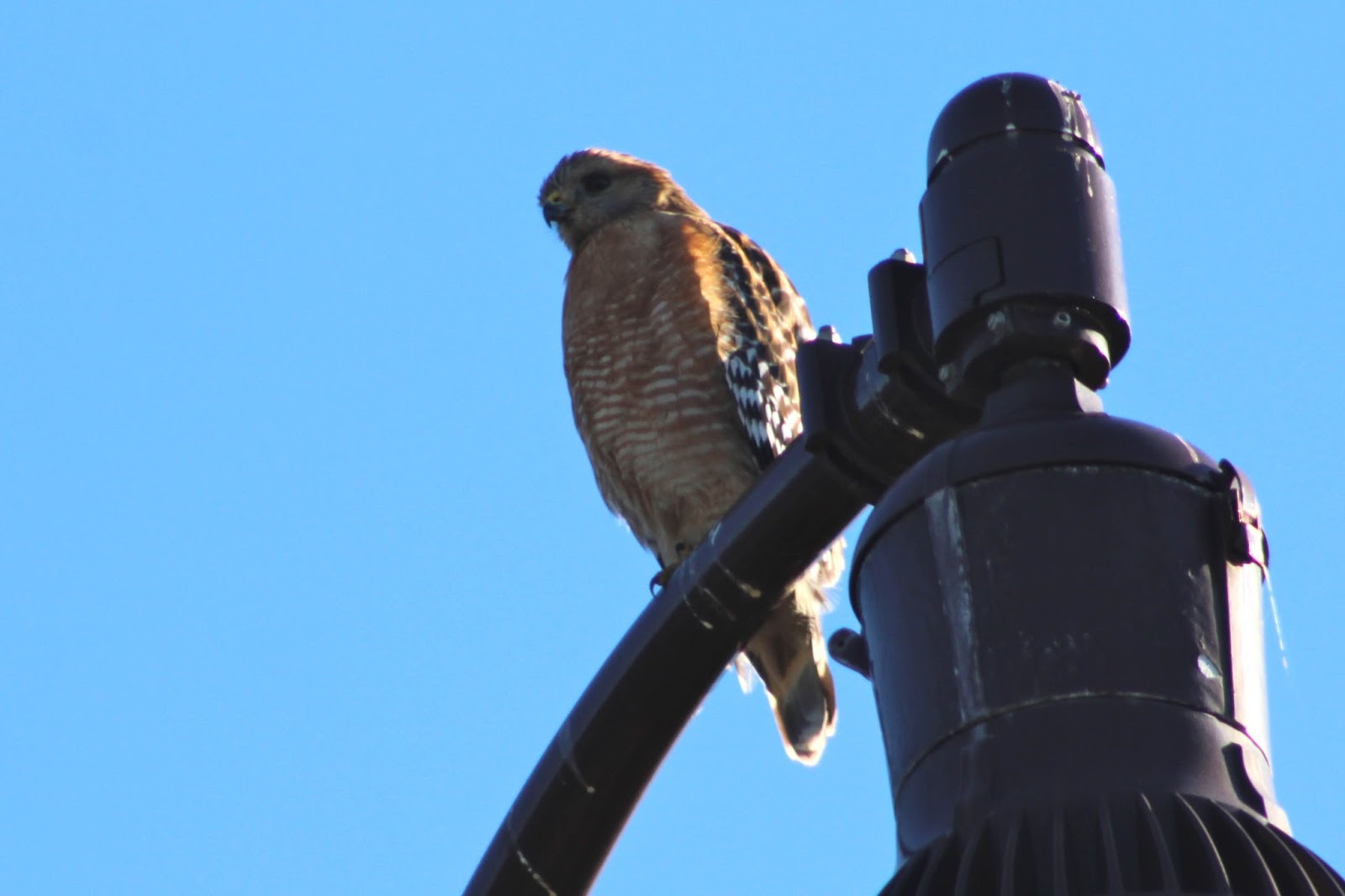
Red-shouldered Hawk

Black Scoter

Red-breaster Merganser (not the aforementioned one)

Belted Kingfisher

After such an excellent outing, we thought we'd push our luck and hopefully end the day with a Wrentit at Yaquina Bay State Park. The skulky buggers proved too elusive, so we had to content ourselves with half a dozen or more Fox Sparrows, easily the most conspicuous bird along the park's labyrinthine trails. But it would have been asking too much to find literally every bird we wanted with the same ease as the Mountain Plover.

Golden-crowned Sparrow


White-crowned Sparrow

(Sooty) Fox Sparrow

Thursday, October 21, 2010

Apalachicola: Shorebirds

Last month we took advantage of the long Labor Day weekend and drove north to the Florida panhandle. The experience was fairly epic, as far as weekend trips go, and there's just too much to share in a single post. Rather than recount what happened, day by day, we decided that best way to highlight everything the area had to offer is dividing the posts up by topic - starting with shorebirds.

Forster's Tern scouting for fish


Our campsite was located looking over Saint Vincent Sound, just off the Gulf of Mexico. On our first morning we walked the short distance from our tent to the water and found a Spotted Sandpiper bobbing its rump up and down the shore. There were also Ring-billed and Laughing Gulls perched on the boat dock, as an Osprey fished and a Bald Eagle flew overhead.


Black Skimmer skimming


Our plan for the day was to head up Cape San Blas to St. Joseph Peninsula State Park, but since this was our first time in the area, we were also open to do a little exploring. Driving up Cape San Blas, we found a public park on the beach and decided to check it out. Being early in the morning, the beach was mostly absent of bathers, and there was only there was only the occasional jogger to disturb the shorebirds. Right away we saw Ruddy Turnstones, Willets, and Sanderlings, in additional to flying Black Skimmers, Brown Pelicans, and Forster's Terns. 

Flock of Black Skimmers

The main attraction for us, though, was the variety of plovers, since our life lists were missing many of these. Most numerous were the Semipalmated plovers, but we also found several Piping Plovers, a single Snowy Plover, and a couple of Black-bellied Plovers towering over them all.


Semipalmated Plover

To our amusement, one tough little Sanderling had apparently claimed that particular stretch of beach for himself, and vigorously defended it by charging at all trespassing Sanderlings with head lowered until they flew off. It seemed that they kept returning, though, and he was forced to fend off the same few offenders repeatedly. 

Snowy Plover in flight


Snowy Plover coming right for us!


But one of our big goals of the trip was to find American Oystercatchers. We heard them calling early on the first morning from our campsite, but they were located in an oyster bed well beyond a reedy area blocking our view. But we eventually did find some on several occasions later on. Driving down S.R. 30, we pulled over and investigated a man-made jetty that looked promising, and did manage to see our first Oystercatcher. Unfortunately, it was much too far away for good pictures, and we were never able to see them much closer when we passed by this area on the following days.

Our best look at an American Oystercatcher


On the drive back home we kept our eyes on the shore as best we could, looking for shorebirds, and hoping get a better look at some Oystercatchers than we'd been able to manage. We spotted a pair just off the road within the first hour, but there was nowhere to safely pull off. I kept driving for another few hundred feet past them before there a suitable place to park, which turned out to be the lot for a public beach. We got our gear and ran out as quickly as we could, but what we found was a disaster unfolding in slow motion. An older couple was taking a stroll along the water, completely oblivious to all of the birds they disturbed on the way. 

If we ran and tried to divert them, we would have risked flushing the entire group of shorebirds. If we did nothing, there was a slight chance that the people would either turn back on their own or that the Oystercatchers simply avoid them and stay nearby. After what seemed like an eternity, the couple finally reached them and scared them off entirely. Nevertheless, we couldn't be too disappointed because the Oystercatchers did lead us to our first ever Marbled Godwits. 


Marbled Godwit getting a running start

Marbled Godwit about to take off