Showing posts with label Black Scoter. Show all posts

Friday, January 29, 2016

Overcoming the Charadrius Radius

The slow, excruciating torture of the eBird needs alert email is an awesome, but ultimately just punishment for the mortal birder's crime of having limited time and resources, while cultivating a series of dependent, voracious lists. When a Mountain Plover first popped up in Newport, OR in early December, inclement weather stopped us from driving out to the coast at the first opportunity. Holiday travel would take us to New York, and later to Texas. And throughout it all, without fail, a daily reminder of our limitations alighted remorselessly in my inbox.

Mountain Plover


For over a month, the plover has been camped out at South Beach State Park, and on January 10 the fates finally cleared the way for us to have our go at it. We parked, crested the sand dune, hiked a quarter mile north, and with only a minimum of effort found ourselves staring down our bins at a small mob of estranged friends: 9 Snowy Plovers and 3 Sanderlings - our first since leaving Georgia almost two years ago. And, oh yeah, the Mountain Plover. It's larger size set it apart, drawing our eyes right toward it, so that it ended up being the first bird we saw along the beach.

Snowy Plover


Plover snacking on an tasty invertebrate


Sanderling & Snow Plover

Sanderling


From South Beach it was just a short distance to Hatfield Marine Science Center, where an overwintering Bullock's Oriole has been the center of some listserv discussion over the possibility of its being an Orchard Oriole. We kept an eye out for the Oriole, but didn't make a concerted effort to turn it up. Instead, we delighted in close-approaching Surf Scoters, and a pair of Horned Grebes. A Common Loon dove and swam right under us, stretching its wings when it surfaced on the other side.

Surf Scoter

Surf Scoter shoving down a bivalve

Horned Grebe


Common Loon


Next, a pit stop at the Rogue Ales brewery, where we ran into a local birder who had just seen a hybrid Common x Barrow's Goldeneye, and a second Goldeneye that was discussed as a possible backcross with Common. Both of them males. The hybrid had intermediate markings, like the white spot in front of its eye, which wasn't quite circular, and not quite a crescent. We saw plenty of pure Commons throughout the afternoon, but no pure Barrows. It looks like we may have to wait until the Winter Wings birding festival next month before we're able to find them easily.

Common x Barrow's Goldeneye

Common(-ish?) Goldeneye

You've got to admire a gull with sideburns

Over at South Jetty, we struggled to stay on a female Long-tailed Duck that spent much more time underwater than above it. If only they were as desperate for our attention as the Golden- and White-crowned Sparrows that gallivanted a few feet away. We pulled the scoter trifecta, turned up loons-a-plenty, and even spotted a male Red-breasted Merganser in breeding plumage.

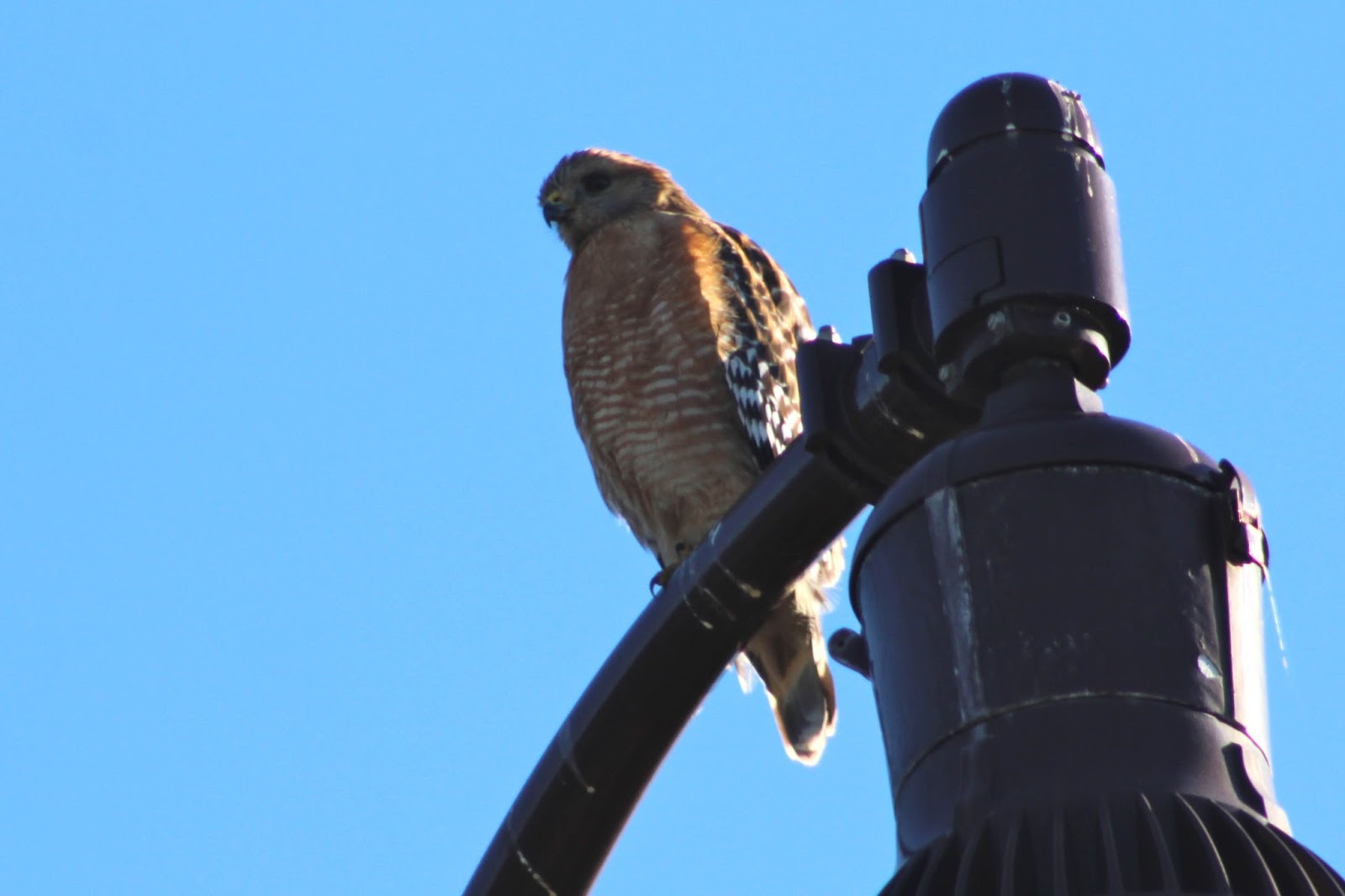
Red-shouldered Hawk

Black Scoter

Red-breaster Merganser (not the aforementioned one)

Belted Kingfisher

After such an excellent outing, we thought we'd push our luck and hopefully end the day with a Wrentit at Yaquina Bay State Park. The skulky buggers proved too elusive, so we had to content ourselves with half a dozen or more Fox Sparrows, easily the most conspicuous bird along the park's labyrinthine trails. But it would have been asking too much to find literally every bird we wanted with the same ease as the Mountain Plover.

Golden-crowned Sparrow


White-crowned Sparrow

(Sooty) Fox Sparrow

Sunday, March 9, 2014

Scoter Trifecta!

It’s early March and duck season is winding down in the South, but as Maureen shared in her previous post, we’ve had some great looks at members of this group this winter. Several of these happened over our holiday travels, but one of our most exciting duck encounters of the season happened right here in Savannah, which involved seeing all three scoter species all in one place and at the same time.

Forster's Terns regularly grace the bridge leading to Ft. Pulaski

Scoters are sea ducks, and over the past couple of winters, we’ve been able to make out Black Scoters from the beach at Tybee Island. Usually when we spot them offshore, the waters are choppy, the birds are far away, and the females are barely identifiable to species. The males are hard to miss, though, with their jet black plumage, and the bright yellow knob at the base of their bill. Even so, these sightings haven’t been as satisfying as we would have liked, and we’d long hoped for the opportunity to see them under better circumstances.

Black Scoter. During one recent visit there were between 1,000-2,000

This Loggerhead Shrike guards the road in, and keeps the riffraff out

For the past couple of months those circumstances have converged on the Savannah River, along the south end of the Ft. Pulaski National Monument. Reports of White-winged Scoters and Surf Scoters, along with Long-tailed Ducks started turning up in my eBird needs alert emails pretty regularly. When we went to check it out, we were treated to well over 1,000 Black Scoters! There were also a considerable number of Greater and Lesser Scaup, dozens of Redheads, and several other species mixed in in smaller numbers. Included in these were a handful of Surf Scoters and White-winged Scoters, lifting our personal lists to new milestone: Our 300th ABA bird!

White-winged Scoter - you can see just a hint of the white wing patch here

White-winged Scoter and Lesser Scaup

White-winged Scoter and Surf Scoter

The light was fading fast when we came upon this feathered flotilla. We would come several more times in the next weeks, trying to locate a Long-tailed Duck (as many as three had been reported). However, we soon learned that birders weren’t the only ones turning out for the ducks. One day we trekked the half-mile from the parking lot toward the island where the ducks had been congregating, and prematurely started congratulating ourselves on the nice group of Canvasbacks mixed in with Redheads, Buffheads, and Scaup. Unfortunately, we’d been fooled by several long lines of decoys set up by a camouflaged group of hunters who had set themselves up on the island. 

White-winged and Surf Scoters, joined by Redhead and Lesser Scaup

A ragtag gang of sea ducks patrol the waterway


We never did turn up a Long-tailed Duck, but all three scoter species persisted throughout the season, sometimes giving pretty stunning looks. White-winged Scoters, in particular, are a fairly uncommon occurrence down here, and yet we were seeing sometimes as many as a dozen in a single outing. Apparently, they’ve come farther south this year to escape the iced over Great Lakes, and there seems to have been plenty of food for them here, as they’d dive to the bottom of the river and resurface some time later with a bill full of mussels. It’s been great to have the opportunity of studying this odd-looking group of ducks so closely, completing for us the scoter trifecta, and helping put us over a birding milestone.

Ft. Pulaski is also one of the most reliable places for marsh sparrows.
We were happy to see this Nelson's Sparrow pop up