Showing posts with label Common Yellowthroat. Show all posts

Thursday, March 3, 2011

Merritt Island, Day 2

Now that I've finished a complete draft of my dissertation, I actually have time to devote to other things (yay, other things!). So here I am to pick up where I left off with our December trip to Titusville (Part 1) (Part 2).

If you'll recall, Maureen and I had made an unsuccessful run at 100 birds on the first day of our trip, and our new goal was to reach that milestone by the end of our 3 days. We began our second morning at Canaveral National Seashore to hopefully pick up some shorebirds. Along the drive in we passed group after group of Lesser Scaup on the water, but weren't able to pick out any other waterfowl, other than a lone Ruddy Duck.

Lesser Scaup, with a lone Ruddy Duck in the bottom righthand corner


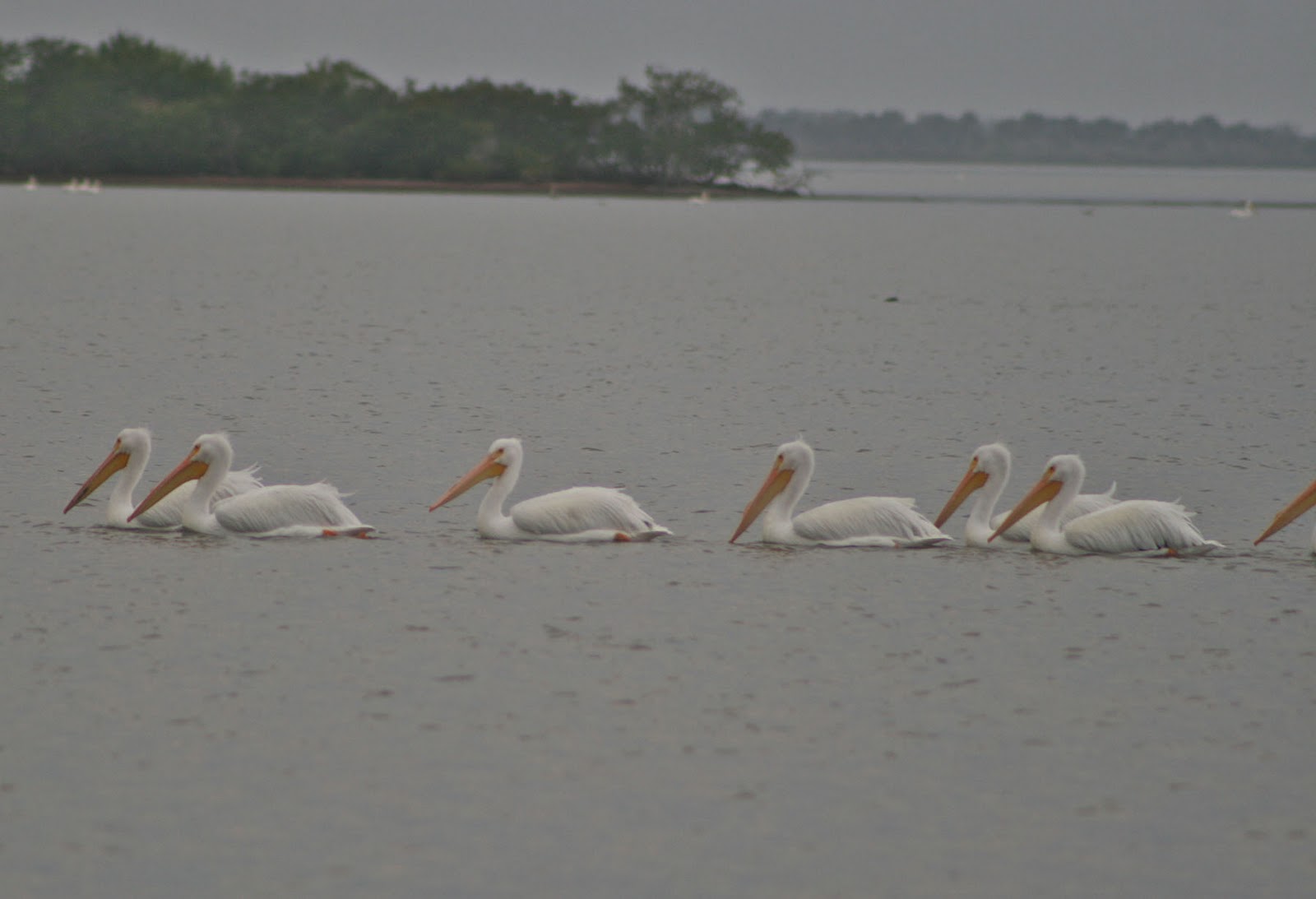
When we got to a boat ramp where we've had luck on previous trips, American White Pelicans were flying all about, with the occasional Brown Pelican plunge diving. Once we followed around the perimeter of the island to get a better look, we noticed at least four Bottlenose Dolphin swimming back and forth, right in amongst the pelicans! 

American White Pelicans and a Bottlenose Dolphin

American White Pelicans

Afterwards, we backtracked, re-checking the groups of waterfowl as we went. At one stop, across the water, we could see a hunter, camouflaged, and crouching in position. It was a little unsettling trying to count birds while there's a rifle hovering over them. Fortunately, no shots were fired as we surveyed them. We were just able to make out a small group of Canvasbacks, which were lifers for us, and much more attractive alive than dead, I'm sure.

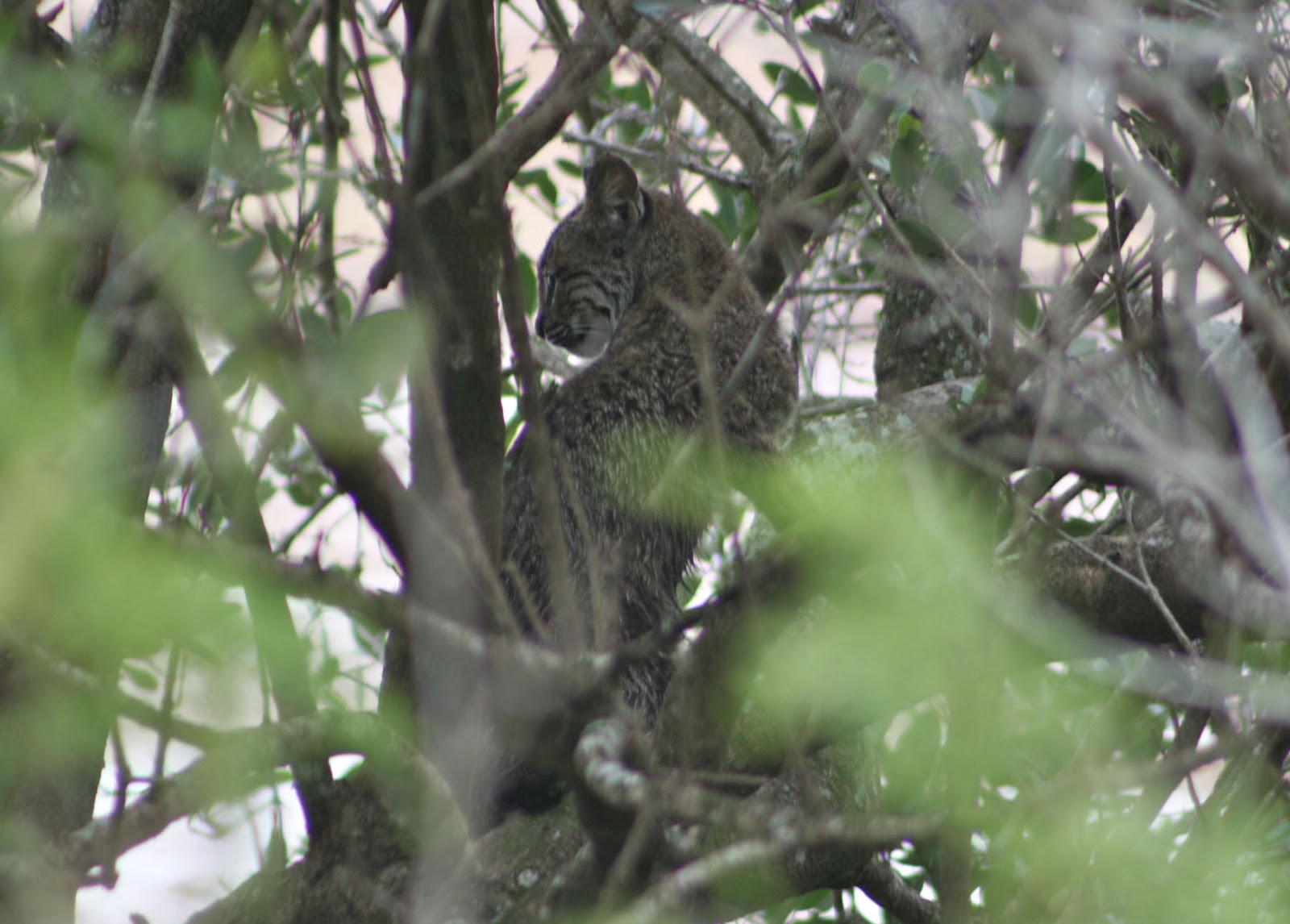
From there, we turned down Bio Lab Rd., which we'd never ventured down. We were hoping to get closer to some Canvasbacks, but we were never able to figure out how to get near the area where we saw them. I drove down the dirt road slowly, while Maureen and I scouted the fields and ditches on opposite sides of the car. Amazingly, tucked away in a ditch, Maureen was able to spot a Florida Bobcat cub. With our time left in Florida counting down to the final months, we had hoped that we would come across this subspecies. They're periodically seen at Daggerwing Nature Center, but we've never been fortunate enough to see one there. 

Florida Bobcat

Florida Bobcat

Bobcat cubs need their beauty rest, too

After snapping a few photos, we decided to leave it alone, and we certainly didn't want to upset mama bobcat, wherever she was. Our very next exciting encounter was… two more bobcat cubs. These were more alert and walking about side by side. One of them ran into the cluster of trees after a minute, and the other lingered for a bit before following into the same tree. The first one sat up near the top of the tree at batted its paw, playfully, at its sibling below. 


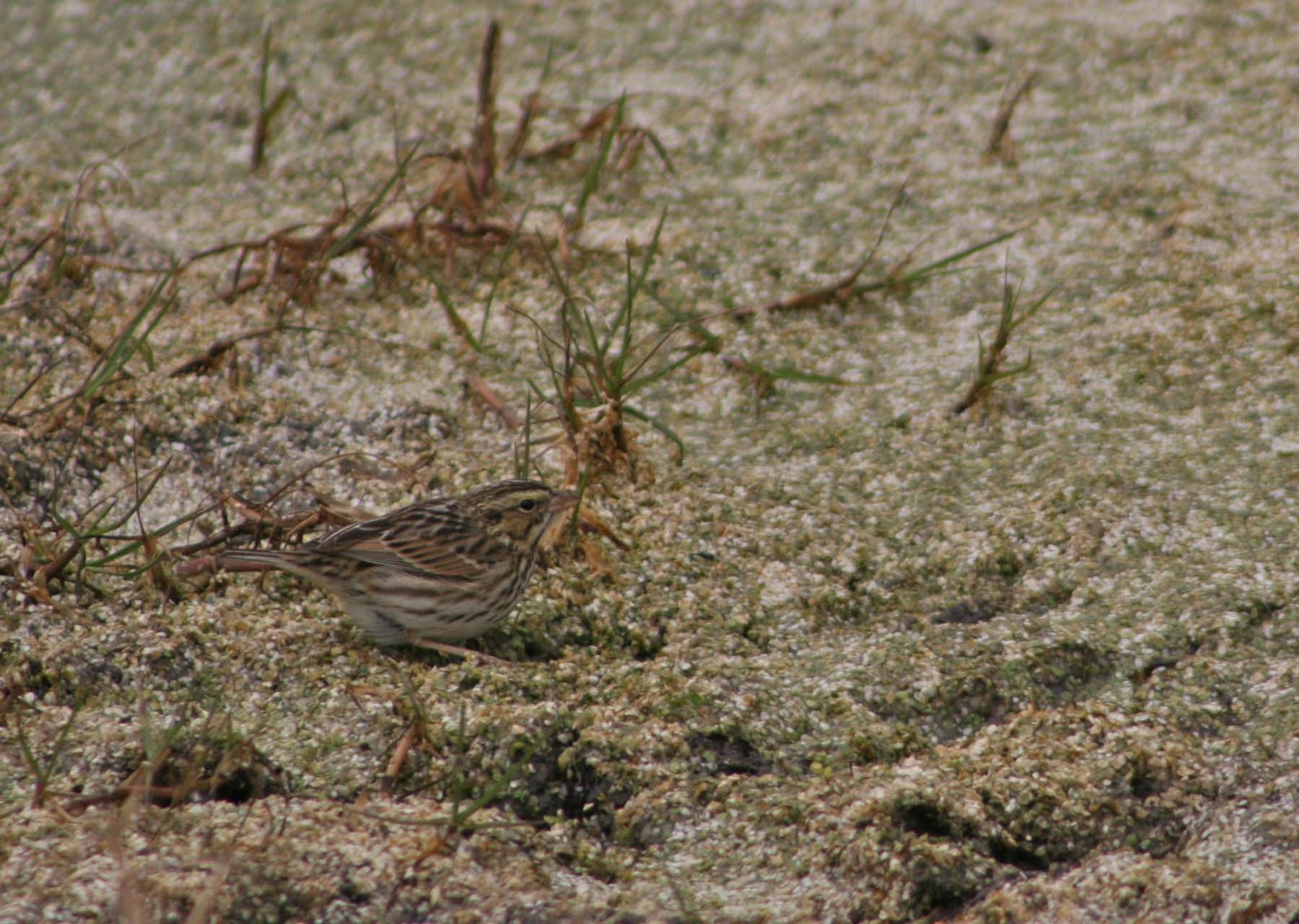
Moving on, we found a cluster of sparrows, and were able to pick out a Swamp Sparrow, in amongst several Savannahs. Several Common Yellowthroats foraged the muddy ground, making their reedy calls.
Savannah Sparrow

Savannah Sparrow

Swamp Sparrow

Common Yellowthroat

Following the road along some shoreline, we finally found the shorebirds we were looking for. Lots of Dunlin, Sanderlings, and an assortment of plovers. Coming across some terns, we found the expected Forster's and Royal Terns, as well as a an unexpected cousin, a single Common Tern. 

Royal Tern

A shy Forster's Tern
Common Tern

A little later, we also found three Red-breasted Mergansers in the sea, and a group of Hooded Mergansers in freshwater. We still weren't going to make it to 100 species by the end of the day, but with Viera Wetlands the next day we were in pretty good shape to hit our goal by the end of the trip… as long as the weather held.

Red-breasted Mergansers

Hooded Mergansers

Red-shouldered Hawk

Tuesday, December 21, 2010

Ft. Lauderdale Christmas Bird Count

This past Saturday, Maureen and I participated in our very first Christmas Bird Count. Unable to join the Palm Beach count in early January, we decided that Ft. Lauderdale would be the next best thing. Only on rare occasions have we ventured into Broward County for birding, so the area was generally new to us. The overcast day wasn't particularly camera-friendly, so some of the pictures didn't come out as clearly as they might have, but the birds were cooperative (except for the warblers), and our companions were just as knowledgable and friendly as we could have hoped.

We began the morning at Long Key Natural Area, arriving before the park officially opened, in order to seek out any owls or other night birds that might be about. With iPhones out and iBird providing the calls, we were hopeful that we could elicit a response from any of the Great Horned or Eastern Screech Owls known to inhabit the area. We did get a flyover from one of the Great Horned Owls, but of course I had my back turned and missed it. Farther down the trail, we flushed a Whip-poor-will, which was off before we knew what happened.

After sunrise, we located a calling House Wren, and then farther down the same path, found a sparrow. Sparrows remain one of our great weaknesses when it comes to field ID, but in our defense, they really just aren't all that common in South Florida. The bulk of our sparrow experience comes from our travels to Upstate New York, but it still leaves plenty to be desired. Fortunately, our partners in counting immediately pegged it as a Grasshopper Sparrow, and declared it our 'bird of the day'. In retrospect, of course, it seems an obvious ID, but at least now we're that much more prepared for next time.


With the sun up we were also able to track down the pair of Great Horned Owls that we had hoped to find before dawn. Rather than play calls again, now we only had to follow the whitewash and look up.


Our next stop was Flamingo Gardens, a botanical garden jam-packed with uncountable birds. Flamingos, Mute Swans, Graylag Geese, and Redheads were some of the main attractions, all of which were invisible to our listing efforts. However, the gardens also serve as a Black-crowned Night Heron rookery, and abundant firebush meant plenty of Ruby-throated Hummingbirds. We weren't there long, though, before it started pouring. We weren't about to give up on the day, and so leaving simply wasn't an option. We sought refuge by the Florida Bobcat enclosure and waited it out - for over an hour and a half. Whenever the rain lightened somewhat, the occasional hummingbird ventured into the enclosure.


Our final stop was the marsh habitat at Volunteer Park, where our count leader had spotted a Marsh Wren during his scouting trip on the previous day. We waited around for several minutes where it has been seen, and set iBird to do its thing, but the only thing moving was a lone Common Yellowthroat. After several minutes, we gave up, and pledged to check again before we left.


Tree Swallows were hawking insects over the water, and as we got nearer, we noticed several Cave Swallows were present among them. The latter gave great looks, swooping just feet in front of us, with the pale orange rump clearly visible, and meeting us at about eye level. A Wilson's Snipe also flew in the distance, which we were able to locate later on along one of the banks.


A little farther along we weren't able to find much more, other than a pair of Loggerhead Shrikes, and some active Palm Warblers. By that time, the rain had started to pick up again, and at that point we were much less willing to brave it out than we had been at the gardens. Retracing our path as the light began to fade, we decided to give the Marsh Wren another go. This time it did make a brief appearance, but soon disappeared back into the reeds and was seen no more.

And so we were able to end the day on a high note. Despite the weather, we had a wonderful day, and birding with such great naturalists as we did was a fantastic educational experience. We only regret that we don't have time to do more than one Christmas Bird Count this year.

Wednesday, November 10, 2010

A Morning at Green Cay

It seems like we've been traveling so much lately that we've hardly had time to do any birding locally. A few weeks ago we decided to change that and spent a long morning on the boardwalk at Green Cay. Now, I love Green Cay, and it's certainly the most reliable location for wading birds within a half hour's drive, but we always have to face the fact that lots of non-birders also visit, and their interests are often at odds with ours.


Little Blue Heron


Occasionally, birds fly up and perch on the railing, giving everyone with a camera a golden opportunity for photos. But the boardwalk is dominated by speed walking senior citizens throughout the morning, and they stop for nothing. On this particular morning, a Wood Stork landed just a few feet away from us. As a group of walkers approached from around a bend, Maureen snapped away, mindful that it was only a matter of seconds before they came near enough to flush it. 


A little farther along, a Roseate Spoonbill prompted one of the most surreal conversations I've ever had.

Woman: Oh, look - a Flamingo!
Me: It's a Spoonbill.
Women (to me): Oh, it's a Spoonbill, not a Flamingo. I don't know why I believed you!

That's right - she attributed the words that came out of her mouth to me, and actually seemed annoyed. I didn't know what to say to that (and still don't), so I just gave her a nonplused look for several seconds and walked away, scratching my head.

Roseate Spoonbill -- NOT a Flamingo
It seems that most of the passing migrants have already made their way through, and more and more we're only seeing those warblers that we can reliably expect to see throughout the winter in South Florida. Among these was this Common Yellowthroat, but the Palms and Yellow-rumped (or is it Myrtle) Warblers were also out in big numbers.


Plenty of ducks were on the water, with a little more variety than just the Mottled Ducks, now that the Blue-winged Teal are back. We couldn't find any Green-winged Teal, although we'd seen them reported, but then, we've never never seen more than a few at a time at Green Cay, even when we have come across them.


As we approached the end of the boardwalk loop, we found a Sora that had ventured out of its hiding place in the reeds. Not long after discovering him, he disappeared back out of sight. It's nice to see the Soras every once and a while to reassure us that they're still around, even if we can't find them most of the time.