Showing posts with label Merritt Island NWR. Show all posts

Thursday, March 3, 2011

Merritt Island, Day 2

Now that I've finished a complete draft of my dissertation, I actually have time to devote to other things (yay, other things!). So here I am to pick up where I left off with our December trip to Titusville (Part 1) (Part 2).

If you'll recall, Maureen and I had made an unsuccessful run at 100 birds on the first day of our trip, and our new goal was to reach that milestone by the end of our 3 days. We began our second morning at Canaveral National Seashore to hopefully pick up some shorebirds. Along the drive in we passed group after group of Lesser Scaup on the water, but weren't able to pick out any other waterfowl, other than a lone Ruddy Duck.

Lesser Scaup, with a lone Ruddy Duck in the bottom righthand corner


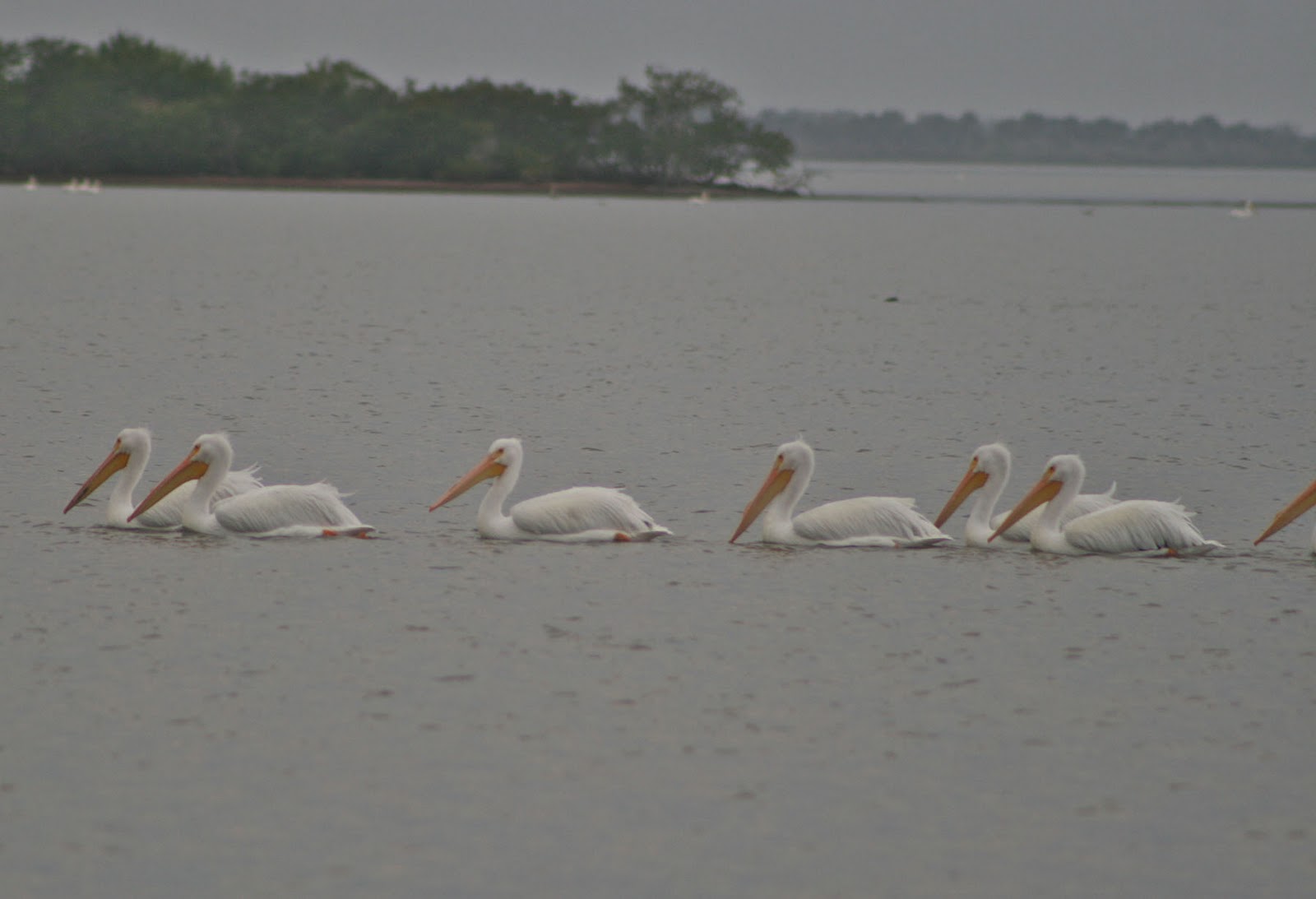
When we got to a boat ramp where we've had luck on previous trips, American White Pelicans were flying all about, with the occasional Brown Pelican plunge diving. Once we followed around the perimeter of the island to get a better look, we noticed at least four Bottlenose Dolphin swimming back and forth, right in amongst the pelicans! 

American White Pelicans and a Bottlenose Dolphin

American White Pelicans

Afterwards, we backtracked, re-checking the groups of waterfowl as we went. At one stop, across the water, we could see a hunter, camouflaged, and crouching in position. It was a little unsettling trying to count birds while there's a rifle hovering over them. Fortunately, no shots were fired as we surveyed them. We were just able to make out a small group of Canvasbacks, which were lifers for us, and much more attractive alive than dead, I'm sure.

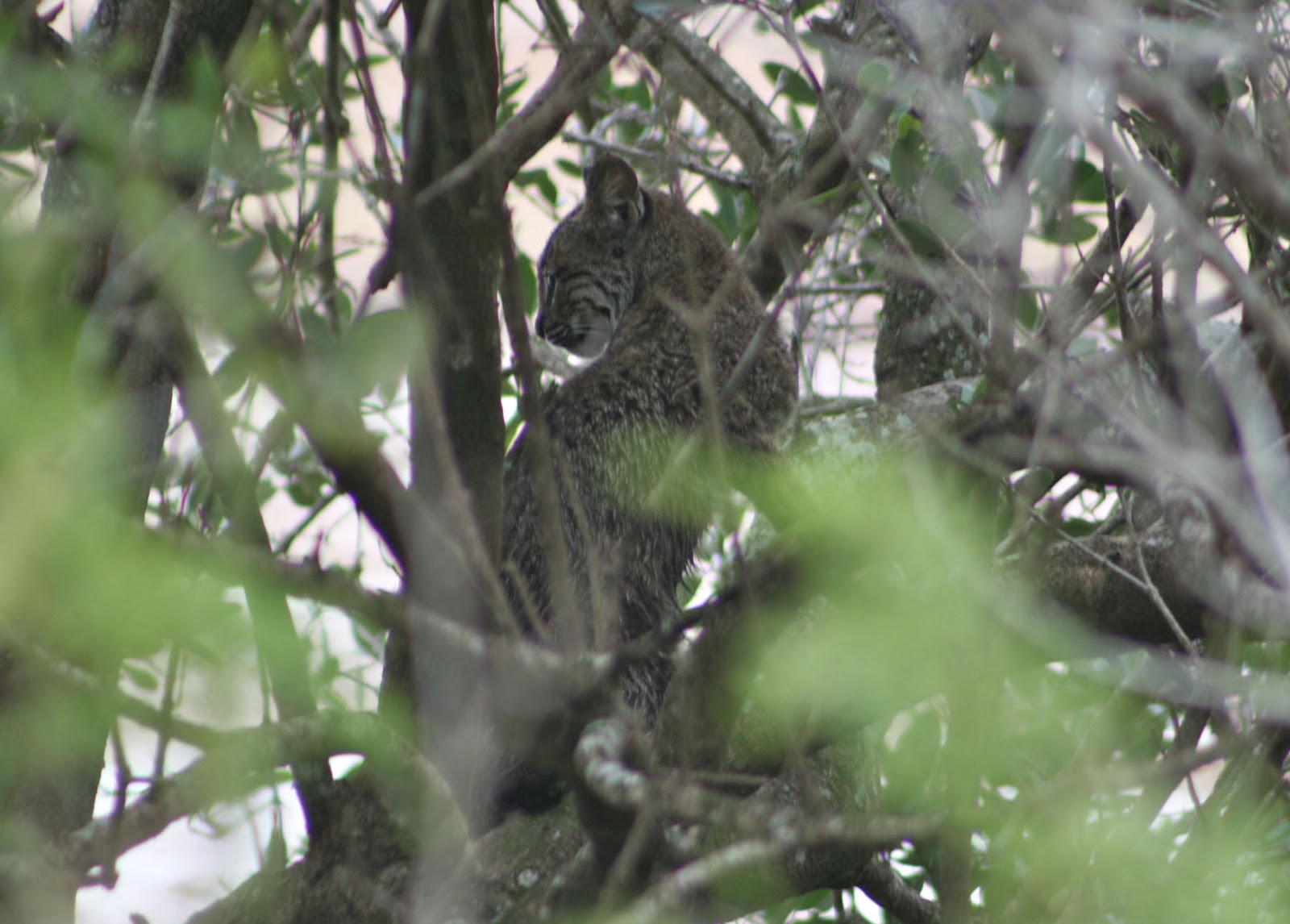
From there, we turned down Bio Lab Rd., which we'd never ventured down. We were hoping to get closer to some Canvasbacks, but we were never able to figure out how to get near the area where we saw them. I drove down the dirt road slowly, while Maureen and I scouted the fields and ditches on opposite sides of the car. Amazingly, tucked away in a ditch, Maureen was able to spot a Florida Bobcat cub. With our time left in Florida counting down to the final months, we had hoped that we would come across this subspecies. They're periodically seen at Daggerwing Nature Center, but we've never been fortunate enough to see one there. 

Florida Bobcat

Florida Bobcat

Bobcat cubs need their beauty rest, too

After snapping a few photos, we decided to leave it alone, and we certainly didn't want to upset mama bobcat, wherever she was. Our very next exciting encounter was… two more bobcat cubs. These were more alert and walking about side by side. One of them ran into the cluster of trees after a minute, and the other lingered for a bit before following into the same tree. The first one sat up near the top of the tree at batted its paw, playfully, at its sibling below. 


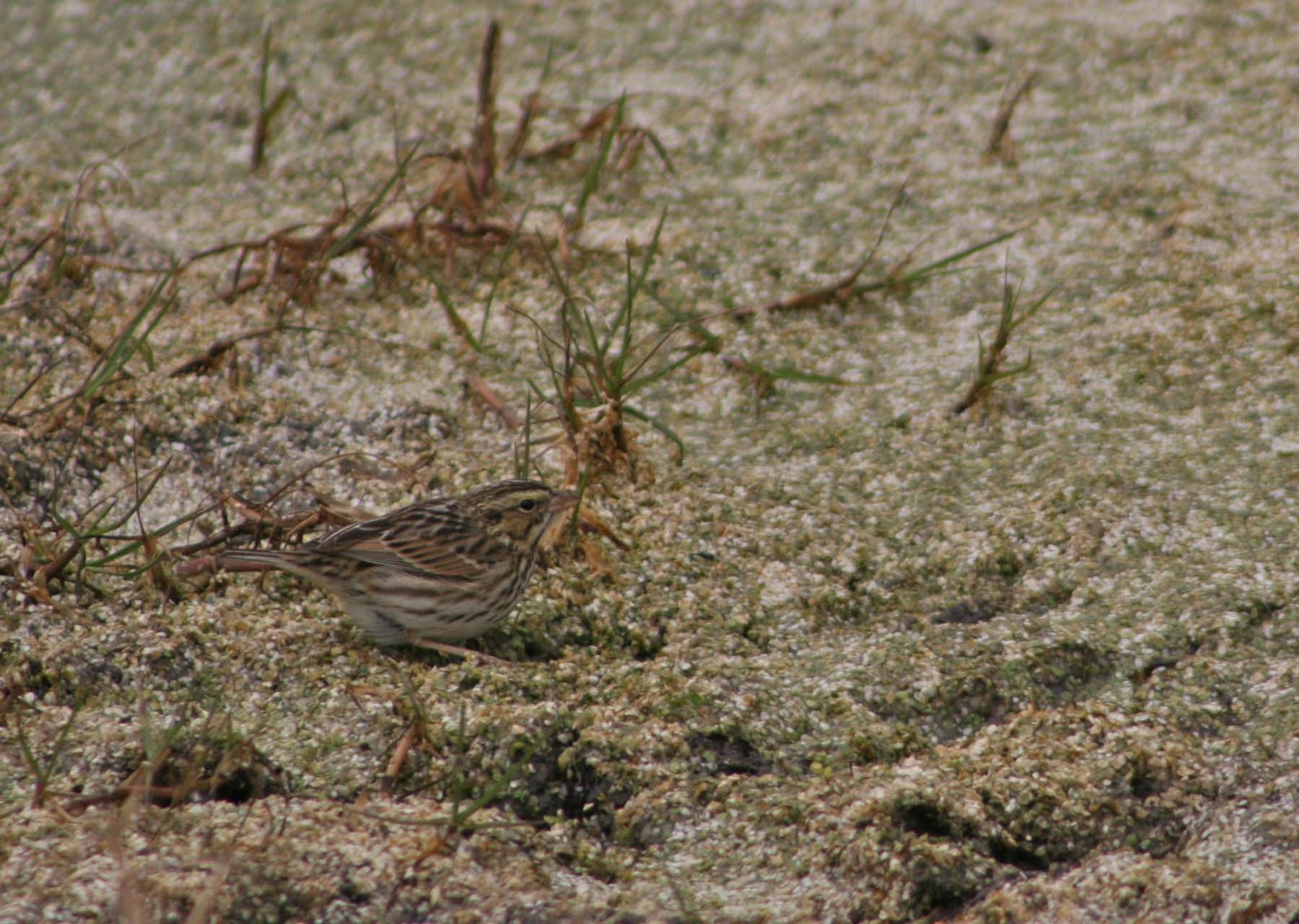
Moving on, we found a cluster of sparrows, and were able to pick out a Swamp Sparrow, in amongst several Savannahs. Several Common Yellowthroats foraged the muddy ground, making their reedy calls.
Savannah Sparrow

Savannah Sparrow

Swamp Sparrow

Common Yellowthroat

Following the road along some shoreline, we finally found the shorebirds we were looking for. Lots of Dunlin, Sanderlings, and an assortment of plovers. Coming across some terns, we found the expected Forster's and Royal Terns, as well as a an unexpected cousin, a single Common Tern. 

Royal Tern

A shy Forster's Tern
Common Tern

A little later, we also found three Red-breasted Mergansers in the sea, and a group of Hooded Mergansers in freshwater. We still weren't going to make it to 100 species by the end of the day, but with Viera Wetlands the next day we were in pretty good shape to hit our goal by the end of the trip… as long as the weather held.

Red-breasted Mergansers

Hooded Mergansers

Red-shouldered Hawk

Friday, January 28, 2011

Merritt Island NWR, pt. 2

As I noted in my previous post, we were well on the road to 100 species on our first day of our 3-day birding weekend in Titusville, FL. But we felt our Century Run slipping away from us as we headed into Black Point Wildlife Drive with only 60 birds under our belt. There seemed a glimmer of hope as we entered the drive, because when we've been down that way in the past we've found huge numbers of waterfowl and shorebirds. This time, however, the first thing we noticed was how dry it was, compared with our other visits.

Almost right off the bat, we saw large animals running together on the far side of some small trees. My gut wanted to say hippos (stupid gut, there are no hippos in Florida), but once we managed a better view, albeit a brief one, I cut myself some slack. It was a small group of feral pigs, one of which was massive! It all happened much too quickly for pictures, but fortunately, it was a memorable enough sight not to need them. Seeing them in person, it's easy to imagine the damage they can inflict, both on humans, and on their environment.

As we drove on, we did manage new trip birds, but they didn't come nearly as quickly as we'd hoped. Areas that we've seen jam-packed with ducks previously were devoid waterfowl, but did contain the occasional Pied-billed Grebe, Greater and Lesser Yellowlegs, White and Glossy Ibises, and an assortment of herons, including Reddish Egrets.

Greater Yellowlegs

When we came up to the first parking area, we joined a largish gathering of people to watch Roseate Spoonbills and Wood Storks feed. These two species feed similarly, but with obvious differences. As the videos below demonstrate, spoonbills are more active feeders, vigorously sweeping their bills from side to side. Wood Storks are more likely to open their bills and hope for the best, occasionally readjusting their position slightly. Doubling back toward the walking trail, Maureen found a Clapper Rail, which vanished before she could point it out. It did briefly reemerge, and I was able to see how much more dull the coloring was compared with it's Gulf Coast cousin, a Clapper Rail we recently saw in Galveston, TX. The good thing about the dull coloration is that it removes the trouble of trying to differentiate it from the nearly-identical King Rail.


Wood Storks, Roseate Spoonbills, White Ibises, and Snowy Egrets


Eventually, we did see large flocks of Lesser Scaup overhead, which ended up being our only ducks for the day. As we watched them fly in, formations of American White Pelicans also passed nearby. After watching flock after flock of Scaup vanish behind the same set of trees we were able to locate where they were gathering. The water almost seemed to be boiling, with all the bathing and splashing they were doing.

American White Pelicans

Flock of Lesser Scaup

Lesser Scaup

A rambunctious group of scaup

On the way out, we tried to locate a Bald Eagle, where her nest is known to be, but the nest was empty, and she was nowhere to be seen. As we met up with the main road again, we saw raptor perched on top of a telephone pole, and as we passed by, we were happy to see that it was her. Although we left Black Point significantly short of our goal, we were nevertheless glad for the great weather and for plenty of birds we don't find as easily at home, just a couple of hours south. With the sun fading, we returned to the shoreline where we ate lunch. A few minutes after we arrived, three Black Skimmers swept in and began skimming the shallow water along the shore. Even though we failed our ludicrous goal, we considered this a perfect end to a perfect day. 73 species is nothing to complain about, after all. Plus, we had two more days left of our weekend, and we had no intention of returning home without all 100.

Black Skimmers

Black Skimmers

Willets

Tuesday, January 25, 2011

Merritt Island NWR, pt. 1

Unfortunately, Maureen and I will not be attending the Space Coast Birding Festival in Titusville this year. We made it last year, and had a really wonderful time attending lectures by the likes of Kenn Kaufman and David Sibley, going on field trips to lands that are normally off-limits, and just generally soaking in knowledge from other birders. We were especially excited by the prospect of (possibly) seeing the mythical Black Rail this year, but by the time we finally got around to registering, that and the other programs that had caught our eyes were already full. Fortunately, Titusville is a mere 2.5 hours north from us, and so we decided that we would drive up and have a look around on our own, since Maureen had a 3-day weekend for MLK day. For those of you are are able to attend this year, hopefully, this and the subsequent few posts can serve to highlight some of the options available to you.

By far, most of our time was either spent in or close-by to the Merritt Island National Wildlife Refuge. The refuge is a massive 140,000 acres and is comprised of myriad trails with a great diversity of habitats. We began with the Scrub Ridge Trail around sunrise, Saturday morning. We hoped that we might come across some Florida Scrub Jays, but were satisfied to find Eastern Towhees, Carolina Wrens, Swamp Sparrows, Savannah Sparrows, American White Pelicans, and a Blue-headed Vireo. This was also the start of our weekend's soundtrack, brought to us by the ever-present Yellow-rumped Warblers and the Gray Catbirds.

Savannah Sparrow

Although we had hoped for Florida Scrub-jays in the scrub habitat, we came up empty. We'd only seen them once before, which was last year at Space Coast Birding Festival. We had taken a guided tour onto restricted NASA land to find them, and we didn't have that option available to us this time around. As we drove from the scrub to the next trail, however, I caught a glimpse of pale blue out of the corner of my eye. I turned the car around right away, and we watched a group of three right from the side of the road. Scrub-jays use a sentinel system, and we were able to see the changing of the guard, as the on-duty jay was replaced by the next shift.

Florida Scrub-jay

A sentinel looking-out for trouble

A Florida Scrub-jay sentinel

Early in the day we decided - either out of hubris or from the sheer variety of birds - that it wouldn't be unreasonable to try for 100 species that day. We stayed on track throughout the morning, too. Next, we stopped in at the Merritt Island visitor's center, and immediately picked up the Painted Buntings at the feeder out back, where they can generally be found this time of year. We also had a White-eyed Vireo, and some American Robins flying overhead. By the time we left the visitor's center, we had already amassed 35 species for the trip, and still had several major areas to survey.

White-eyed Vireo

White-eyed Vireo

Painted Buntings at the feeder

From the visitor's center, we went straight for the Oak Hammock Trails, still buzzing with activity, even though the morning was growing late. We picked up some great songbirds in quick succession: Black-and-white Warbler, Tufted Titmouse, House Wren, and Ruby-crowned Kinglet. Farther in, we found a warbler that baffled us for a minute. High up in the canopy, we could just make out white underparts and a yellow face. We tracked it for several minutes before we saw an object plummet straight to the ground. It fell so quickly that it didn't even occur to us right away that it was the warbler. Once it was staring us right in the face, we saw that it was a Black-throated Green, right at the northernmost edge of its wintering range. We don't really chase target birds often enough for me to consider any bird a "nemesis bird," but it had occurred to me that we should have seen one of these before now. We were elated to be able to add this to our day's count.

Black-throated Green Warbler


Several Pileated Woodpeckers were very active for the remainder of our time in the trails, and seemed to follow us through the woods.

Pileated Woodpecker


We grabbed some lunch and ate it in the car, while we parked along a short stretch of shore to survey the gulls and shorebirds. The Ring-billed Gulls mobbed the car once they sensed there was food about. There was also a smaller number of Laughing Gulls, and a couple of sub-adult Herring Gulls. Horseshoe crabs lay strewn along the beach, both alive and dead and overturned. Among the shorebirds we counted Ruddy Turnstones, Sanderlings, and quite a few Dunlin. Just when we thought the shore was tapped, in flew an adult Great Black-backed Gull. We've seen these on pelagic trips, but never standing, and never directly in front of us. These are impressively huge gulls, towering over the Ring-billeds, and even dwarfing the Herring Gulls. It rested on the water for several minutes before flying back in to bathe in a small puddle.

Great Black-backed Gull

Great Black-backed Gull looking like he's in charge

Bathing in mixed company (w/ Herring Gulls and Ring-billed Gulls)

Dunlin, Sanderlings, and Ruddy Turnstones

Dunlin

Dunlin

Atlantic Horseshoe Crab (Limulus polyphemus)

By 2:15, we had 60 species for the day, and still had Black Point Drive ahead of us. Check back soon to see whether we were able to make our goal of 100!