Showing posts with label Limpkin. Show all posts

Tuesday, April 24, 2012

Featured Feathered Friend: Baby Edition! - Limpkins

Today's FFF shows off the incredibly adorable chicks of Limpkins. We miss seeing (and hearing) these Florida specialty birds in our waters. Some say that these birds are hard to find, but we've never had problems finding them. They often are right out in the open in freshwater areas looking for and feeding on large apple snails and sometimes freshwater mussels. Limpkins will pick a pond clean of all apple snails in sight, competing with another Florida specialty bird that eats only apple snails, the Snail Kite.

"Remember to keep your wings up for balance!"

Serious cuteness going on here

Limpkin parents and a trail of chicks

If you've been to Florida and haven't seen them, then you may have heard them. If you ever hear what sounds like a flamboyant diva screaming while running away in heels, then you may have heard a Limpkin. This can be especially startling in the middle of the night. But fear not, it's most likely not some scandalous mischief going on - it's just a Limpkin calling.

Doting Limpkin parent and chicks

That's a big foot, mama!

Limpkin parents showing how to forage

Well before you get a loud, wailing adult Limpkin, you have these precious little brown balls of fuzz! We stumbled upon this family of Limpkins at the end of May in 2009 at a pond right in front of a local public library. We were already pleasantly surprised to find two adult Limpkins together. And then we noticed these little fuzzballs trailing after them. We quickly went home to grab our camera to capture this uber cute sighting!

Family Portrait

Love seeing those tiny wings!

These Limpkin chicks were just as cute as can be! There were a group of 4 of them following mom and pop looking for snails. It was nice to see both doting parents caring for their young ones and showing them the ropes.

A perfect portrait of baby Limpkins in these flowers!

Another lovely family pic

Sunday, November 20, 2011

Avian CSI

WARNING: This post includes some graphic photos that some may find disturbing. Viewers beware! 

Migration has slowed down quite a bit, but that doesn't stop Nick and me from going out and enjoying the slightly cooler weather to go birding. Just yesterday we went out in the late morning to a nice little area called the Wellington Environmental Preserve. This is a fairly new area that opened to the public last year, and we haven't had great numbers of birds here, but we have gotten nice variety and some good ducks that we don't find in most of our other birding hot spots.

 
Female Belted Kingfisher

It was a fairly slow day. We had previously seen lots of limpkins here as there is an abundance of apple snails. You can tell by all of the empty shells that will line the banks and even along the boardwalk bridges. But we had only seen 1 or 2 limpkins this time. Some of the other highlights from this trip were a number of American Kestrels, about 20 Lesser Scaups, and a juvenile Bald Eagle. We also had some nice views of a female Belted Kingfisher.


Female Belted Kingfisher

On our way out, Nick and I decided to go off the path a little to try to find Savannah Sparrows that we thought we had heard on our way in but were unable to locate. We didn't find them, but instead, we found a whole wing laying in the grass. We'll see feathers lying about all the time, but never a whole wing! It was perfectly intact. You could see where the bone had been cleanly snapped off. By the looks of the size and the color of the wing, we determined that it must have been a limpkin. 

Limpkin Wing

So that made us think, hmmm, where is the rest of it? We looked a little bit more in the grass, and about 5 feet away we found the rest of the remains. There wasn't a body, but there was the other wing, 2 legs, a bill, and more feathers. We were able to confirm that it was indeed a limpkin, especially because of the bill. Again, viewers beware, but it looks like there was also the bird's throat. (Eww, gross, I know!) 

Limpkin Crime Scene 2

Other Limpkin Wing


And then a few more feet from this evidence of a kill is what we determined to be the "plucking station," where the predator must have cleaned off the little feathers of the poor limpkin. We determined that it must have been a large bird of prey like a Peregrine Falcon that could have taken this large water bird down and cleaned it so well -- the limbs and bill snapped off so neatly like breaking small twigs off of a larger branch. 
 
Close Ups of Limpkin Bits

Another View of the Limpkin extremities

The "Plucking Station"

There was definitely a mix of emotions -- pity for this poor limpkin, a bit of disgust, but also intriguing wonderment of this evidence left behind of predator versus prey in the avian world.

And to make you feel better, below are some pictures of a viceroy butterfly also taken during our birding adventure. =)


Viceroy Butterfly

Viceroy Butterfly

Viceroy Butterly


Monday, March 28, 2011

Wellington Environmental Preserve

Yesterday morning, Maureen and I returned to Wellington Environmental Preserve for our second visit to this spacious (365 acre), brand-new public wetland. Just a few weeks ago we made our way up to twitch us some Canvasbacks, which are uncommon visitors to Palm Beach County. We had been able to find the Canvasbacks, but the vastness of the park left us wondering what we were missing.

This time around there were noticeably fewer waterfowl - an ominous sign that we're getting on with Spring, and about to lose our Winter visitors. All that remained of this group were a lone female Northern Shoveler, a male Ring-necked Duck, several Blue-winged Teals, and Florida's very own Mottled Ducks, which won't be going anywhere.

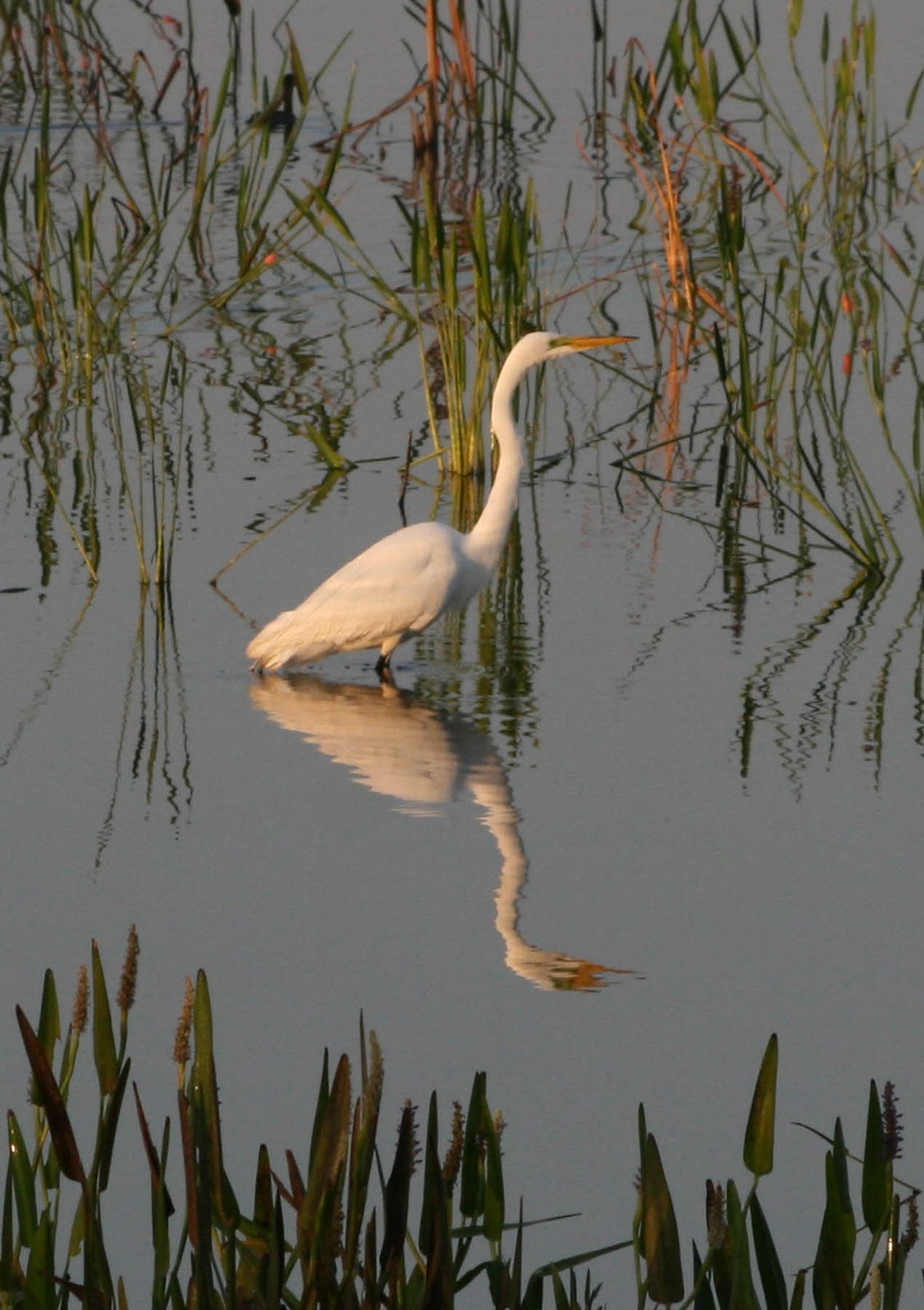
Great Egret

Right out of the car Maureen (who has more of an ear for birdsong than I do) heard an Eastern Meadowlark. Our only other Meadowlarks were during a day-trip to Galveston late last year, making this a state bird for us. It took some effort to locate where the bird was perched because of the distance their song carries. We finally picked it up as a speck across the street and in someone's private property, effectively keeping us from obtaining a better view. Once we started for the trail, though, we heard several others, which sounded like they were always just ahead of us. We were only able to locate one other, but he was pretty lively. Initially, we found him in a tree, before he flew down to the ground, walked across the path and into a clump of tall grasses (and singing the whole time). 

Eastern Meadowlark

Eastern Meadowlark

Eastern Meadowlark

One thing about Wellington Environmental Preserve is that they are Limpkins EVERYWHERE! Above all others, this is the bird that you know you're going to find when you come here. Apple snail shells litter the shores, and sometimes you even find yourself crunching a discarded shell underfoot on the boardwalk. There are so many Limpkins, in fact, that even the Limpkins want to see what else is around (see below). 


Limpkin

Limpkin

Among the highlights of the day was when we picked a single American Avocet out of a small flock of Black-necked Stilts. It's always a pleasure to pick up a new county bird, as this was for us. Still, it's a shame that we didn't get to see it stick around, since Avocets are among my favorite shorebirds, and we only see them rarely, and usually from a great distance.

The Palm Warblers are all looking fancy in their breeding plumage, which in Florida, means that they're getting ready to leave us any day now. All throughout winter, these common birds are the classic LBJs, and now look at them! It's like watching a caterpillar become a butterfly. I wish them well on their journey back north. 

Palm Warbler

When we arrived at the 6-story observation tower, we felt obligated to trudge our way up, since we had been short on time during our only other visit. It turned out to be well worth the effort. From that vantage, we were able to watch a juvenile Northern Harrier terrorize dozens of Common Moorhens and American Coots. Just a couple of minutes later, a juvenile Snail Kite flew in low from the direction that we'd just seen the Harrier disappear. 

Northern Harrier

From above, a juvenile Harrier and a juvenile Snail Kite can look remarkably similar - both are brown overall, with a broad patch of white toward the base of the tail. Luckily, we were on our toes and weren't taking anything for granted, for which we were rewarded by watching the kite snatch an apple snail out of the water. Easy prey, perhaps, but still, it's pretty awesome to watch a Snail Kite do as Snail Kites do.

Snail Kite

Snail Kite with an apple snail

Florida very fortunate to have it's very own population of Sandhills with us year-round, albeit not in anything near the numbers seen in the Platte River valley. Early on, we had a group of five fly over while making their bugling calls. This one was just taking a stroll.

Sandhill Crane

Tuesday, March 8, 2011

Viera Wetlands

We've finally arrived at the report of our third and final day of birding Brevard County, Florida - a trip that, earlier, included both Merritt Island NWR (Part 1, Part 2) and Canaveral National Seashore (here). While we would have loved to spend all of our remaining time at Viera, from sunrise to sunset, we had been keeping our eyes on the weather forecast, and expected the thunderstorms to cut our day short. While, on past occasions, we'd parked the car at the entrance and hiked our way through the trails, with the impending showers, we thought it better, this time around, to keep the car close.

Limpkin

Limpkin

The cloud cover was less than complete, and we felt reasonably sure that we'd be able to get some quality birding in. It didn't hurt when, right off the bat, we saw an adult Crested Caracara land in a distant pine alongside a juvenile.

Viera Wetlands at dawn

Driving slowly up the dirt road, and carefully scanning every which way, I excitedly called out "Eastern Screech Owl!" We both whipped our binoculars out and stretched through the car windows for a better look at the object resting on a wood post up ahead. But, embarrassingly, what I had seen had actually been the post itself, the top of which had big chunks missing out of it, and making it look vaguely like a screech owl. Sadly, this wasn't the first time my enthusiasm has created birding-induced paradolia, and I'm sure it won't be the last. 

Fortunately, there was no mistaking the two Sandhill Cranes that flew beside us. Looking over into the fields beyond the fences lining the perimeter of the wetlands, we found about a dozen more standing around. 

Sandhill Cranes

Sandhill Cranes

Although the waterfowl were much more abundant at Viera than at any other location during our trip, we didn't find any great diversity of species. The Ring-necked Ducks, Hooded Mergansers, and Northern Shovelers were some of the highlights. These are all very beautiful birds, of course, but I think I was most thankful that they broke up the monotony of the many thousands of American Coots out in front of us. 

Ring-necked Ducks

Northern Shovelers and American Coots

In the reeds along the banks, we found a secretive little thing flitting about, down where it was difficult to make make out any features. The call, however, was that of a Marsh Wren. Our only previous look at a Marsh Wren was disappointingly brief, and so we decided that we would stick it out until he gave us the looks we wanted. Little did we realize how obliging he'd be! Jumping up to the very tops of the reeds, he grabbed hold of a reed in each foot and spread his legs far apart. Over the course of several minutes, he repeated this display a couple of different times. We also discovered a handful more Marsh Wrens as we continued around the trails. 

Marsh Wren

Marsh Wren

Seeing as how difficult to find one American Bittern, we were shocked to be able to see two in one morning. The first one flushed as soon as we spotted it, but the other, farther down along the road, laid low for as long as we remained watching. 

American Bittern

American Bittern

American Bittern

While we were out to look at this second bittern, an alligator made an unsuccessful attempt at taking a coot, out in the water. The immediate response of every bird in the immediate and not-so-immediate vicinities was to get the hell out of the there as quickly as possible. Below, you can see a number of coots lined up along the banks, alongside several Blue-winged Teal. It my not be evident in the picture, but those birds weren't prepared to return to the water any time soon. 

Trying not to get eaten

Of course, seeing a Bald Eagle is always a highlight of any outing, and is an experience, that, I hope, never gets old. A single adult perched atop the tall stump of a Cabbage Palm and posed for several minutes before finding another, closer perch, and finally flying nearly right over us. 

Bald Eagle

Bald Eagle

Bald Eagle

By this point, the storm was just about upon us, and the rain began to fall. By the end of our three days, we wound up with 106 species, meeting and exceeding our fanciful hope of hitting triple digits. If you ever have the opportunity to visit Central Florida, you MUST visit these places: Viera Wetlands, Merritt Island NWR, and Canaveral National Seashore. If you need an excuse, there's always next year's Space Coast Birding Festival!

Great Blue Herons before the storm

This was more interesting than whatever was off to the right