Nick and I are knew that we couldn't make the most of our time here in South Florida without taking a good trip to the Everglades. We'd done a day trip to Shark Valley before, but we decided the best way to really experience it would be to camp there so that we could immerse ourselves in the awesomeness that is the Everglades. So we drove on a Friday evening down into Everglades National Park to Long Pine Key campground. When we get there, the first thing we noticed was how secluded this area really is. There are just tons of tall slash pines - their silhouettes lining the dark sky. And we lucked out with perfectly clear skies so you could see all the stars.
Long Pine Key
Right away, we realized we were in a new world. As soon as I walk into the ladies restroom, I notice a tiny scorpion on the floor! It was only about an inch and a half long. We had no idea we even had scorpions in South Florida! And we continue to see some awesome stick bugs along the outside bathroom walls. We knew right away how awesome this trip was going to be.
Baby Hentz's Striped Scorpion
Palmetto Walkingstick
We quickly set up camp and hit the hay. We were awakened around 6am to unfamiliar but intriguing sounds. I knew that these were not only bird sounds, but NEW bird sounds. Nick had remembered these sounds as Chuck-Will's-Widows from our Bird Songs CD, and sure enough, they were! These were life birds for us! It started with just a few distant calls, and then we seemed to be surrounded by them. We laid there in our tent with only the mesh top between us and the sky, and we felt completely immersed in the forest as the calls got louder and more frequent. It was one of those really incredible bird moments that we'll never forget. But never did we actually see one of these new life birds. And quickly, the other birds of the forest joined in the morning chorus - including Cardinals, Eastern Towhees, and Gray Catbirds.
Sunrise in the Everglades
Eastern Towhee
Gray Catbird
We then hit up the famous Anhinga Trail. As we turn on the road leading to the trail, we see a sign about the possibility of panthers - an incredible yet daunting warning. Unfortunately, we did not get to see these big cats, but I am sure that they were lurking about in the tall straw-colored grasses for which they are perfectly camouflaged. At the entrance to the trail, there are warnings about vultures ruining cars. The black vultures were abundant, and in fact, we did see one in the parking lot trying to tear up a top of a convertible Ford mustang.
Black Vulture
Black Vultures cooling off (This scene really made me laugh
for some reason...)
And of course we did see plenty of Anhingas, and even a mother feeding its chicks. You can see a video in our previous post. And the alligators were also plentiful, including the one hanging around under the feeding chicks, just waiting for one to fall down and be a quick snack.
Smiley Alligator
Female Anhinga feeding her chicks
Alligator waiting for an Anhinga Snack
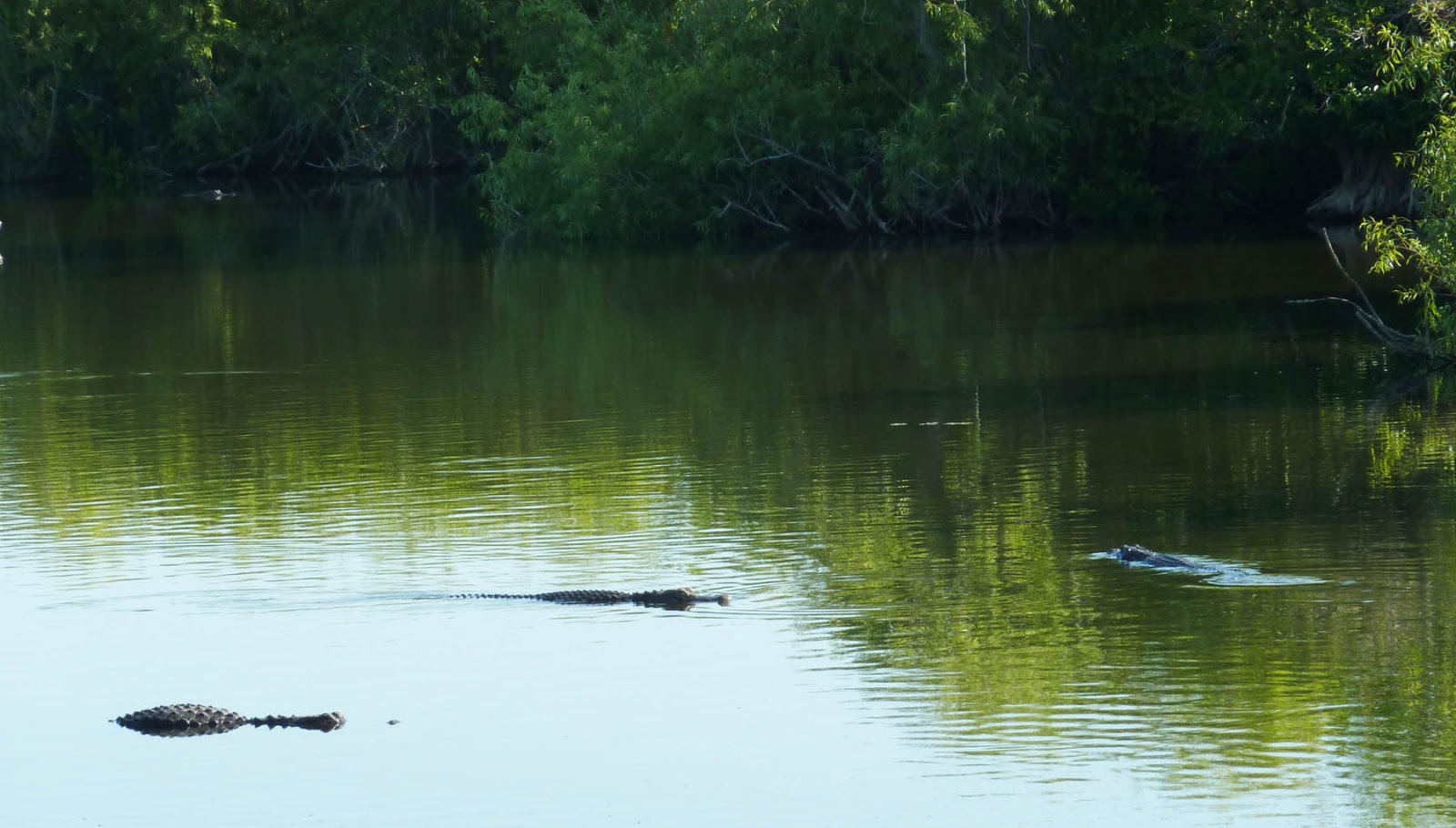
How many Gators can you count?
Anhinga taking a break on the
boardwalk
Air Plant Flower
We saw some usual suspects, including Little Blue Heron, Great Blue Heron, Palm Warbler, Common Yellowthroat, and Red Shouldered Hawks. And surprisingly, we saw quite a number of Purple Gallinule out and about. They are usually pretty shy, but we saw a few foraging along the waterline.
Little Blue
Heron waiting for a fish
Palm Warbler
Purple Gallinule
Purple Gallinule
Purple Gallinule
The next day, we decided that we would try to get up especially early to see if we could actually try to get a view one of the numerous Chuck-Will's-Widow that fly about. A man the day before advised that we could find them all along the wires on a side road. So we woke up as soon as we heard the first set of calls while it was still dark out and drove to this secluded road. We drove up and down looking for these birds, but we had no luck. We thought we might have seen some fly by, but no definite ID's. I couldn't hear as many as the day before, but we could definitely hear them closer. We parked and walked out into the road to search on foot for a little bit. But after realizing that we were in panther territory with nobody else awake and nearby to hear our possible screams for help, we went back in the car to search again. But alas, still no sightings.
Morning fog over the swamp
One Eyed Gator
We headed to Anhinga Trail again the next morning, and we got to see the morning fog hovering over the marsh in a ghostly manner as the sun was rising. And we had a nice little surprise by a pair of Norther Waterthrush calling to each other and foraging for food while bobbing their little tails. We also had some nice views of a pair of Red-Shouldered Hawks, what appeared to be one adult and one juvenile.
Yesterday morning, Maureen and I returned to Wellington Environmental Preserve for our second visit to this spacious (365 acre), brand-new public wetland. Just a few weeks ago we made our way up to twitch us some Canvasbacks, which are uncommon visitors to Palm Beach County. We had been able to find the Canvasbacks, but the vastness of the park left us wondering what we were missing.
This time around there were noticeably fewer waterfowl - an ominous sign that we're getting on with Spring, and about to lose our Winter visitors. All that remained of this group were a lone female Northern Shoveler, a male Ring-necked Duck, several Blue-winged Teals, and Florida's very own Mottled Ducks, which won't be going anywhere.
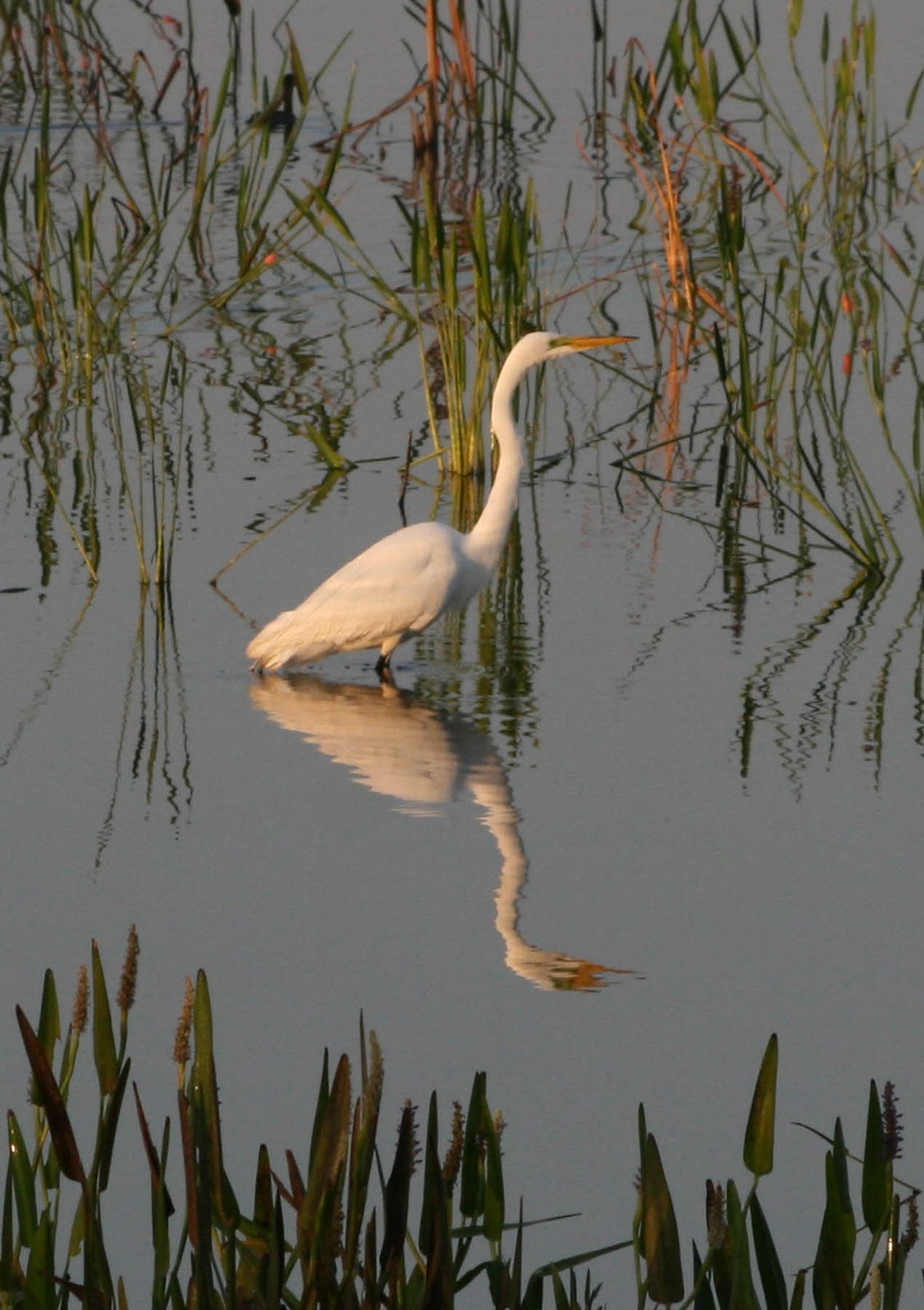
Great Egret
Right out of the car Maureen (who has more of an ear for birdsong than I do) heard an Eastern Meadowlark. Our only other Meadowlarks were during a day-trip to Galveston late last year, making this a state bird for us. It took some effort to locate where the bird was perched because of the distance their song carries. We finally picked it up as a speck across the street and in someone's private property, effectively keeping us from obtaining a better view. Once we started for the trail, though, we heard several others, which sounded like they were always just ahead of us. We were only able to locate one other, but he was pretty lively. Initially, we found him in a tree, before he flew down to the ground, walked across the path and into a clump of tall grasses (and singing the whole time).
Eastern Meadowlark
Eastern Meadowlark
Eastern Meadowlark
One thing about Wellington Environmental Preserve is that they are Limpkins EVERYWHERE! Above all others, this is the bird that you know you're going to find when you come here. Apple snail shells litter the shores, and sometimes you even find yourself crunching a discarded shell underfoot on the boardwalk. There are so many Limpkins, in fact, that even the Limpkins want to see what else is around (see below).
Limpkin
Limpkin
Among the highlights of the day was when we picked a single American Avocet out of a small flock of Black-necked Stilts. It's always a pleasure to pick up a new county bird, as this was for us. Still, it's a shame that we didn't get to see it stick around, since Avocets are among my favorite shorebirds, and we only see them rarely, and usually from a great distance.
The Palm Warblers are all looking fancy in their breeding plumage, which in Florida, means that they're getting ready to leave us any day now. All throughout winter, these common birds are the classic LBJs, and now look at them! It's like watching a caterpillar become a butterfly. I wish them well on their journey back north.
Palm Warbler
When we arrived at the 6-story observation tower, we felt obligated to trudge our way up, since we had been short on time during our only other visit. It turned out to be well worth the effort. From that vantage, we were able to watch a juvenile Northern Harrier terrorize dozens of Common Moorhens and American Coots. Just a couple of minutes later, a juvenile Snail Kite flew in low from the direction that we'd just seen the Harrier disappear.
Northern Harrier
From above, a juvenile Harrier and a juvenile Snail Kite can look remarkably similar - both are brown overall, with a broad patch of white toward the base of the tail. Luckily, we were on our toes and weren't taking anything for granted, for which we were rewarded by watching the kite snatch an apple snail out of the water. Easy prey, perhaps, but still, it's pretty awesome to watch a Snail Kite do as Snail Kites do.
Snail Kite
Snail Kite with an apple snail
Florida very fortunate to have it's very own population of Sandhills with us year-round, albeit not in anything near the numbers seen in the Platte River valley. Early on, we had a group of five fly over while making their bugling calls. This one was just taking a stroll.
Sunday morning, Maureen and I set off on another of our monthly bird surveys for Daggerwing Nature Center to see what's been hanging around and try to uncover some surprises.
For long stretches, it seemed like everything that moved was either a Palm Warbler or a Blue-gray Gnatcatcher. Eventually, more and more Pine Warblers started showing up, and got friendly with the camera. Appropriately, the Yellow-rumped (Myrtle) Warblers were the most active within the rows of wax myrtles.
A House Wren peeked out at us from behind a stump, and then darted off into the crevice of a fallen tree. We staked it out for several minutes and were rewarded with much better looks than we've managed in the past. It would call out, duck behind a branch, and then pop back up and start calling again. Although we only saw one, we heard the calls of others from not far off.
Overhead, massive flocks of American Robins passed over the park, heading north. Only one relatively small contingent of 50 or so made a brief sojourn in one of the trees back toward the perimeter before continuing on their way through.
We counted more Eastern Phoebes than I can remember seeing on one outing. One particularly audacious individual swooped down from its perch to snatch an insect off the grass a mere 3 ft. from where I stood.
It started off as a slow day for raptors. The Ospreys are a given - we almost always see several right away - and we had an early Red-shouldered Hawk, but surveying the snags in areas that have been reliable for Red-tailed Hawks and American Kestrels, we came up empty. After backtracking, we headed down the other arm of the boardwalk and found a solemn-looking Merlin (is there any other kind?). Then, after climbing the observation tower, a Buteo passed us by. I apologize, dear readers, that all I can say with confidence is that it was either a Broad-winged or a light-morph Short-tailed Hawk. I was able to make out light underparts with a dark border around the wings, but it soon moved on. Maureen noticed it hold its wings at a slight downward angle, so Broad-winged seems likely.
On the way back toward the nature center, Maureen was able to spot an American Bittern, doing it's best impression of pickerel weed. This was the most open we've ever seen one, and we watched it for at least 20 minutes before it flew to where it was no longer visible. While it generally moved through the reeds cautiously, and remained as still as it could manage, it charged at a Tricolored Heron that wandered too close to its favorite hiding place, and sent the heron flying before it even knew what happened.