So yes, I, Maureen, am still here! Lady Hipster Birder had to go on a posting hiatus while finalizing wedding plans and decor. But now that we've tied the knot, I'm ready to get back to the blog.
 |
| A couple that plays together... |
 |
| … stays together. =P |
So, as I mentioned in my previous post from our birding adventures in NYC, we were fortunate to spend a lovely morning at the famous Jamaica Bay. While planning our trip, I had noticed on the website for the Jamaica Bay Wildlife Refuge that they were going to have quite an exciting event on the very day we planned to be there - a trip just down the road to Broad Channel American Park to see the emerging of mating horseshoe crabs and the numerous shorebirds expected to appear to feast upon their juicy, tasty eggs.
 |
| A look at the underside of this ancient creature. |
 |
| An intimate moment… |
 |
| Horseshoe Crab Action |
Although I had visions of hundreds of Red Knots congregating for this feast as they are known for especially having an affinity for horseshoe crab eggs, there were actually none present on this day. But we did have hundreds of Semipalmated Sandpipers and a handful of other shorebirds, such as Willets and Ruddy Turnstones.
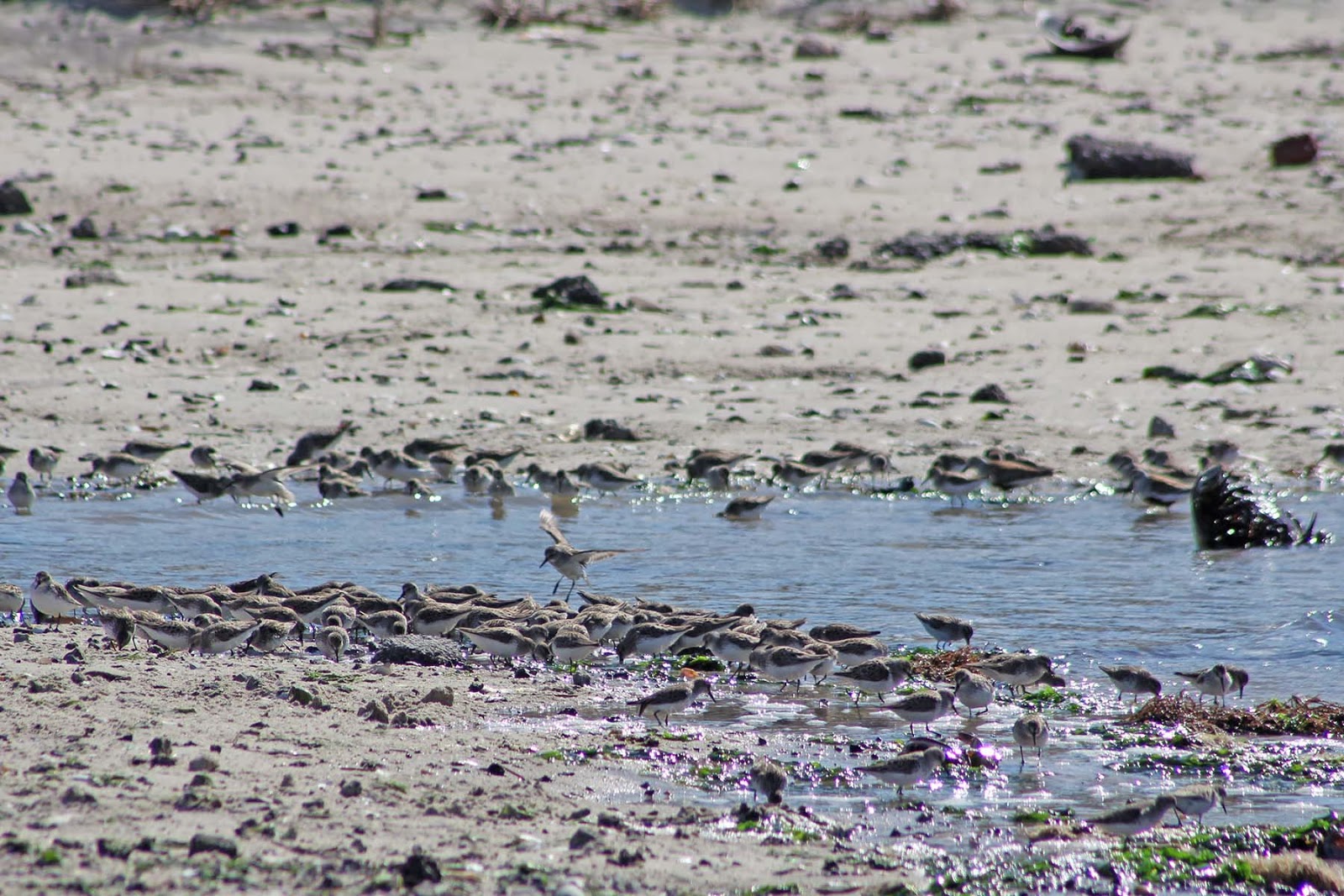 |
| Semipalmated Sandpipers |
 |
| Semipalmated Sandpipers |
The shear number of sandpipers was pretty exciting, but what made this part of the morning especially exciting was seeing our LIFER Brants - and not just one or two, but about 150 of them! There were great rafts of them floating along the shore, and they created such a splendid sight as they were gently carried on the waves as the Semipalmated Sandpipers swooshed above them in great numbers.
After playing with horseshoe crabs and basking in our glee from our lifer Brants, we went back to the Jamaica Bay Wildlife Refuge and hit the trails to see what else we could find. We didn't have any lifers there, but there were some great sightings nonetheless. A darling Canada Goose family greeted us as we started on the trail. As we walked parallel to the shore, we saw yet another avian family - this time a pair of Osprey doting over a couple of young chicks in their platform nest.
One pleasant surprise wasn't a lifer, but it was a fantastic and long look at a close-by perched Tree Swallow, a bird usually seen on the wing. And if we have seen them perched, they're always too far away to get good looks like this one, showing off his brilliant, electric blue sheen.
Another "striking" encounter was something we'd never seen before - a Brown Thrasher attacking a snake! It happened all so quickly, and we cheered in excitement as we witnessed this most unheralded display.
The rest of our day was much more serene as the day warmed up and the bright passerines continued to dot the verdant spring trees. Yellow Warblers seemed to pop up everywhere we turned, and a few other warblers, such as Magnolia Warbler and American Redstart, also greeted us. We had an overall fantastic time at Jamaica Bay, and we can't wait to go back some day!
 |
| Brants |
 |
| Brants Flying |
 |
| Brants in the Concrete Jungle |
 |
| More Brants a-floating |
 |
| Brants and Semipalmated Sandpipers en masse |
After playing with horseshoe crabs and basking in our glee from our lifer Brants, we went back to the Jamaica Bay Wildlife Refuge and hit the trails to see what else we could find. We didn't have any lifers there, but there were some great sightings nonetheless. A darling Canada Goose family greeted us as we started on the trail. As we walked parallel to the shore, we saw yet another avian family - this time a pair of Osprey doting over a couple of young chicks in their platform nest.
 |
| Canada Goose |
 |
| Canada Goose Family with a Human Family reflecting in the background |
 |
| Osprey Family |
 |
| Ospreys feeding their chicks |
One pleasant surprise wasn't a lifer, but it was a fantastic and long look at a close-by perched Tree Swallow, a bird usually seen on the wing. And if we have seen them perched, they're always too far away to get good looks like this one, showing off his brilliant, electric blue sheen.
 |
| Tree Swallow |
 |
| Tree Swallow |
 |
| Tree Swallow |
Another "striking" encounter was something we'd never seen before - a Brown Thrasher attacking a snake! It happened all so quickly, and we cheered in excitement as we witnessed this most unheralded display.
 |
| Step One: Approach Snake from behind |
 |
| Step Two: Attack that snake with all of your fury! |
 |
| Step Three: Make sure you show that snake who is boss! |
The rest of our day was much more serene as the day warmed up and the bright passerines continued to dot the verdant spring trees. Yellow Warblers seemed to pop up everywhere we turned, and a few other warblers, such as Magnolia Warbler and American Redstart, also greeted us. We had an overall fantastic time at Jamaica Bay, and we can't wait to go back some day!
 |
| Lazy Caterpillar |
 |
| Eastern Towhee with a morsel |
 |
| Another look at the Eastern Towhee with grub |
 |
| Yellow Warbler |
 |
| Magnolia Warbler |