Showing posts with label Purple Gallinule. Show all posts

Saturday, May 19, 2012

A Smattering of Southeastern Specialties

A few weeks ago, in late April, we and a dozen or so other birders from the local Audubon headed to Webb Wildlife Management Area in Hampton County, SC. With a good mix of habitats, the trip promised some fantastic birding, including specialties of long leaf pine forests, like Bachman's Sparrows and Red-cockaded Woodpeckers.

I was particularly excited for the Bachman's Sparrows. Although they're year-round residents of coastal Georgia and South Carolina, you'd never know it. Notoriously difficult to find outside of breeding season, these secretive birds normally stay silent and hidden in understory. But our group was fortunate in having visited at just the right time of year, and everybody was afforded excellent, open looks of the males singing their clear and melodious song. 

Bachman's Sparrow
 
Bachman's Sparrow

Bachman's Sparrow with a tasty (for him) morsel

Singing Bachman's Sparrow

Red-cockaded Woodpecker, another target species for the day, took a little more patience to locate, but we were handsomely rewarded in finding a mated pair make repeated trips to their nesting cavity. The cavity was just beside the road, and we could hear the nestlings' begging call each time a parent left to forage more grubs. The experience was more than we could have hoped for, and it was encouraging to see evidence of this species recovering with the help of wildlife management. 

Red-cockaded Woodpecker

Red-cockaded Woodpecker on the way into the nesting cavity

Both members of a successfully mated Red-cockaded Woodpecker pair

We also stopped in on a small rookery, where twenty or so Little Blue Herons were safeguarding the fruits of a successful breeding season. Occasionally, one would briefly move off of their nest, letting us see their aqua blue eggs or (snow-white) egg-sized chicks. The rookery was situated within a small pond, where we were also treated to Green Herons, Purple Gallinules, Blue-winged Teal and others. 

Little Blue Heron rookery. You can just make out the blue eggs in the nest

Great Blue Heron with an good-sized eel
Purple Gallinule

Purple Gallinule

At one especially noteworthy spot, a covey of Bobwhites flushed as we exited our cars. Although right out in the open, they were perfectly invisible until they were already in the air, and heading toward a strip of dense understory, never to be seen again. We also managed a pair Yellow-breasted Chats, which at one point shared a tree with a Bachman's Sparrow! Seeing these skulkers out in the open together nearly sent me into a swoon, but I pulled through as best I could. 

Yellow-breasted Chat - I've been wanting to see one of these for a long while

Other notable birds for the day included Prothonotary Warblers, Blue Grosbeaks, Orchard Orioles, and Indigo and Painted Buntings. While we tallied an impressive number of species, there were noticeably few passing migrants. Taken together with a possible (heard) Blackpoll Warbler, it seemed as though we were seeing the tail-end of migration. But with residents like these, who needs migrants! 

The ol' "Swamp Canary" - Prothonotary Warbler

Prothonotary Warbler

Prothonotary Warbler

Indigo Bunting

Afterwards, some of us stopped in at Millstone Landing (in Jasper County) to check for raptors. We didn't have to wait long before a swarm of kites appeared in the distance, including 2 Swallow-tailed, and over 30(!) Mississippi. They gradually moved farther North along the Savannah River, giving us a better and better view as they flew closer, while hawking insects in mid-air. 

Carolina Chickadee with lunch

Finally, we ended our (very) long day with a quick trip through the driving trail at the Savannah National Wildlife Refuge. Our aim was locating migrating Bobolinks, which we found immediately on entering the refuge, congregating in the rice fields. We heard them on their way south last autumn, when we were living in Florida. Their distinctive "plink!" called out from plots of tall grasses, but we never managed to lay eyes on them. Now, they were out in abundance, and we were able to watch the (mostly male) blackbirds to our hearts' content. It was a terrific way to end a truly awesome field trip and an unforgettable (and exhausting) day of birding.

Bobolink

Bobolink

Bobolinks

Sunday, April 17, 2011

Excursion to the Everglades

Nick and I are knew that we couldn't make the most of our time here in South Florida without taking a good trip to the Everglades. We'd done a day trip to Shark Valley before, but we decided the best way to really experience it would be to camp there so that we could immerse ourselves in the awesomeness that is the Everglades. So we drove on a Friday evening down into Everglades National Park to Long Pine Key campground. When we get there, the first thing we noticed was how secluded this area really is. There are just tons of tall slash pines - their silhouettes lining the dark sky. And we lucked out with perfectly clear skies so you could see all the stars.


Long Pine Key


Right away, we realized we were in a new world. As soon as I walk into the ladies restroom, I notice a tiny scorpion on the floor! It was only about an inch and a half long. We had no idea we even had scorpions in South Florida! And we continue to see some awesome stick bugs along the outside bathroom walls. We knew right away how awesome this trip was going to be.


Baby Hentz's Striped Scorpion


Palmetto Walkingstick


We quickly set up camp and hit the hay. We were awakened around 6am to unfamiliar but intriguing sounds. I knew that these were not only bird sounds, but NEW bird sounds. Nick had remembered these sounds as Chuck-Will's-Widows from our Bird Songs CD, and sure enough, they were! These were life birds for us! It started with just a few distant calls, and then we seemed to be surrounded by them. We laid there in our tent with only the mesh top between us and the sky, and we felt completely immersed in the forest as the calls got louder and more frequent. It was one of those really incredible bird moments that we'll never forget. But never did we actually see one of these new life birds. And quickly, the other birds of the forest joined in the morning chorus - including Cardinals, Eastern Towhees, and Gray Catbirds.

Sunrise in the Everglades


Eastern Towhee


Gray Catbird


We then hit up the famous Anhinga Trail. As we turn on the road leading to the trail, we see a sign about the possibility of panthers - an incredible yet daunting warning. Unfortunately, we did not get to see these big cats, but I am sure that they were lurking about in the tall straw-colored grasses for which they are perfectly camouflaged. At the entrance to the trail, there are warnings about vultures ruining cars. The black vultures were abundant, and in fact, we did see one in the parking lot trying to tear up a top of a convertible Ford mustang.


Black Vulture


Black Vultures cooling off (This scene really made me laugh
for some reason...)


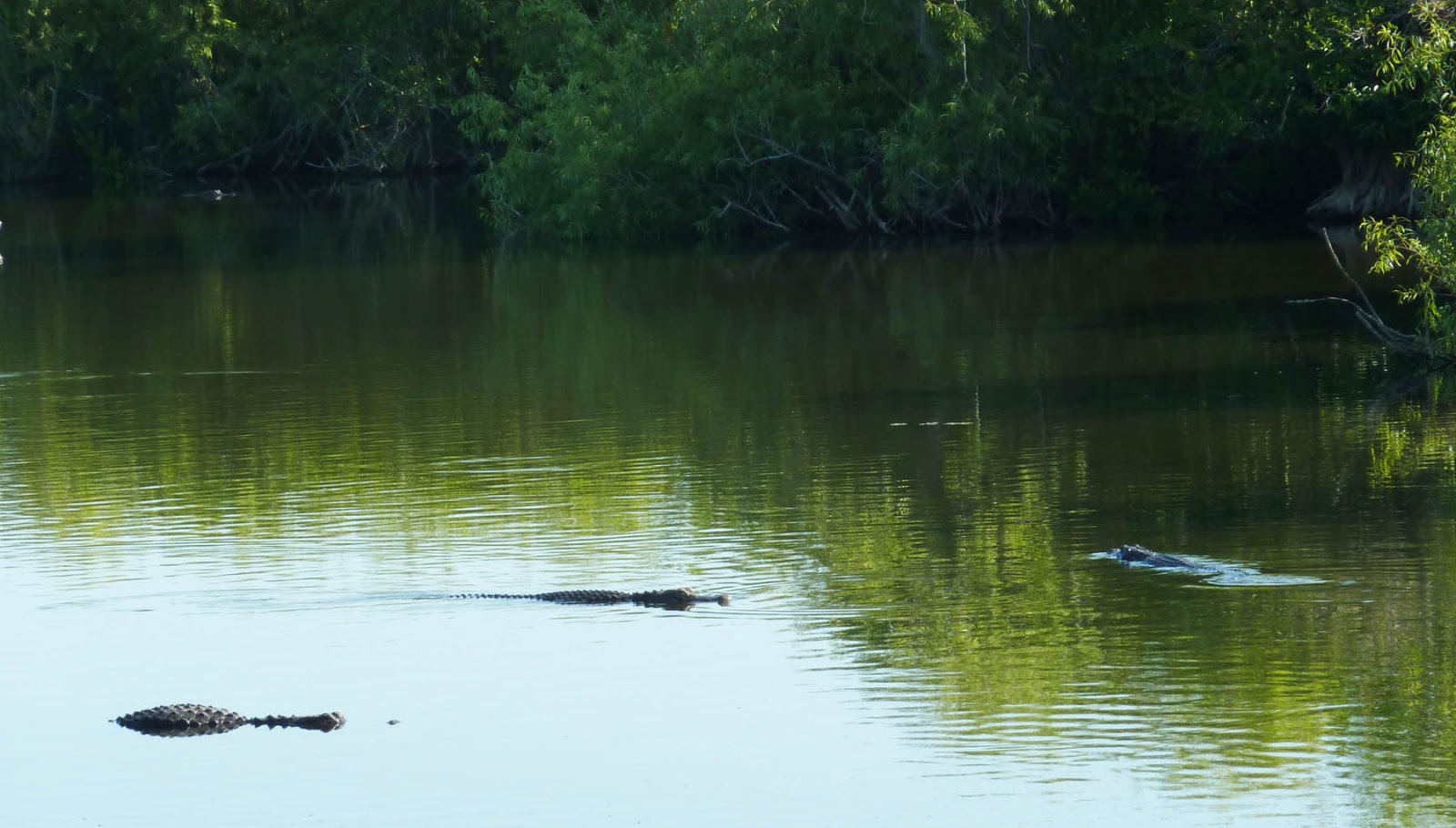
And of course we did see plenty of Anhingas, and even a mother feeding its chicks. You can see a video in our previous post. And the alligators were also plentiful, including the one hanging around under the feeding chicks, just waiting for one to fall down and be a quick snack.


Smiley Alligator

Female Anhinga feeding her chicks


Alligator waiting for an Anhinga Snack


How many Gators can you count?

Anhinga taking a break on the
boardwalk


Air Plant Flower


We saw some usual suspects, including Little Blue Heron, Great Blue Heron, Palm Warbler, Common Yellowthroat, and Red Shouldered Hawks. And surprisingly, we saw quite a number of Purple Gallinule out and about. They are usually pretty shy, but we saw a few foraging along the waterline.


Little Blue
Heron waiting for a fish


Palm Warbler

Purple Gallinule


Purple Gallinule


Purple Gallinule


The next day, we decided that we would try to get up especially early to see if we could actually try to get a view one of the numerous Chuck-Will's-Widow that fly about. A man the day before advised that we could find them all along the wires on a side road. So we woke up as soon as we heard the first set of calls while it was still dark out and drove to this secluded road. We drove up and down looking for these birds, but we had no luck. We thought we might have seen some fly by, but no definite ID's. I couldn't hear as many as the day before, but we could definitely hear them closer. We parked and walked out into the road to search on foot for a little bit. But after realizing that we were in panther territory with nobody else awake and nearby to hear our possible screams for help, we went back in the car to search again. But alas, still no sightings.


Morning fog over the swamp


One Eyed Gator

We headed to Anhinga Trail again the next morning, and we got to see the morning fog hovering over the marsh in a ghostly manner as the sun was rising. And we had a nice little surprise by a pair of Norther Waterthrush calling to each other and foraging for food while bobbing their little tails. We also had some nice views of a pair of Red-Shouldered Hawks, what appeared to be one adult and one juvenile.


Great Blue Heron


Northern Waterthrush

Adult and Juvenile Red-Shouldered Hawks

Juvenile Red-Shouldered Hawk

Me with my camera in hand

Nick getting a head start on the trail