Showing posts with label Pelagic Cormorant. Show all posts

Sunday, February 26, 2017

Sunny, Winter’s Day on the Coast

It’s our third winter here in Oregon. The first one was very mild and was a good easing in to living in a place with actual seasons (at least for me, anyway). The second year was a bit more typical for Oregon. But this year has been especially wet and cold. There’s been heavier rain showers rather than just gray mist, and lots more snow and ice. So, when there are sunny days with no rain in sight, we have to take advantage of them and head outside!

What a gorgeous day at Hatfield Marine Science Center Trail

A couple of weeks ago, one of these precious sunny days meant going to the coast. The birds seemed to enjoy this lovely sunshine just as much as we did. There were lots of leaps for joy! Ok, so more like leaps for food, but still fun, nonetheless. It so happened that I got good shots of some of these hopping water birds. Can you guess what they are? Test your bird ID skills with this fun little quiz. Answers will be revealed at the end of the post. (Those of you who already know the answers from following me on facebook or instagram, let others guess!) No peeking!

Bird ID Quiz Pic #1

Bird ID Quiz Pic #2

Bird ID Quiz Pic #3

It was quite a ducky day, overall. We saw both Greater and Lesser Scaup, Common Goldeneyes, tons of Surf Scoters, White-winged Scoter, Bufflehead, Hooded and Red-breasted Mergansers, and Harlequin Ducks.


Female Common Goldeneye

Female Common Goldeneye

Pair of Surf Scoters

We had especially good looks at some Surf Scoters as a few individuals kept floating close by and sometimes underneath us, popping out on either side of the fishing pier where we stood. Most other people on this pier were crabbing and looked oddly at this pair of birders loaded with optics and no crab traps. But it wasn’t just crabs they were catching. One guy pulled up a couple of Sculpin, which he tossed right back into the water, but not before I got a shot of that oh-so-amazing face.

Male Surf Scoter

Female Surf Scoter

What an amazing face on this duck! That bill is wild!

But this face is even wilder! And it looks like his side fins are fingers. 

While walking the trail at the Hatfield Marine Science Center, we had a super close encounter with a gorgeous male Northern Harrier. It was so odd to see him on this estuary trail, and he gave us quite a great show! It was almost overshadowed by our frustration of getting a good flight shot of him, but Nick prevailed and got one awesomely clear shot.

Looks like he's hunting something in the tall grasses


Boom! There it is!

It was also a pretty good grebe and loon day, too. Just ask this adorable Common Loon! We saw a few Red-throated loons, too, but they stayed farther away.


The South Jetty in Newport was especially productive that day. We had super close looks at a Brant. We saw plenty of them at Hatfield, but this one was kind enough to hang out close and in good light. These are definitely one of my favorite geese. They are so elegant and chic.


We also had not just one, but two Long-tailed ducks turn up! We had a male and a female. The male did some funny butt-scooting in the water, almost as if he were trying to sit on his rump. It was weird, and it made for some funny poses.

Female Long-tailed Duck


Male Long-tailed Duck


Duck booty-scootin' boogie!

The South Jetty is a good spot to watch gulls. They gather at the parking area and sit nice and still while you work on your gull ID skills. One other birder there pointed out what looked like what could have been a Glaucus Gull. His wife and he deliberated, and we examined it, as well. It was so evenly light-colored all over, and it did have a dark tip on the bill. But alas, the not clean bill (black bleeding into the inner bill) indicated that it was a very glaucussy-looking Glaucus x Glaucus-winged Gull Hybrid. Bah!

NOT a pure Glaucus Gull, unfortunately for us

So, now that you’ve had some time to look at the bird ID quiz photos, here come the answers. Number one is a female Greater Scaup! I think this one was especially tricky. It’s hard enough to ID a lone female brown duck in the first place, let alone with her head dunked under water.

Female Greater Scaup


If you guessed a grebe for number two, then you were on the right track. And if you guessed Red-necked Grebe, you were 100% right! This was also a tricky one since it is a mottled, grayish grebe, and the bodies of Eared, Horned, Western, and Red-necked Grebes (all of which we saw) can all look quite similar in the winter.


And lastly, this long-bodied bird with a greenish sheen and white flank patch indicates the ever lovely Pelagic Cormorant! The sun was hitting this guy just right, making his iridescent feathers gleam so nicely. And even the colors of his orange bill and red gape really popped. 

Thanks for playing along! I hope you had fun with the quiz and seeing the sights of our sunny coastal day.


Sunday, September 18, 2016

A Mini-Pelagic out of Mini-Depoe Bay

Head-fake! Just when you think we're gonna start posting dispatches from our France trip, we hit you with a mini-pelagic instead. Thanks to Stephanie Hazen, who organized the outing, we were able to join a group of fellow Salem Auduboners heading out of Depoe Bay on zodiacs to get up close and personal with seabirds and Gray Whales.

Collectively, we were led by marine biologist Carrie Newell, owner of the Whale, Sea Life and Shark Museum, who studies Gray Whales and who's made important discoveries about their local feeding habits. Her dog joins her on the boat and barks whenever he smells a whale nearby. It's awesome. Our zodiac was captained by Captain Joe, who led us farther out to sea than the other boats, which allowed us to pick up some really excellent birds that the others didn't get to see.

These are our marina buddies. We spotted this Harbor Seal on our way out of the harbor.

And this Pelagic Cormorant came right up to the boat as we were docking on our way back in. It was easily just an arm's length away outside the zodiac.


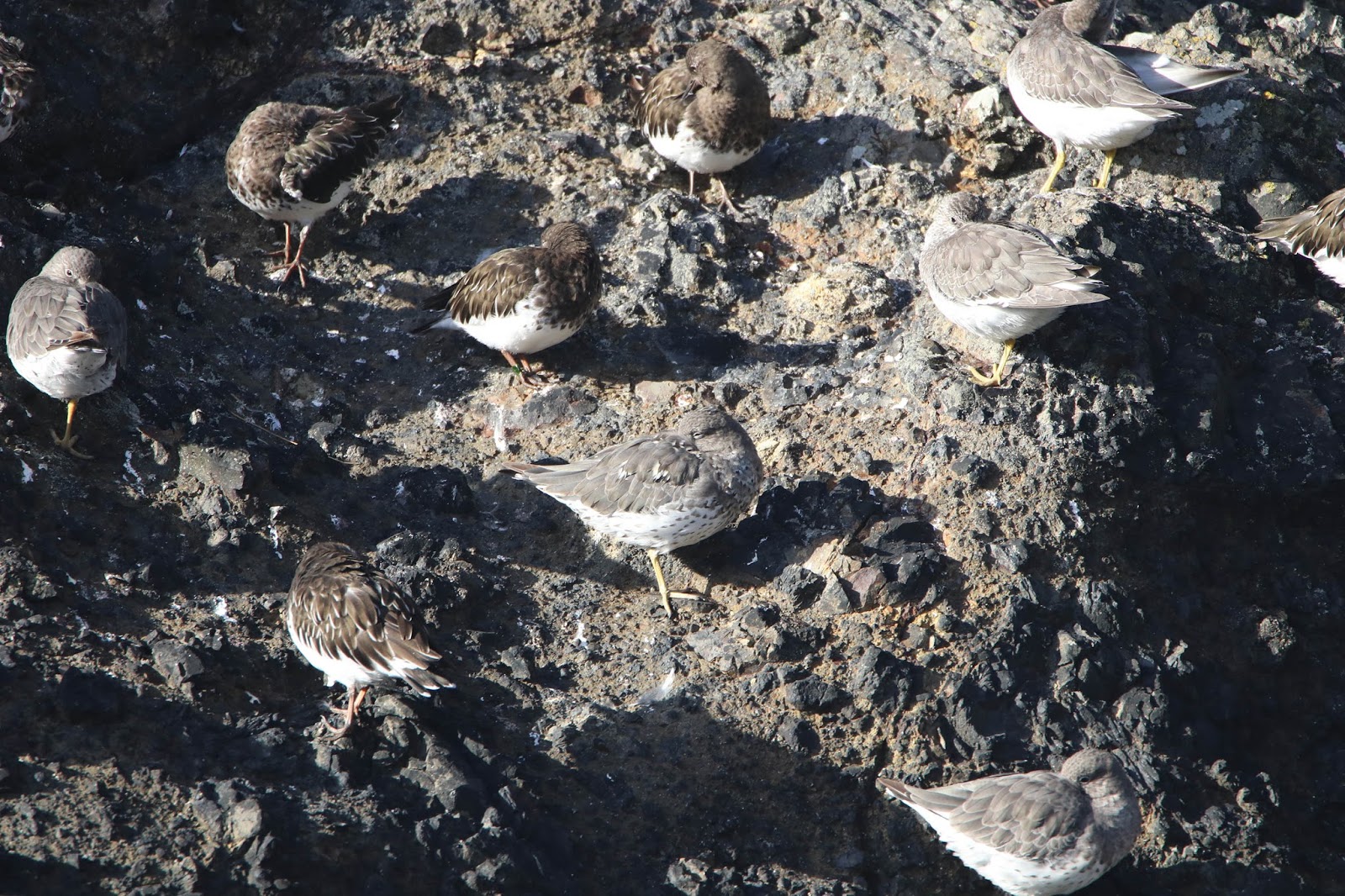
The bay is the world's smallest navigable harbor (or so the claim goes). You would know it as the scene of the fishing trip in One Flew Over the Cuckoo's Nest. On the way out of (and back into) the harbor we passed dozens of Surfbirds and Black Turnstones, mostly looking drowsy.

Surfbirds and Black Turnstones


It wasn't long after we hit the open sea that the whales started popping up. One of the other zodiacs radioed in so we could zero in on the location, and in the process of getting the boat oriented we came alongside a Lion's Mane Jellyfish, which is among the largest jellyfish species, if not the largest altogether. As someone who's read the entire Sherlock Holmes canon more than once, I'm starstruck having now met the antagonist of "The Adventure of the Lion's Mane". (Sorry about the spoiler).

Lion's Mane Jellyfish


When we managed to get on a whale, the experience was a lot more intense than past sightings. For one thing, the zodiac brings you a lot closer to the level of the water than when you see them from a fishing boat. The boats are prohibited from approaching within less than 100 or 150 yards, but with an animal this large we certainly didn't feel like we were out in the nosebleed section.

Gray Whale


It was perfectly thrilling being as close as we were, and getting to see the entire tail fluke rise out of the water was the absolute best. Even the spray from the blowhole put on a show for us, turning into a rainbow for one spectacular moment.


Steller's Sea Lions were the only other mammals out there, hanging out on a buoy. Steller's Sea Lions tend to hang out farther from shore, so pelagic trips are the only time we really get to see them.

Steller's Sea Lions


Clusters of half a dozen or so Common Murres consisted of dads and their young, the fathers spending this time feeding the chicks out on the water, instead of back at the nest. Very occasionally, we chanced upon Marbled Murrelets, adorably tiny, and whose constant diving made it difficult to watch for any length of time.

Common Murre


Marbled Murrelet


The auklets were the particular specialty the zodiac we rode on. At first we started getting looks at Rhinoceros Auklets. A bit later, a Cassin's Auklet took off before we got a proper look. We weren't content to count it, as a would-be lifer, but fortunately, we were able to find another not long after.

Rhinoceros Auklet

So long, Cassin's Auklet

Our most numerous seabirds were the Sooty Shearwaters. From several places along the coast you can watch them migrate in tremendous numbers, but this was our first time getting out among them. I'd conservatively estimate we saw at least 50. You can see seven just in the photo below. Several of them came close to the boat, but none settled on the water.

Sooty Shearwaters


When we arrived at the museum before the trip out, we heard a Wrentit calling from some low trees up against the bridge. It came right out in the sun, and was way more cooperative than any Wrentits we've seen. Unfortunately, our cameras weren't ready, and we thought we'd blown our chance. Fortunately, it just happens to be a really friendly Wrentit, and there it was still singing to welcome us back to shore.

A sinister-looking Wrentit


From the harbor we traveled down to Hatfield Marine Science Center, but it was uncharacteristically slow. Aside from hundreds of Mew Gulls, about the only thing it had going for it were the Least and Western Sandpipers along the shore.

Least Sandpipers

Western Sandpipers


This happened to be the same day that Dave Irons discovered Oregon's fourth Yellow-throated Vireo, just a few miles up Hwy 101. The sighting was a few hours old by the time we got there, and we ran into a few folks who had been hanging around without any luck. We gave it a go, but apparently weren't patient enough -- it was seen later that day, and everyday since. C'est la vie (that's a teaser for the next post).