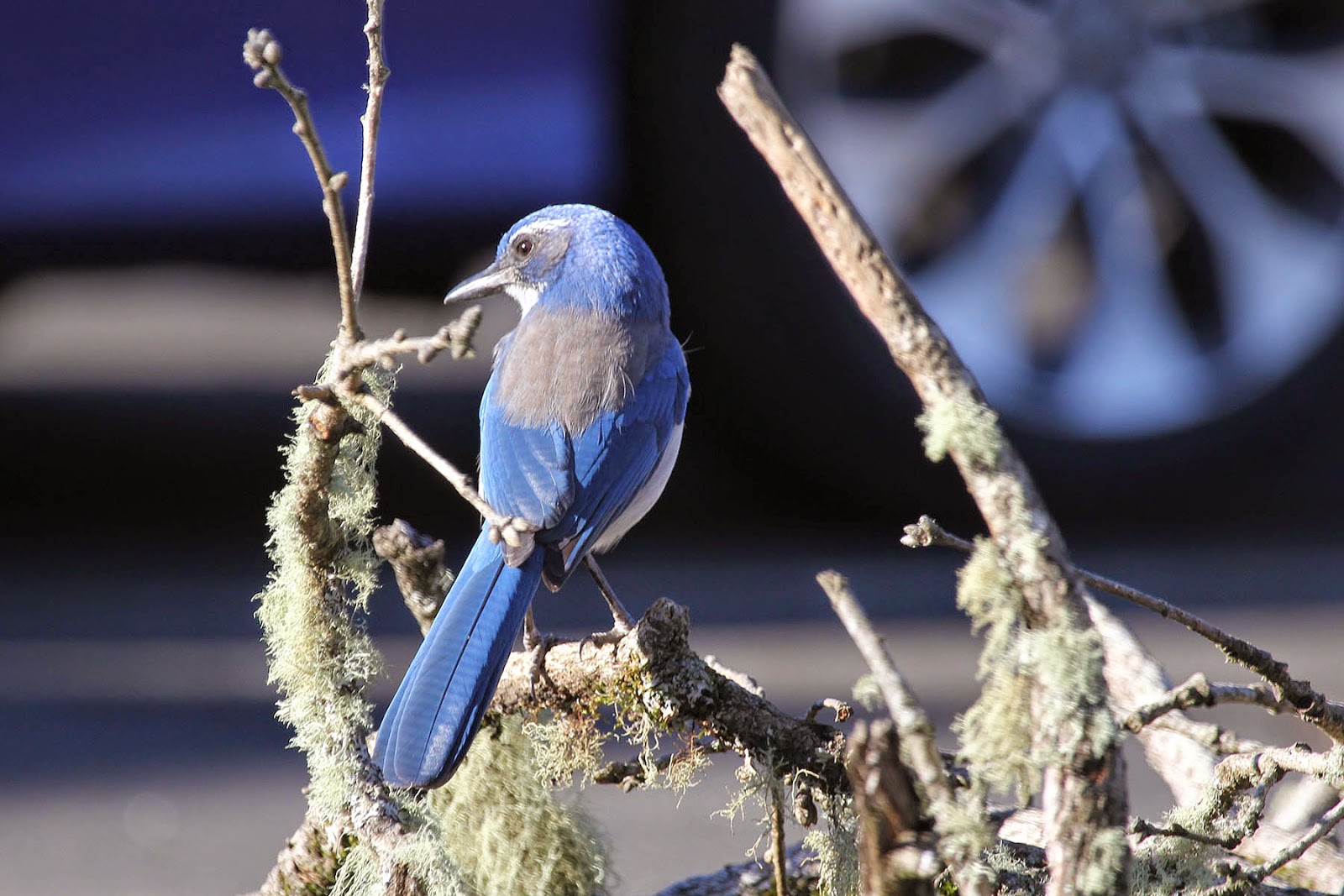
Head-fake! Just when you think we're gonna start posting dispatches from our France trip, we hit you with a mini-pelagic instead. Thanks to Stephanie Hazen, who organized the outing, we were able to join a group of fellow Salem Auduboners heading out of Depoe Bay on zodiacs to get up close and personal with seabirds and Gray Whales.
Collectively, we were led by marine biologist Carrie Newell, owner of the Whale, Sea Life and Shark Museum, who studies Gray Whales and who's made important discoveries about their local feeding habits. Her dog joins her on the boat and barks whenever he smells a whale nearby. It's awesome. Our zodiac was captained by Captain Joe, who led us farther out to sea than the other boats, which allowed us to pick up some really excellent birds that the others didn't get to see.
 |
| These are our marina buddies. We spotted this Harbor Seal on our way out of the harbor. |
 |
| And this Pelagic Cormorant came right up to the boat as we were docking on our way back in. It was easily just an arm's length away outside the zodiac. |
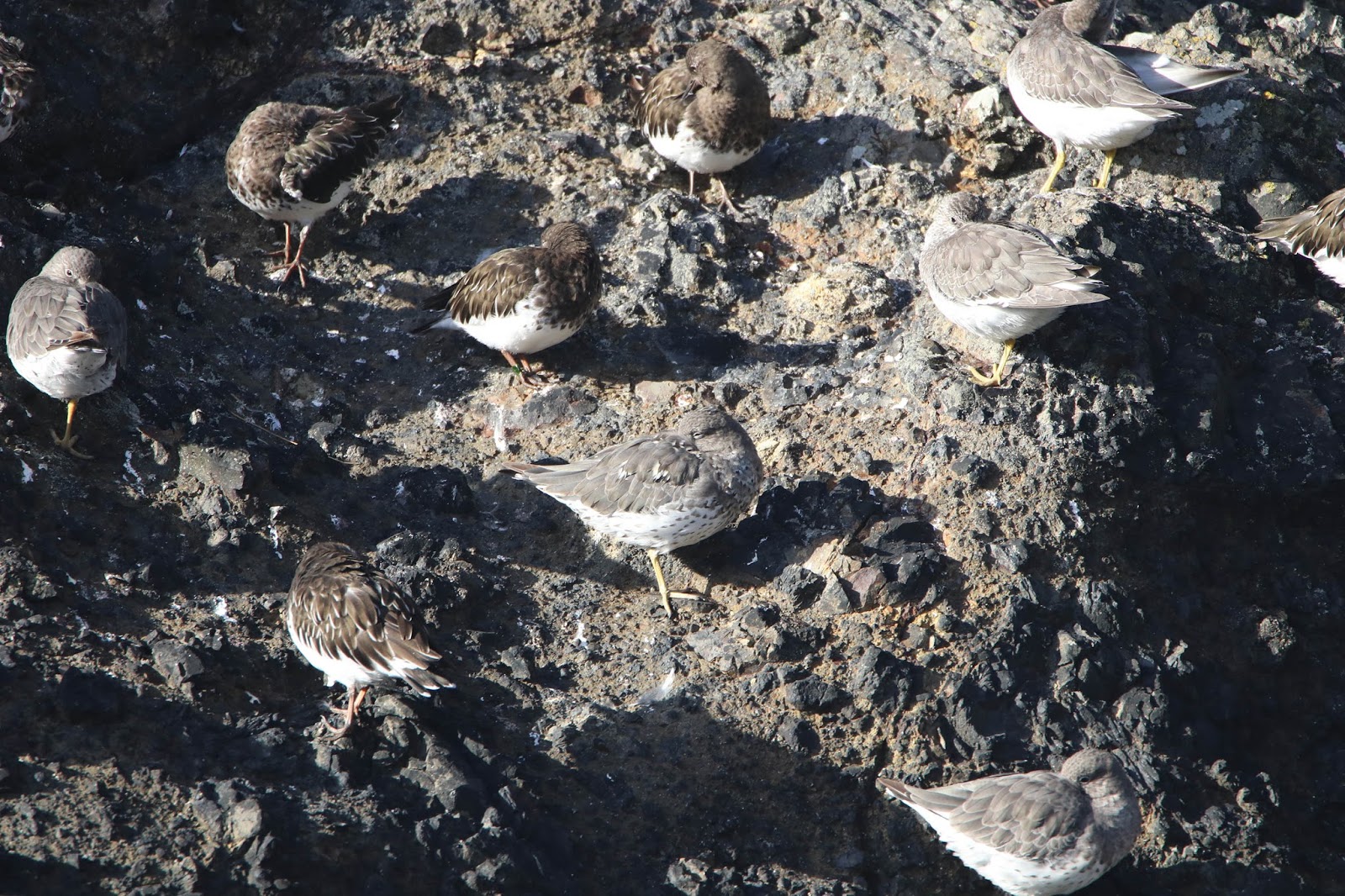
The bay is the world's smallest navigable harbor (or so the claim goes). You would know it as the scene of the fishing trip in One Flew Over the Cuckoo's Nest. On the way out of (and back into) the harbor we passed dozens of Surfbirds and Black Turnstones, mostly looking drowsy.
 |
| Surfbirds and Black Turnstones |
It wasn't long after we hit the open sea that the whales started popping up. One of the other zodiacs radioed in so we could zero in on the location, and in the process of getting the boat oriented we came alongside a Lion's Mane Jellyfish, which is among the largest jellyfish species, if not the largest altogether. As someone who's read the entire Sherlock Holmes canon more than once, I'm starstruck having now met the antagonist of "The Adventure of the Lion's Mane". (Sorry about the spoiler).
 |
| Lion's Mane Jellyfish |
When we managed to get on a whale, the experience was a lot more intense than past sightings. For one thing, the zodiac brings you a lot closer to the level of the water than when you see them from a fishing boat. The boats are prohibited from approaching within less than 100 or 150 yards, but with an animal this large we certainly didn't feel like we were out in the nosebleed section.
 |
| Gray Whale |
It was perfectly thrilling being as close as we were, and getting to see the entire tail fluke rise out of the water was the absolute best. Even the spray from the blowhole put on a show for us, turning into a rainbow for one spectacular moment.
Steller's Sea Lions were the only other mammals out there, hanging out on a buoy. Steller's Sea Lions tend to hang out farther from shore, so pelagic trips are the only time we really get to see them.
 |
| Steller's Sea Lions |
Clusters of half a dozen or so Common Murres consisted of dads and their young, the fathers spending this time feeding the chicks out on the water, instead of back at the nest. Very occasionally, we chanced upon Marbled Murrelets, adorably tiny, and whose constant diving made it difficult to watch for any length of time.
 |
| Common Murre |
 |
| Marbled Murrelet |
The auklets were the particular specialty the zodiac we rode on. At first we started getting looks at Rhinoceros Auklets. A bit later, a Cassin's Auklet took off before we got a proper look. We weren't content to count it, as a would-be lifer, but fortunately, we were able to find another not long after.
 |
| Rhinoceros Auklet |
 |
| So long, Cassin's Auklet |
Our most numerous seabirds were the Sooty Shearwaters. From several places along the coast you can watch them migrate in tremendous numbers, but this was our first time getting out among them. I'd conservatively estimate we saw at least 50. You can see seven just in the photo below. Several of them came close to the boat, but none settled on the water.
 |
| Sooty Shearwaters |
When we arrived at the museum before the trip out, we heard a Wrentit calling from some low trees up against the bridge. It came right out in the sun, and was way more cooperative than any Wrentits we've seen. Unfortunately, our cameras weren't ready, and we thought we'd blown our chance. Fortunately, it just happens to be a really friendly Wrentit, and there it was still singing to welcome us back to shore.
 |
| A sinister-looking Wrentit |
From the harbor we traveled down to Hatfield Marine Science Center, but it was uncharacteristically slow. Aside from hundreds of Mew Gulls, about the only thing it had going for it were the Least and Western Sandpipers along the shore.
 |
| Least Sandpipers |
 |
| Western Sandpipers |


 From the harbor we traveled down to Hatfield Marine Science Center, but it was uncharacteristically slow. Aside from hundreds of Mew Gulls, about the only thing it had going for it were the Least and Western Sandpipers along the shore.