We’re in Oregon now, and more or less settled after our big move. There’s A LOT to take in, with the Pacific Northwest being so different from Savannah and south Florida, both being primarily flat and marshy. We were hungry for a change of scenery, and now we’ve got plenty of that — within about an hour of our apartment we can see ocean, rainforest, mountains, wetlands, or desert, depending on which way we head. And with a variety of habitat comes a variety of birds — different birds than we’re used to. I’d be lying if I said that birds weren’t a primary motivation for coming out here, and we’ve enjoyed tallying new species after new species for the past month and a half.
Both of us have travelled fairly extensively, both in the U.S. and abroad, but much of that was done “BB” (before birding). We’ve even made multiple trips to the West Coast, and since kicked ourselves for the missed opportunities, when we could have spent at least part of the time looking out for birds. But the important thing is that we’re finally here and ready to bird, and we’re not likely to waste any more opportunities when we find them. Which is why we didn’t waste any time when we arrived in Salem, and headed to Minto-Brown Island Park as soon as we were able.
 |
| Brush Rabbits have got to be my favorite non-birds that we find at Minto-Brown |


Minto-Brown is a nearly 900-acre local park, largely populated by dogs and their owners, joggers, and bicyclists. So, there was a good deal of activity all around us, as we struggled to find our bearings (and some birds) in the heavy fog that had settled overnight. First off were a mixed group of Zonotrichia just around the parking lot: White-crowned and Golden-crowned Sparrows. White-crowned Sparrows are the much more widespread species, yet we’d only ever seen one individual before — a first-year bird that had lost its bearings and ended up wintering in south Florida. Now we were seeing adults, and plenty of them. We haven’t only heard them, either. In fact, aside from Song Sparrows, White-crowned Sparrows are probably the species we’ve heard singing most often this Spring, and it’s been a pleasure to get better acquainted with them.
 |
| White-crowned Sparrow |
The Golden-crowned Sparrows were a real treat, although our time with them was rather brief, coming, as we did, at the tail end of their northward migration. That first morning, though, they were showing in good numbers, and giving us great looks as they foraged dandelions out in the open. Since we arrived in late spring, we’d already missed a good number of wintering species entirely, and Golden-crowned Sparrows are one of the few birds that we’ve seen in Oregon that have departed altogether for the summer. By all accounts, the winters here are miserable, but at least we have the return of the Golden-crowns to look forward to.
 |
| Golden-crowned Sparrow |
 |
| Golden-crowned Sparrows LOVE dandelions! |
 |
| All gone. |
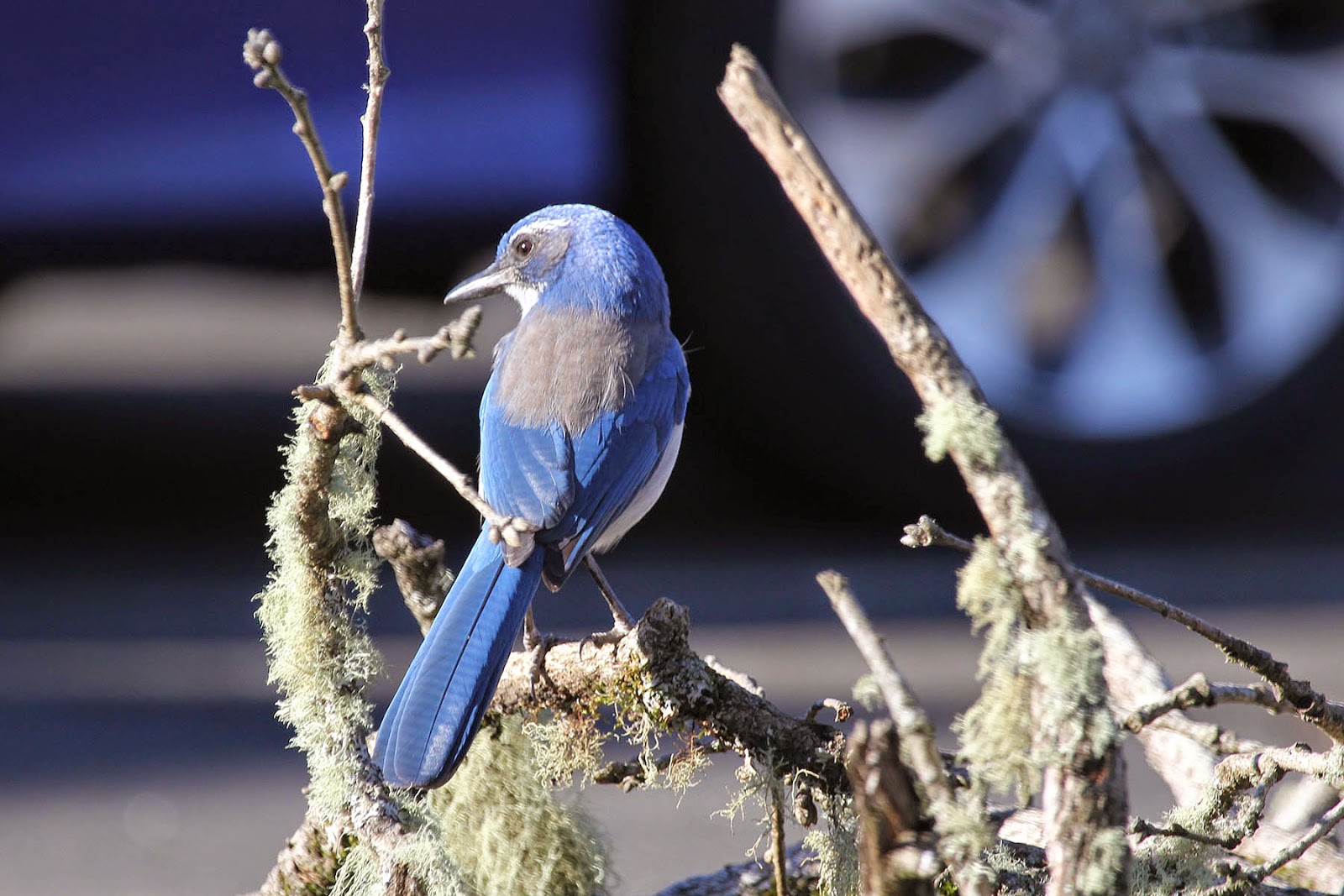
In the East, Blue Jays are one of the most ubiquitous and quintessential neighborhood birds, being well adapted to living around people, and as boisterous as they are. Before coming out here, I’d naturally assumed that their role would be filled by the closely related Stellar’s Jay, but instead have been amazed to find Western Scrub-jays filling that niche instead. As someone who started birding in Florida, Scrub-jays conjure a much different set of associations for me: local, communal, threatened, and having very specific habitat requirements. Western Scrub-jays may look similar, but they’re clearly more adaptable, and we see them nearly everywhere we go.


Western Scrub-jays were, in fact, one of the first birds we saw at Minto-Brown, but we’ve since seen Stellar’s Jays there in small numbers, including what looked like a nesting pair during our most recent visit. I’m in complete awe of these birds whenever we see them, with their improbably tall crest, and the blue racing stripe running up their foreheads. They’re like more mature Blue Jays, shunning Blue Jays’ childish rambunctiousness, and assuming a more solemn and dignified aspect.


Speaking of dignified birds, who’s more dignified than an owl? Who? Who? (get it?). There are so many great owl species out here, not least of which is the famous Spotted Owl. We were temporarily hopeful of having a Spotted some weeks back when we found a Strix owl on the ground, down in a sort of gully, but once we got a good look it turned out to be only a Barred Owl. At first it seemed to me that it was holding one of its wings funny, but we think it was just trying to figure out how to escape from its twiggy enclosure, as there didn’t seem to be a clear flight path out. Eventually, it started climbing up a tree trunk, and was able to free itself that way.
 |
| Barred Owl |
Spotted Owls face threats from a number of sources, not least of which is an invasion of Barred Owls, moving far west of their traditional range. I can well understand the threat posed by a Barred Owl, and empathize with their persecuted cousins. On a later trip to Minto-Brown, I heard some activity down in the same gully, and stepped up to the edge of the trees to see if I could pish something up. Nothing came, and I wandered a few yards away, when Maureen quietly called me back over, making O’s with her hands held up to her eyes (the universal sign for owl, of course!). It turned out that, not a dozen feet from Maureen, and directly above where I’d been pishing, that same (I assume) Barred Owl was perched not very high up and looking our way. After a few seconds, it flew out, over Maureen’s head and then in my direction, leaving me ducking for cover behind our spotting scope. I regret any disturbance we caused it, and will assume at all times from henceforth that their’s an owl just above me, waiting for an excuse to rip me to ribbons.