On our third full day of the Winter Wings Birding Festival, we headed out to the Lava Beds National Monument on our own, just as we did a year before. It was a beautiful morning drive, with snowy Mt. Shasta glowing in the distance. It wasn’t super foggy like it was the last time we were here a year ago, so we were able to pull over onto the narrow shoulder of Hwy 161 running along the Oregon-California border to check out the waterfowl hanging out in Lower Klamath Lake.
Mount Shasta as the sun rises
Lower Klamath Lake
Bald Eagle
The serene waters were dotted with black, white, and gray with pops of red from lovely Redheads. The clear blue skies were happily interrupted with flocks of Tundra Swans flying by the mountainous backdrops. It was just a really fantastic scene with a somewhat busy freeway cutting right between it.
We hit up Captain Jack’s Stronghold, a fun rocky hike with lots of nooks and crannies perfect for hiding and imagining what it may have been like when it was used as a natural fortress in battles in the Modoc War. We had great views of Mt. Shasta, but unfortunately, we only had a handful of birds, and none of the wrens (Rock or Canyon) we had expected.
Walking around Captain Jack's Stronghold
Cool, colorful lichen
Mt. Shasta
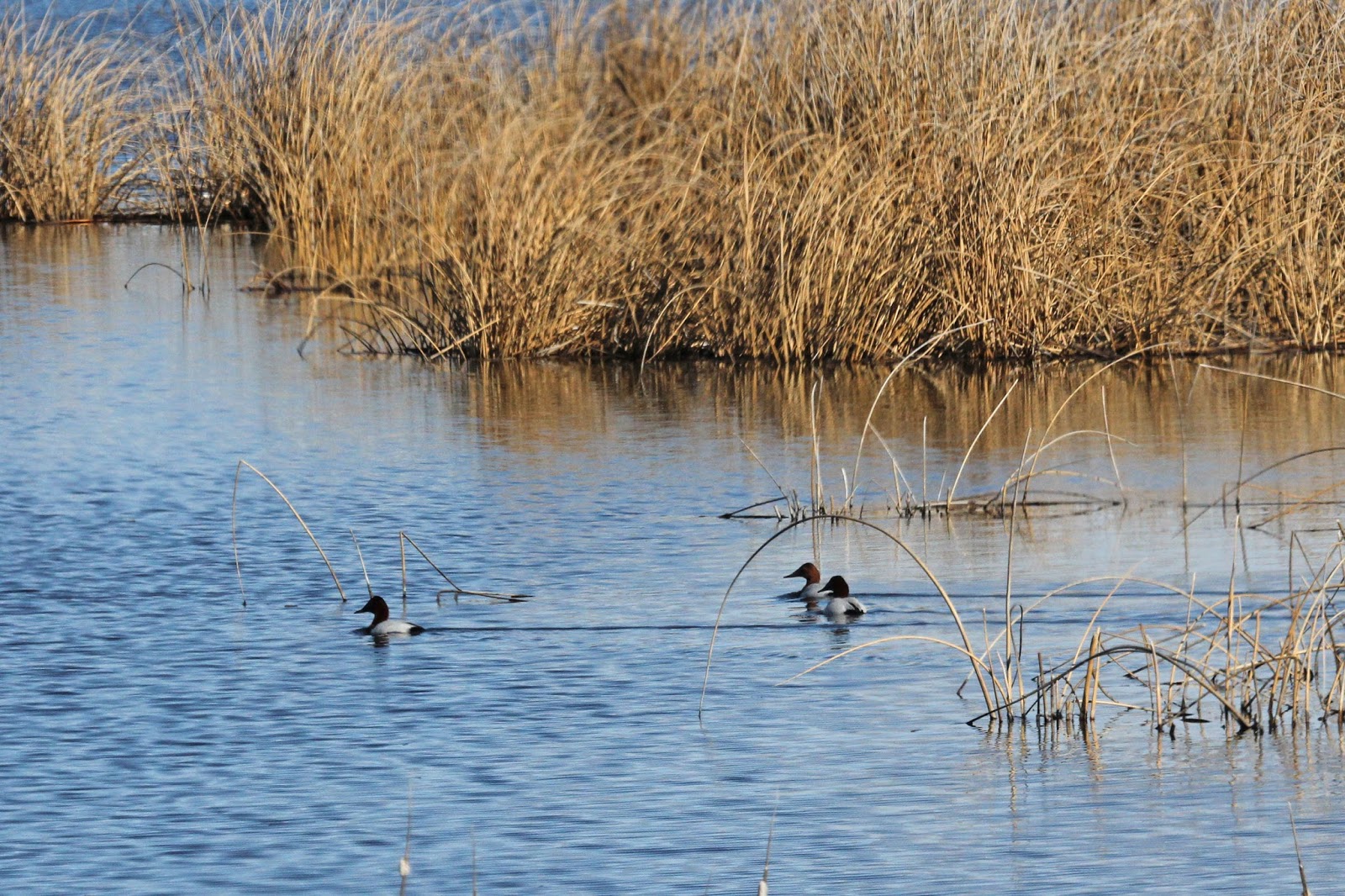
On the drive along Tule Lake, we stopped at a couple of pullouts, getting nice views of a juvenile White-Crowned Sparrow and juvenile Red-Tailed Hawk. We also got to admire the mightiness that are Canvasbacks. These big ducks are some of my favorites with their striking red heads and big, sloped bills.
Juvenile White-Crowned Sparrow
Juv. White-Crowned Sparrow
Juvenile Red-Tailed Hawk
Canvasbacks
Our next main stop was Petroglyph Point. As expected, we saw Prairie Falcons circling the large rock island. Nick and I were able to get a few nice shots, including some with a little morsel of what was likely a Belding’s Ground Squirrel. I didn’t quite get the awesome shot of tandem ones in flight like before, but still very happy with this sighting.
Prairie Falcon
No, not an extra set of furry legs - the legs and tail of its prey!
Belding's Ground Squirrel - likely prey item
We also got a few other surprises here, like TWO different nesting owls. A Great Horned Owl was nicely poised on its nest, giving us a stare down. It didn’t seem too bothered by us or the van-load of photographers who stopped here on one of the Winter Wings Festival guided photography tours. The Barn Owl, on the other hand, was content to keeps its back turned towards us. How I found it in this tiny crevice, I don’t know. But once I saw it, I knew for sure it was a beloved Tyto.
Great-Horned Owl
Barn Owl
We got a quick glance at a Rock Wren before it darted out of sight. But we did get good looks at some other critters at Petroglyph Point, including this strapping Yellow-Bellied Marmot and this tiny wolf spider of some sort. Arachniphobes - beware of awesome up-close photos!
Yellow-Bellied Marmot
Wolf Spider
Wolf Spider
Time restraints prevented us from exploring the lava tube caves last time, but this time we were able to check them out. I discovered that I’m a bit freaked out by caves. Pure darkness without knowing how deep the cave is and not knowing if some dangerous critter is just around the corner was a bit unnerving. But it was totally cool and fascinating to walk around and see the super cool textures remaining from ancient lava flow (from 10,500 to 65,000 years ago).
Entering a cave
Cave Ceiling
I call this my "X-Files" Photo
Exploring the cave
More cool lava tube cave textures
This trip was filled with Townsend’s Solitaires. We saw them at just about every stop, and quite a few at a time around the caves. We got great looks at one in particular – such great looks that one even came down within a few feet from me on the ground, but it was too close for my telephoto lens to capture it! I cursed like a sailor about this missed opportunity, as I knew it would NEVER happen again. But I have since mostly calmed down about the whole thing (haha) and enjoy the memory and these pics.
Townsend's Solitaire
Townsend's Solitaire
Our day ended at Big Painted Cave where we expected to see some pictographs. We did not find them, but we found something even better – a PIKA!!! It was super cooperative, and I think we must have watched it run back and forth from its hay pile to its feeding spot for at least half an hour. We knew they could be around, but we did not know that we’d be lucky enough to find one, and such a cooperative one at that. I don’t even need to tell you how adorable these guys are. Just look at this one and see for yourself why this has got to be one of the top cutest animals on the planet!
(For best quality and full Pika effectivness, select to watch in 1080p HD)
It was such an amazing way to end the day. Oh how I just love this beautiful desert!
Last weekend Maureen had to travel to San Diego for a conference, leaving me to figure what to do with myself for a few days. Saturday, I thought I'd venture out and take some macro shots, hoping the weather would cooperate. But at every point during the day, it threatened to rain. I'd been keeping myself cooped up for fear the storm clouds would break open, but at a certain point I just got tired of waiting, so late in the day I headed down to Ankeny NWR to take my chances.
A sinister-looking Brewer's Blackbird greeted me in the parking lot
Northern Flicker
Ankeny's mostly off-limits between October and March to give "Dusky" Canada Geese and other waterfowl undisturbed wintering habitat. With spotting scope you can scan a good portion of the area from the parking lots, but Pintail Marsh also has a 1.8 mile loop trail and it's been ages since we've been able to walk it. A couple of times since it's opened back up, we've taken short trips after work and checked in some of the willows along the trailhead without getting very far. I hadn't expected to get far this time either, but the birds kept drawing me in.
Red-winged Blackbird
Savannah Sparrow
By far the most active were the Yellow-rumped Warblers. Both the "Myrtle" and "Audubon's" Yellow-rumps are sporting their fancy breeding costumes and flycatching left and right. "Myrtle" seem like they're outnumbering their brighter, fancier-looking brothers and sisters right now, which is still surprising to an easterner like me who thought we were swapping Myrtles for Audubon's when we moved out here. Maureen's been waiting and hoping for a handsome male Audubon's to show off for her, but so far hasn't found any cooperative volunteers. But the minute she leaves town, this happens… and with her own camera no less.
"Audubon's" Yellow-rumped Warbler
"Myrtle" Yellow-rumped Warbler
A gentle warbling emerged from the same willows where the Yellow-rumps were frolicking. Even if it was more shy than the warblers, it was great to see my first Warbling Vireo of the year. Other FOYs included Yellow and Wilson's Warblers, and Yellow-headed Blackbirds. At around this same point in the trail as the vireo I noticed the damselflies were swarming a certain kind of grassy seed heads. One of them let me get close enough to snap a photo with my macro.
Warbling Vireo
Bushtit
Least Sandpiper
The other major source of activity was the swallows. From the parking lot, you can see them swirling around and around over a cluster of snags, occasionally landing on them in tight groups. Now that I was able to get farther along the trail, I came across a nesting box complex, and the Tree Swallows were getting to work.
It was mostly Tree Swallows I should say, but there was at least one Violet-green getting ready to nest, and, as you can see, we were fast friends. Cliff and Barn Swallows are also making their way to Ankeny, although the Cliffs are likely to nest in other parts of the refuge, where there are structures for them to build on.
Violet-green Swallow
While the swallows and other songbirds are preparing their nests and pairing off, the Canada Geese are already busy raising their first brood. I'm pretty sure these were the first baby birds either of us have seen so far this year. Lets home some of these little guys survive the inevitable onslaught of the eagles, harriers, red-tails, and other raptors that use the marsh as their hunting grounds. Good luck, little ones.