A few weeks ago, Maureen and I headed to eastern Oregon to see some great birds, and celebrate our 10-year(!) anniversary. We booked a trip to Malheur NWR before the refuge actually opened back up, post-occupation, and lucked-out when they announced that everything would be accessible again, except for the HQ. Since we were heading that way anyway, priority numero uno would be an overnight stop in Bend in hopes of seeing a Greater Sage-grouse lek.
Pronghorn
Pronghorn butt
Yellow-bellied Marmot
The adventure started on our first night out, though. Just as we were heading into the mountains, not long before we headed into a surprise blizzard, with the sun dropping quickly behind us, we found ourselves at a living roadblock. A gigantic Elk was straddling our narrow lane (lifer mammal, finally). I braked and it took off downslope like a lightning bolt.
Sage-grouse, we heard, might be found strutting about from an hour before sunrise to an hour after. We headed out plenty early, and made a beeline for the coordinates of the eBird hotspot. Nothing. We pulled over and hoped for the best when a pair of birders with the same goal pulled up. They seemed just as lost as us, but fortunately they knew who to call for more specific directions, and soon we convoyed over to the right spot.
Greater Sage-Grouse lek
For the most part, the bulk of the grouses (grice?) stayed mostly obscured behind tall grasses, but the occasional male would wander over toward a clearing, giving open, albeit distant, views. As far as we could tell, there were at least 13 males putting on a show, with no females to impress but Maureen (sorry guys, she's taken).
Maureen taking her photography to new heights
Even though we found them at about sunset, we still got to spend another two hours with them. Eventually, around 8:30 a pack of coyotes started howling from far off, but it was enough to spook the grouses/grice and they all scattered.
With our main target out of the way, we headed to Malheur NWR. Our first stop in Harney County was the Sage Hen Rest Area, which we remembered fondly from last year for the omnipresent Mountain Bluebirds taking advantage of the nest boxes hung all around. Also along Hwy 20 we had some nice looks at Pronghorn just off the side of the road. It's great to come out this way, and see these awesome animals everywhere. It's especially great when they're not sprinting away from you at 55 mph (fun fact: Pronghorn aren't true antelopes; their closest relatives are giraffes and okapis).
Mountain Bluebirds
Mountain fluffball
Pronghorn
Now we hit Malheur proper. OR-205 runs south along the length of the refuge, from Burns to Fields, and some of the best birding opportunities are along here. Not only did we find thousands of Snow and Ross's Geese, we started picking out dozens of Black-necked Stilts and American Avocets - some of our favorites shorebirds that you'll see featured in a future post.
Snow and Ross's Geese, Black-necked Stilts, and American Avocets
Yellow-headed Blackbird
Say's Phoebe
The refuge HQ is still closed while the authorities catalogue the evidence that will hopefully keep the Bundy crew in prison for the maximum sentence (P.S., fuck the Bundys). The HQ is spectacular, and it was a shame to pass it up, but the nearby Field Station was open. It was too early for the Cliff Swallows to start nesting like we found them last year, but we were content with some splashes of yellow that brightened up the place.
(Audubon's) Yellow-rumped Warbler
Yellow-headed Blackbird
Belding's Ground-squirrel
Swainson's Hawk
Down the auto route tour, we started seeing Black-tailed Jackrabbits in greater numbers. We must have seen 50 over the weekend, darting every which way, including out in front of the car.
Black-tailed Jackrabbit
Tree Swallows
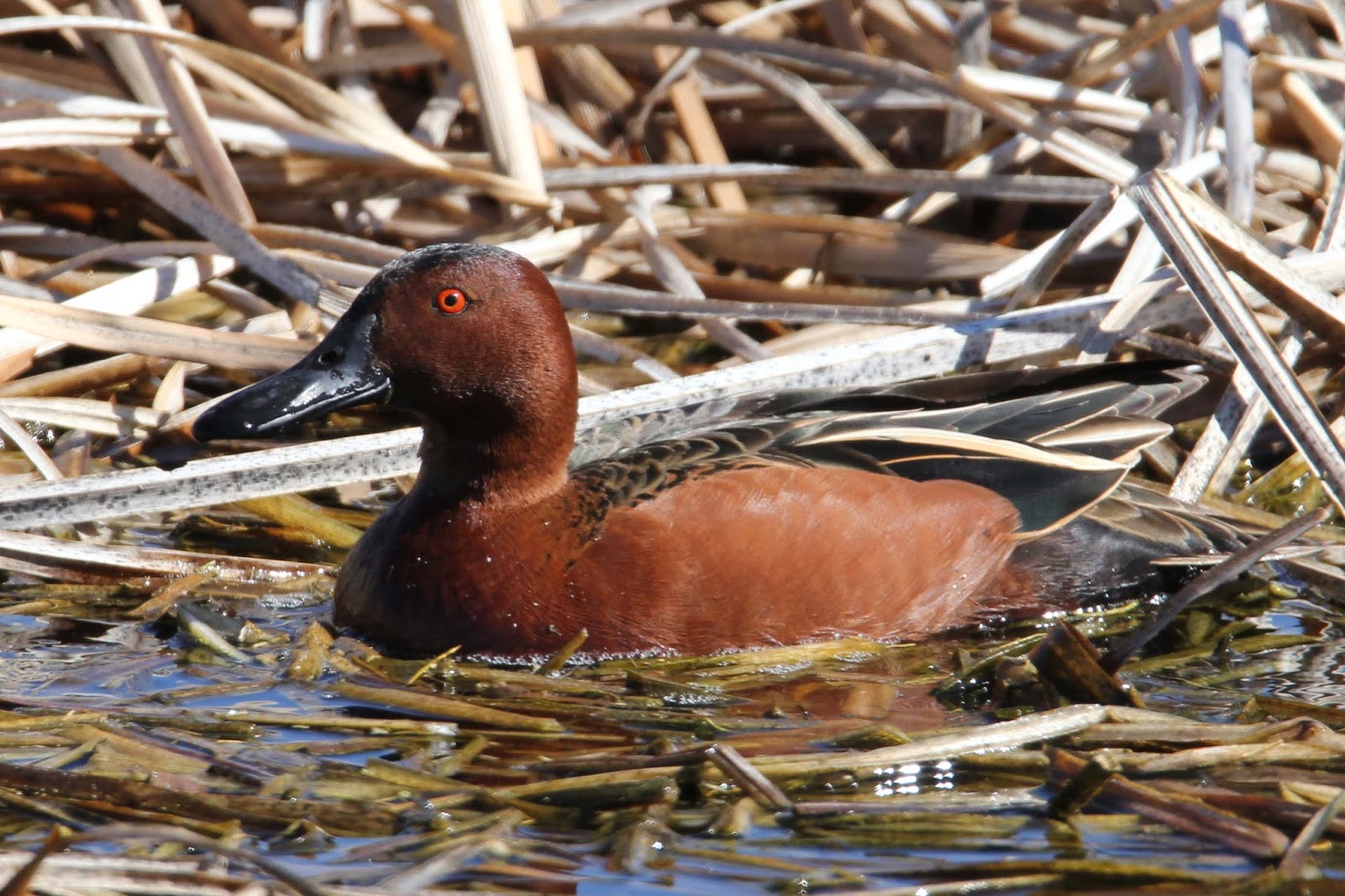
Cinnamon Teal pair
We would spend the night in Frenchglen (population: 8), but when we got into town there was still enough light for one more stop, so we headed to P Ranch for a quick stroll. As the sun started to drop, the Turkey Vultures started crowding into their roosts, the most prominent of which was an old fire lookout (I assume). At the same time, we started hearing the most eerie sound all around us. And it kept moving, first far away, and then practically on top of us. We searched and searched, and couldn't turn up any clue until I picked out a shorebird directly above us. It took some detective work, but we soon figured out it was being made by several Wilson's Snipes. It wasn't a call exactly, but the winnowing noise they make with their tail feathers as they display in flight. Between that and the colors of the sunset reflected off the mountains, it was a truly awesome end to our first day.
Last weekend Maureen had to travel to San Diego for a conference, leaving me to figure what to do with myself for a few days. Saturday, I thought I'd venture out and take some macro shots, hoping the weather would cooperate. But at every point during the day, it threatened to rain. I'd been keeping myself cooped up for fear the storm clouds would break open, but at a certain point I just got tired of waiting, so late in the day I headed down to Ankeny NWR to take my chances.
A sinister-looking Brewer's Blackbird greeted me in the parking lot
Northern Flicker
Ankeny's mostly off-limits between October and March to give "Dusky" Canada Geese and other waterfowl undisturbed wintering habitat. With spotting scope you can scan a good portion of the area from the parking lots, but Pintail Marsh also has a 1.8 mile loop trail and it's been ages since we've been able to walk it. A couple of times since it's opened back up, we've taken short trips after work and checked in some of the willows along the trailhead without getting very far. I hadn't expected to get far this time either, but the birds kept drawing me in.
Red-winged Blackbird
Savannah Sparrow
By far the most active were the Yellow-rumped Warblers. Both the "Myrtle" and "Audubon's" Yellow-rumps are sporting their fancy breeding costumes and flycatching left and right. "Myrtle" seem like they're outnumbering their brighter, fancier-looking brothers and sisters right now, which is still surprising to an easterner like me who thought we were swapping Myrtles for Audubon's when we moved out here. Maureen's been waiting and hoping for a handsome male Audubon's to show off for her, but so far hasn't found any cooperative volunteers. But the minute she leaves town, this happens… and with her own camera no less.
"Audubon's" Yellow-rumped Warbler
"Myrtle" Yellow-rumped Warbler
A gentle warbling emerged from the same willows where the Yellow-rumps were frolicking. Even if it was more shy than the warblers, it was great to see my first Warbling Vireo of the year. Other FOYs included Yellow and Wilson's Warblers, and Yellow-headed Blackbirds. At around this same point in the trail as the vireo I noticed the damselflies were swarming a certain kind of grassy seed heads. One of them let me get close enough to snap a photo with my macro.
Warbling Vireo
Bushtit
Least Sandpiper
The other major source of activity was the swallows. From the parking lot, you can see them swirling around and around over a cluster of snags, occasionally landing on them in tight groups. Now that I was able to get farther along the trail, I came across a nesting box complex, and the Tree Swallows were getting to work.
It was mostly Tree Swallows I should say, but there was at least one Violet-green getting ready to nest, and, as you can see, we were fast friends. Cliff and Barn Swallows are also making their way to Ankeny, although the Cliffs are likely to nest in other parts of the refuge, where there are structures for them to build on.
Violet-green Swallow
While the swallows and other songbirds are preparing their nests and pairing off, the Canada Geese are already busy raising their first brood. I'm pretty sure these were the first baby birds either of us have seen so far this year. Lets home some of these little guys survive the inevitable onslaught of the eagles, harriers, red-tails, and other raptors that use the marsh as their hunting grounds. Good luck, little ones.