Showing posts with label Great Blue Heron. Show all posts

Saturday, August 13, 2016

"Heeey Yooouuu Guuuuuuys!" - Birding in the Footsteps of the Goonies

In July we took our first trip to the Goondocks, where we'd follow in the famous footsteps of Chester Copperpot (Goonies), Det. John Kimble (Kindergarten Cop), Johnny Utah (Point Break), and Johnny 5 (Short Circuit) -- (why so many Johns?). Believe it or not, there's actually more to do in Astoria than visiting the sets of '80s movies.

We camped at Fort Stevens State Park, which was loaded with historical artifacts like a WWII battery, and the 110-year old remains of the Peter Iredale shipwreck. It's also got some pretty righteous birding opportunities. We started our morning by heading over to South Jetty, hoping to wrack up shorebirds and gulls. Auspiciously, an Elk walked across the road ahead of us on the drive over, and when we pulled into the jetty, three bull Elk feeding along the edge of the parking lot. We were no longer thinking about gulls.


An elusive Two-headed Elk!

The Elk casually grazed and paid us little attention, other than occasionally looking in our direction. We only had our first, brief, Elk encounter earlier this year, and had hoped we'd get a chance to see and enjoy them like this. Eventually we went up the observation tower that looks out over the jetty. We couldn't find much out to sea, we did see a gull harassing a Common Murre that somehow found it's way on shore. It wasn't a great sight, so here are more Elk shots instead.


On the observation tower itself, Barn Swallows had built several nests, and were periodically returning to feed their little ones, nestled right up against the stairs.

Barn Swallow


Over at the insipidly-named Parking Lot D, Caspian Terns flew past with some regularity. We counted ourselves fortunate when a handful swooped and dove not far off from us, along the river. After several minutes, we crossed the parking lot and walked a short path and found ourselves surrounded by that tearing call of theirs. Spread out over the mudflats where close to 50 terns along with a good number of Semipalmated Plovers and some peeps.

Caspian Tern


The conventional wisdom is that if you want to see Tufted Puffins, you go to Haystack Rock. Since we've found puffins at other spots along the coast we didn't think about it too much. Our mistake for being so dismissive. As soon as we set up the scope, we were staring at groups of 3 or 4 puffins at a time, and close. Occasionally one would dive off its ledge and circle over our heads before heading out to sea. If you want to see Tufted Puffins, you go to Haystack Rock. Got it.


Tufted Puffin and Common Murres. You can see a nesting burrow center-left


Diving off Haystack Rock


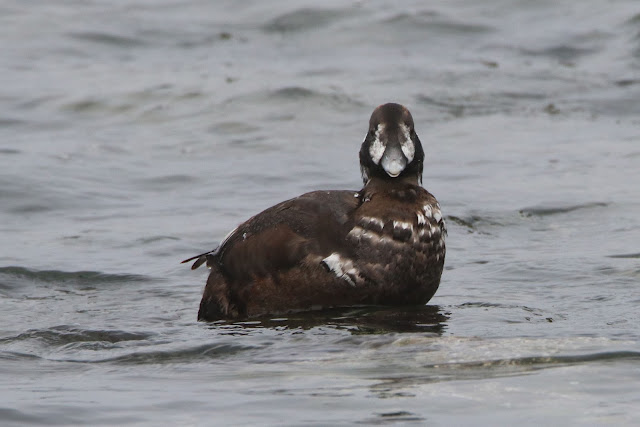
The puffins were joined on Haystack by countless other seabirds, mostly cormorants and gulls, but also decent numbers of Pigeon Guillemots. A male Harlequin Duck came in closer than I'm used to, and I almost got stranded taking snapping photos as the tide kept creeping in around me.

Haystack Rock

Pigeon Guillemots

Harlequin Duck


At low tide, this is a good spot for tide-pooling, and several volunteer naturalists were showing off the anemones and keeping people from climbing where they aren't supposed to.

Anemone


I'd wanted to swing by Del Rey Beach after checking out eBird reports, but it was pretty quiet when we got there. But we did pick up a lifer moth in the parking lot, where Red-shouldered Ctenuchas had swarmed all over the ragwort and the dune tansy. We pushed onward to Ft. Clatsop to visit a recreation of Lewis and Clark's winter camp (1805-6) and picked out some Red Crossbills kip-kip-kipping high overhead. I guess we lucked out -- of all the animals Meriwether Lewis described along their journey, Red Crossbill wasn't one of them.

Red-shouldered Ctenuchas


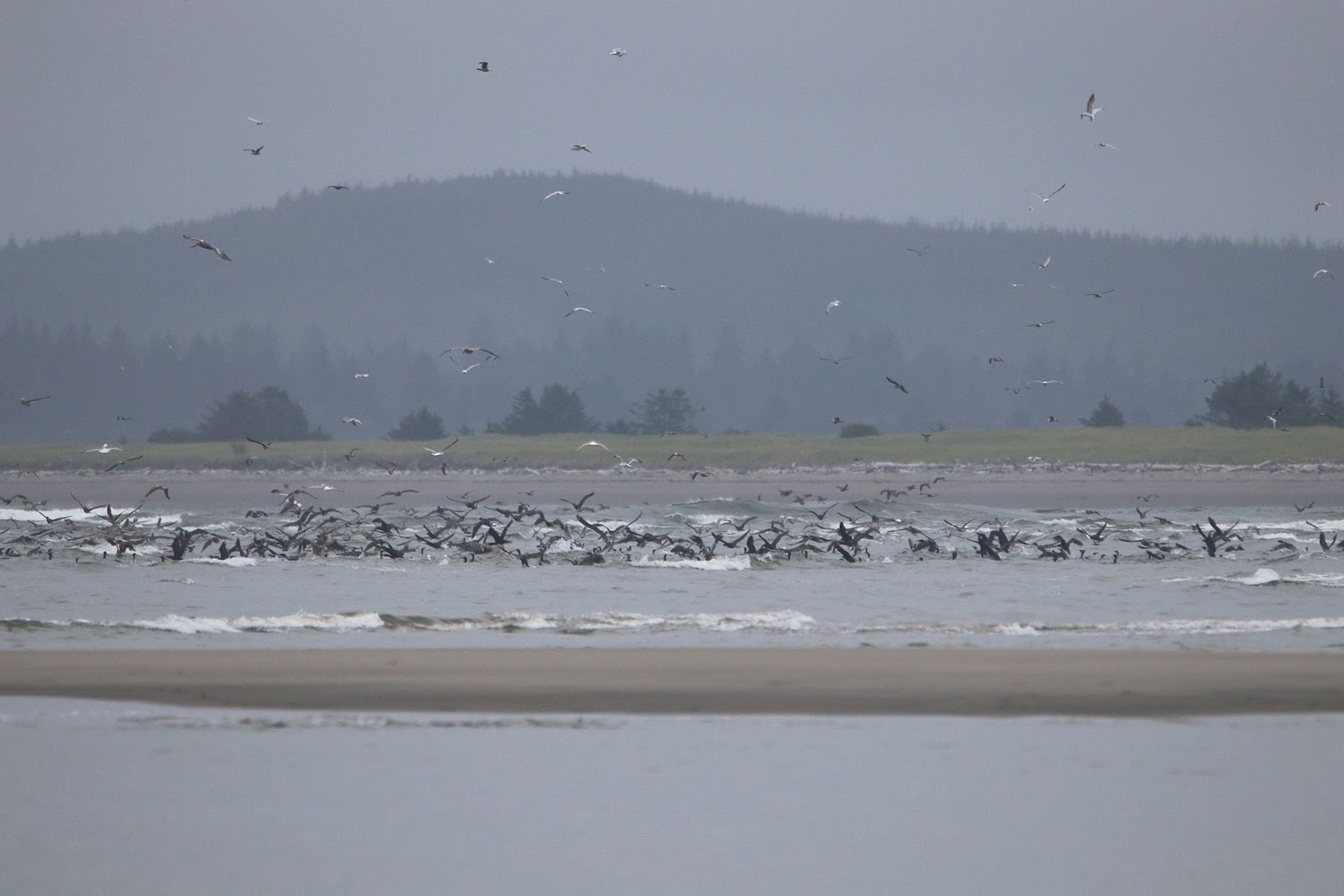
We started the next day back at South Jetty, but only saw one Elk this time. We took the trail that leads to the beach and came across hundreds of Heermann's Gulls congregating on a sandbar. Farther off was a massive mixed flock in the midst of a feeding frenzy. Assorted pelicans, cormorants, gulls, and terns were gathering up whatever they could find, and there must have been plenty of it, whatever it was. On the way out, an Elk family crossed the road just ahead of us, and we got our fist glimpse of an Elk baby!

Heermann's Gulls


Baby Elk!!

We'd heard that Seaside Cove was worth checking out, and it was indeed. Right along the shore were several adult and first-summer Heermann's Gulls -- the closest we've managed to get to these handsome larids. The water was relatively calm, and we were able to pick out a lone Marbled Murrelet and a good 80 or so Western Grebes.

Heermann's Gull


While we were there some guy asked us if we'd seen any Harbor Seals or sea lions anywhere at Seaside Cove (we hadn't). Then he asked if we'd seen the Walruses back in Astoria. He obviously knew the difference between seals and sea lions, so I wanted to believe he knew what he was talking about while also remaining cautiously skeptical. PRO TIP: there are no Walruses in Oregon. But we were heading into town anyway, and there might have been something good -- Maureen suspects he meant Elephant Seals, which would have been great, but instead there was nothing.


Great Blue Heron

Wednesday, January 28, 2015

Water Water, WA

The plan was simple: we would head up to Portland for the day and kick around Multnomah County for a while. Even though we're up there practically every other weekend (and I work up there), our county list is pitiful and we were finally going to do something about it.

Ruby-crowned Kinglet

We decided on Smith and Bybee Wetlands, where we were sure to pick up waterfowl, and where the trails around the lakes make for a pleasant stroll. Though the water level was higher than during our previous visit, and there wasn't quite as much activity as we'd hoped, we were greeted by a pair of Varied Thrushes just as soon as we got started. Later, we chanced upon four immature Bald Eagles -- one of whom had nabbed a fish out of the lake, only to be pursued over the treeline by three less enterprising siblings. But for us the highlight of the morning wasn't a bird at all.

Bald Eagles

Bewick's Wren


Maureen and I had had salamanders on the mind, as the previous weekend we'd attended a field trip to McDonald Forest with high hopes of finding assorted salamanders and newts. We'd braved the rain and cold thinking we might glimpse some new amphibians and were sorry when none had turned up. Today, though, luck was on our side. Maureen turned over a couple of logs, and under the second was the most cooperative Long-toed Salamander one could ask for. We gawked and admired for several minutes, and wrangled passers-by to share in our find. The salamander took it all in stride, finally disappearing into the loose soil only after everyone had had a chance to appreciate him.

Long-toed Salamander


In deciding where to go next, Maureen noticed a big green patch on Google Maps: "Oh, but it's in Washington." In our 9 months of living here, through all of our exploring, we've somehow never ventured across the border to our northern neighbor, literally on the other side of the river from Portland. Today we decided that Ridgefield NWR was worth the trip (bonus: every bird's a new state bird!). The refuge consists of a 4.2 mile driving trail through some pretty awesome wetlands. Unlike other driving trails we've been on, people are positively forbidden to leave their cars, except at a single photo blind mid-way through.

Red-winged Blackbird

Great Blue Heron

Northern Harrier

Ducks and swans were everywhere. There were also more nutria per acre than anyplace I've seen. Much of the action took place right beside the road, which was fortunate, since there was nowhere else to go. Fortunate for us, that is, though not for one frog, who was set to make a meal fit for an egret. This fairly robust and wily frog didn't make it easy for the Great Egret to put it down: the egret tossed it a little, maneuvered it, dunked it back in the water, and started the whole process over again. The dunking seemed like the cruelest part of all, like he just wanted to give the frog a false hope of escape. It took a couple of minutes before the frog was positioned just right, and that was the last anyone will see of it.

Tundra Swans

Nutria

Great Egret hanging a most unfortunate frog out to dry

In a happier context, you might think the frog was just hitching a ride from his buddy


At the photo blind pit stop, a young Red-tailed Hawk perched over the parking lot was the star attraction for the half-a-dozen or so other photographers stretching their legs. The hawk was great, but to be honest I was more excited for us to find a much smaller subject, since I was itching to use the macro attachment for my iPhone. We didn't know what we were looking at at the time, but the insects we found were a diurnal type of firefly. Unlike it's beloved cousins, members of this particular group aren't bioluminescent at all, using chemical signaling to communicate instead.

Red-tailed Hawk

Firefly, probably Ellychnia hatchi

We've been paying more attention to lichens lately (Xanthoria sp.?)

And let's not forget the fungi...


The benefit of having everyone stay in their cars in a wetland is, of course, that the waterfowl don't flush nearly as easily as they would from pedestrians. This gave us an opportunity for some great looks at birds we're accustomed to seeing from farther away. This was especially true of a few individuals who preferred the channels alongside the road, rather than out in the open water: a sharp-looking Hooded Merganser, a pair of Gadwall, and a couple of Northern Shovelers dancing their feeding tango. I always love watching Shovelers feed, swimming around and around each other, stirring up prey in the vortex.

Hooded Merganser


Gadwall -- the most worried-looking of the ducks

Female Gadwall

Northern Shoveler


As we drove along one of the channels checking for waterfowl, Maureen spotted an American Bittern. Sort of. It wasn't the bird that caught her eye at first, but its reflection. The bittern was so perfectly camouflaged that it took her a few moments to find it among the reeds. Even though must have been staring right at it, I don't think I saw it until it started to move. It was a nice surprise encounter to end an impromptu trip to a new state. Certainly Washington state must have a lot more surprises in store for us, provided we remember to cross the border from time to time.

What did you see first: the bird or the reflection?
American Bittern

Googly eyes