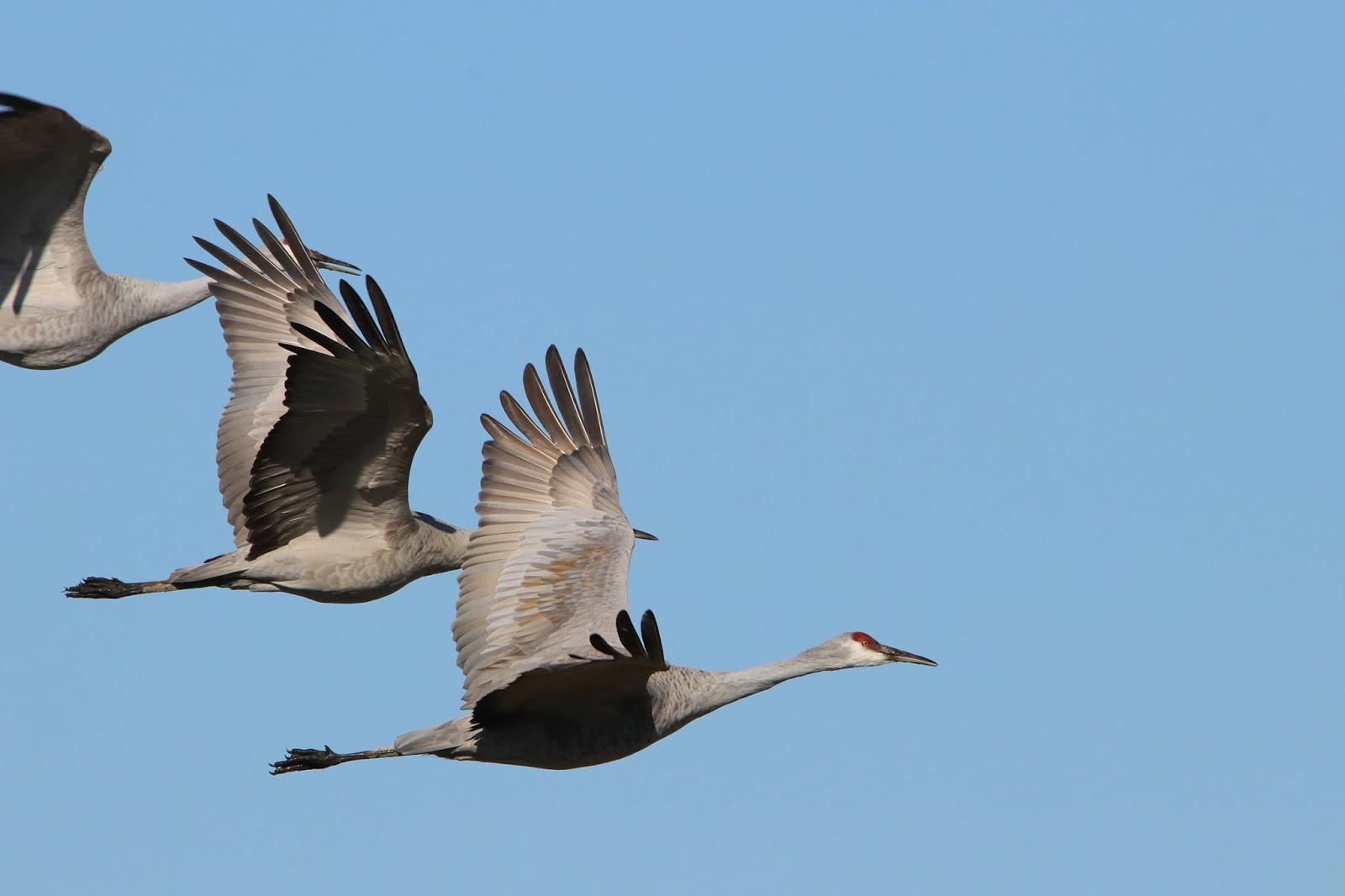
A welcome bout of warmish, sunny days meant we had a couple of days last weekend to plan a couple of semi-ambitious daytrips (ie, we left town). On Saturday we drove up to Sauvie Island to get our crane fix. Sandhill Cranes bugled away in big numbers, while we also counted Snow Geese in the hundreds, and Canvasbacks in the dozens. It’s always worth a winter tirp to Sauvie, even though we typically only make it up there once or twice a year.
Sandhill Cranes
The view of Mt. Saint Helens from Rentenaar Road
Afterwards, we decided to take a look for the Yellow-bellied Sapsucker that had been found earlier in the week, not far from there. Not to be confused with the one in Beaverton that’s been hanging around reliably for months. This new one, in Columbia County, had been found along a paved trail that runs just behind the residential area. Sure enough, it turned up at the precise intersection (with Bird Rd., appropriately enough) where others had seen it.
It was nice to get YBSA for the state to complete our sapsucker set for Oregon. I miss seeing them reliably like we did when we lived back East, but at least we still manage to see them every year when we travel to Texas for the holidays. This one flew a circuit between only three or four trees, and never left the tiny perimeter it established for itself.
The sapsucker sees a couple of saps
While the sapsucker was busy sucking sap on high, the lower trunk had a
couple of Brown Creepers creeping, until one of them stopped creeping
and started sunning. It found a cushy patch of moss and spread itself to
soak up some rays. It's hard enough just to catch one staying in one
spot for more than a second, it was unprecedented that we found one in
good light and posing in all its Certhiid glory.
Brown Creeper
We were heading to Beaverton next to run some errands and pay a visit the best noodle house around (Frank’s), so we figured we might as well pull a twofer, and see if we could turn up the other Yellow-bellied Sapsucker. We pulled up to Commonwealth Lake Park, and found the sweet gum trees easily enough. We even spotted a sapsucker right off the bat, but it ended up being a Red-breasted. We walked the path around the lake and found the resident ducks and grebes totally, ludicrously photogenic.
Pied-billed Grebe
American Wigeon
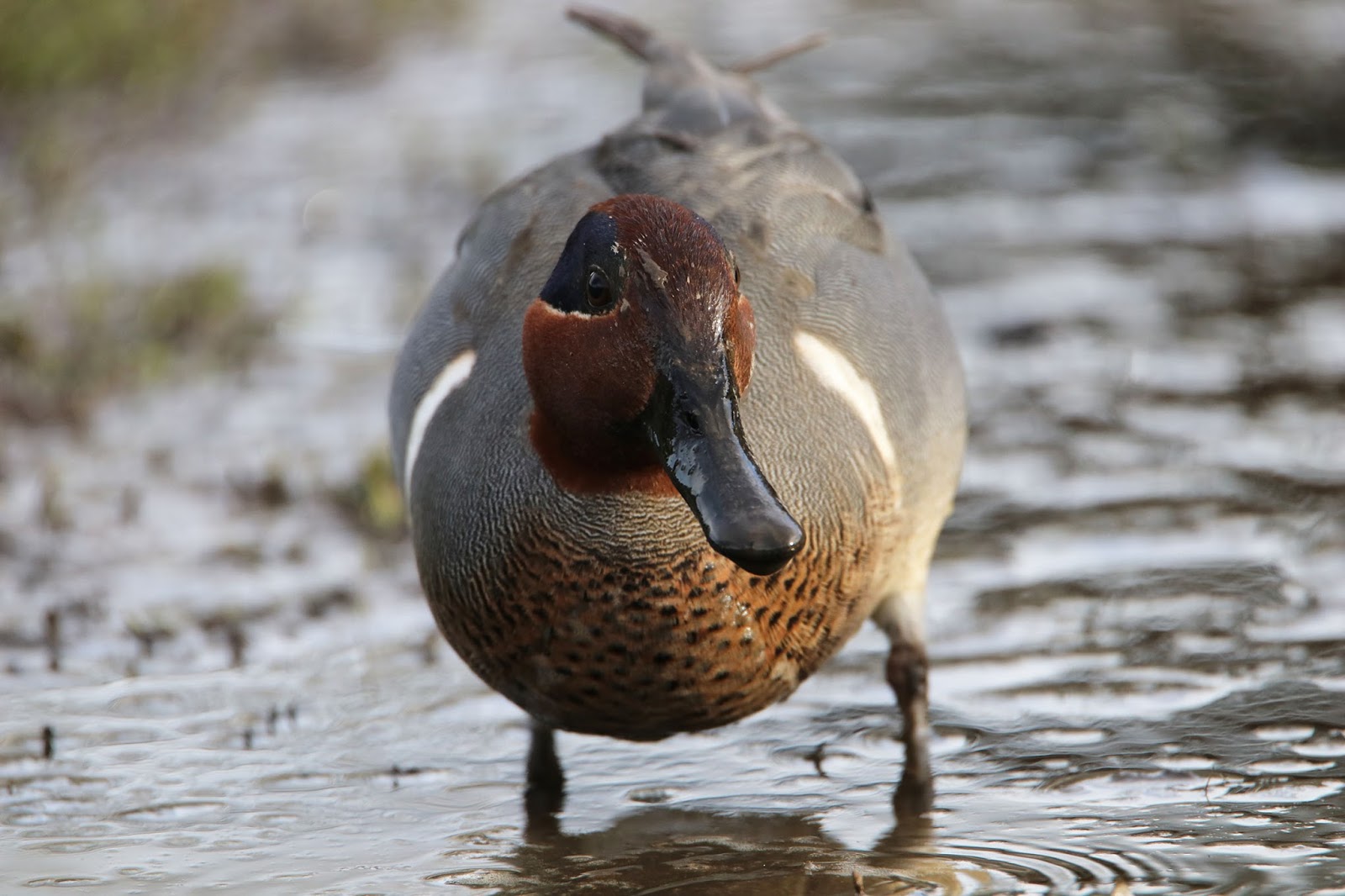
The American Wigeon were as tame as domestic Mallards, either swimming right up to the edge of the lake, or feeding en masse on the lawn and chasing breadcrumbs. A pair of Green-winged Teal even got into the action and rooted around in the mud and the puddles while I crouched down a few feet away.
Green-winged Teal
The following day we drove over to Newport for a quick coast trip. We strolled around Hatfield Marine Science Center where we picked up some year birds, but nothing mind-blowing. Our best find of the day came later at Ona Beach State Park, and it did actually blow our minds, even if it looked like it had been dead awhile (R.I.Petrel). From a distance it looked like a sub-adult gull, but up close we made out the naricorn. The bill was too short and stout for a shearwater, and eventually we figured out we had a Northern Fulmar on our hands. Pretty damn cool.
Northern Fulmar
From there we visited the Beaver Creek Natural Area where the clever Steller's Jays were finding a way of getting around the suet baffle
Just a couple of birds hanging out
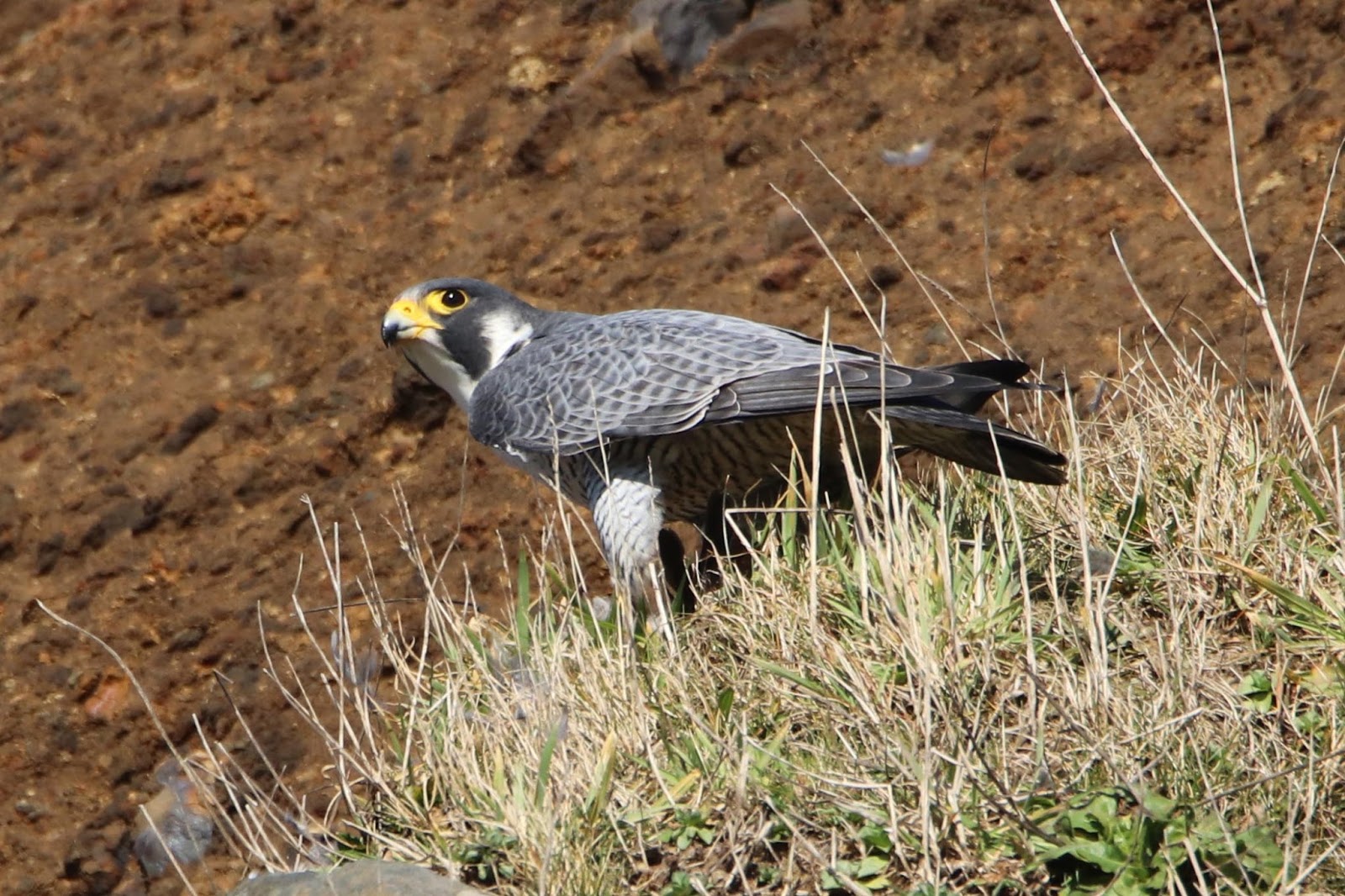
We wrapped up the weekend by heading over to Yaquina Head Outstanding Natural Area, where you can always see the pair of Peregrine Falcons that call the cliffs outside the visitor's center home. One of them had a small bird that it spent some time plucking and tucking into. Not a bad finale to a pretty packed weekend.
Peregrine Falcon
Underneath its tail you can see a leg and foot of its prey sticking out
There are certain birds that everybody seems to love, or at least have a fascination of. One of those birds is the Peregrine Falcon. Known for its speed and hunting prowess, it brings awe to just about anyone who is fortunate to encounter one.
The book Urban Peregrines by Ed Drewitt takes a look into the lives of these fascinating birds in an alternative habitat – the urban (and suburban) areas of Europe. Drewitt does also touch upon other areas, including the United States, but the examples and anecdotes are primarily from Europe, and mostly Great Britain.
Overall the book is well written and has a good flow as if Drewitt were having a personal, but well-informed, conversation with you about Peregrine Falcons. He has years of experience researching these incredible birds, and he is very enthused to share that knowledge with you. Plus, there are plenty of gorgeous (and sometimes gory for the sake of telling the truth) photos included to keep you visually stimulated.
He starts by giving you the basics of the Peregrine – explaining its features and characteristics that make it well suited to high speed pursuits of prey. The overall adaptability of these birds have allowed them to thrive not only on wild landscapes and cliffs where it occurs naturally, but also in cities and towns that are populated by more people than wildlife. In some regions, there are extremely high percentages of peregrines nesting in urban areas, like Germany. This benefits the peregrines and researchers alike as the researchers can more easily monitor these birds, which then means deterring predators.
Drewitt takes you through the lifecycle of the peregrine in detail, going over some interesting facts about breeding behavior, including cooperative breeding in which older male offspring sometimes stay with the parents to help rear newer chicks. He also goes over their hunting behaviors, which surprisingly includes nocturnal hunts. Also, the author makes the reader aware of the conflict between some individuals, such as pigeon fanciers (those that breed and raise racing pigeons) and peregrines.
Although I found much of what Drewitt had to say as very interesting and informative, as a general audience reader, I also found that there was a lot of details in the many anecdotes that didn’t really didn’t add to my understanding. It was sometimes a bit distracting. I think if I were a budding peregrine researcher or environmental educator, then this information would have been more relevant to me. The section on learning how to set up a peregrine watch and ringing (banding) them would be great for anyone who wants to start up research on peregrines or other birds of prey.
A male and female (larger) sitting on a cathedral
Overall, I think the author’s enthusiasm and dedication for these magnificent creatures shines through. He highlights a bird that is fascinating, sharp, and handsome, and makes the science of them accessible to the public. And I’m always for revealing behaviors and attitudes that that we can work on in order to make more conscientious decisions that affect conservation. Generally, it seems most people embrace the peregrine falcon for the awesomeness that it is, and Urban Peregrines teaches us more about them and how we can live in harmony with them.
For most of my life, I’ve haven’t lived anywhere more than an hour away from the ocean (or at least a gulf). I think I have to live somewhere with moisture in the air or I’ll just shrivel up like a dry sponge. So, although I loved birding Arizona, I know I could never live there for fear of constantly being dehydrated.
Art Deco Style Yaquina Bay Bridge
Nick and I enjoying the rocky west coast
When we moved to Oregon just a short time ago, we knew that we’d have to hit the West Coast coast – to see all the crazy new birds that were sure to come (or should I say SHORE to come… bah-dum-dum-CHHH!). We took advantage of a three-day weekend to spend a whole day exploring the coast, seeing the Pacific Ocean after moving away from the Atlantic Ocean. To do a two-for-one deal, I thought we could go somewhere that was going to be near the Rogue Brewery where we could enjoy some beer-bird beers that we just knew we were going to earn. Nick found Yaquina Head Outstanding Natural Area just a few miles away. With a name like that, we had high hopes for its outstanding-ness, and boy did it live up to it!
I've become a little obsessed with panoramic photos, especially with views like this.
The drive out there was so lovely as we curved around the mountains to reach the open water. This was a much nicer drive than our pitch black, rainy, snowy, stuck between 18-wheelers, treacherous drive through the mountains when we first entered Oregon. Right before we got to our destination, we made a playful bet of how many lifers we’d get that day – Nick said eight and I said six. As soon as we arrived and pulled over to the first lookout, we almost immediately got as many as I had predicted. We looked down at a cliff to see lifer Pelagic Cormorants NESTING! We were awestruck, but we had no idea what we were in for that day. There were a handful here and some flying back and forth gathering nesting material. We even had a nice peak at some eggs!
Pelagic Cormorant tending to her eggs
Pelagic Cormorant Parents on their nest
Pelagic Cormorants nesting on the side of a rocky cliff
Gorgeous portrait of a Pelagic Cormorant - phoniscoped by Nicholas
Our eyes didn’t linger long, though, as we quickly saw lifer Pigeon Guillemots – GUILLEMOTS! We’d been dying to see Alcids, and here were our first ever. They really do have a pigeonous look to them. They were quite the characters frolicking in the water with their goofy yet stunning red legs and inside of their mouths and those broad white brushstrokes on their wings.
Another lovely phoniscoped portrait by Nicholas - Pigeon Guillemot
Pigeon Guillemot
Check out those bright red feet on that Pigeon Guillemot!
Pair of Pigeon Guillemots
"Look Jack, I'm flying!"
A couple of Pigeon Guillemots yucking it up!
We had been dreading trying to ID the gulls out on the West Coast, but there were some clear specimens hanging about amongst some hybrids. We picked up lifer Western Gulls and Glaucous-Winged Gulls and their hybrids (a.k.a., Olympic Gulls). Oh, and while we’re at it, let’s go ahead and pick up a lifer Wandering Tattler – a wandering migrant that we were very fortunate to pick up at this time.
Western/Olympic Gull
Western/Olympic Gull
Western/Olympic Gulls either kissing passionately or fighting over food.
Wandering Tattler
We stopped by the visitor center as a set of friendly birders told us about nesting Peregrine Falcons in the vicinity of the building. Almost immediately we spotted an adult Peregrine perched near the top of a cliff with people walking on a path directly a few feet above him. They were totally oblivious to his presence. He was literally under their noses, but they couldn’t see him from their point of view. The falcon swooped across the parking lot and perched in a little rocky nook that allowed our best views of this truly magnificent predator. We also did spot the nest with another adult in it, but she was very hard to see clearly. We actually couldn’t stay away long and went back to Yaquina Head a few weeks later and saw three fluffy little chicks! Papa stood guard a few feet up while Mama was likely hunting for dinner.
Peregrine Falcon
Peregrine Falcon
Fluffy Peregrine Falcon Chicks
Fluffy Peregrine Falcon Chicks
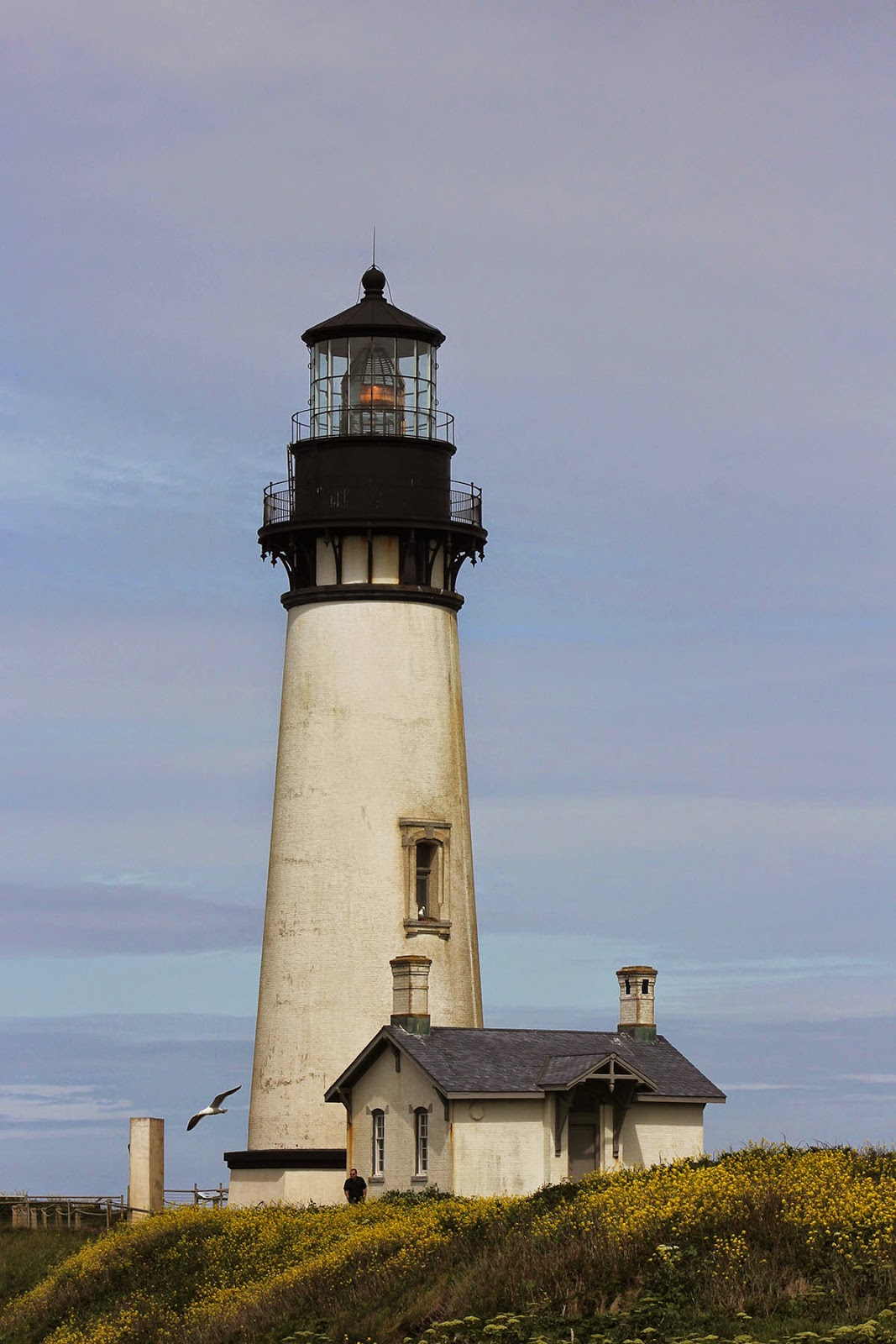
A little down the road, we came up to the lovely lighthouse that sits amongst a bunch of little yellow wildflowers. But what was most impressive is what was all around that lighthouse. As we got closer to the edge of this cliff, our jaws dropped as we came upon the rocky cliffs just beyond the shore that hosted hundreds of nesting Brandt’s Cormorants and at least a couple of thousand Common Murres! (Two more lifers!) The proximity and the overwhelming number of all of these seabirds was absolutely astonishing. These birds that you would usually only expect to see on a pelagic trip were yards away. And I just could not get over those electric blue gulars on those cormorants.
Yaquina Head Lighthouse
Those dark spots atop this cliff aren't just rocks… those are Common Murres and Brandt's Cormorants!
Common Murres and Brandt's Cormorants. What stunning gulars!
Remains of a Common Murre Egg
The pictures just don’t do the experience justice. Even non-birders were struck by this ridiculous amount of birds on these huge rocks. But who seemed even more intrigued by all of these nesting birds was an adult Bald Eagle who unsuccessfully swooped in trying to get a delicious snack. The Murres started spilling off the cliff like an avalanche rushing down a mountain to escape this hungry predator.
Incoming!
Bald Eagle on the move!
"Why have you forsaken meeee!?!?!"
And not too far away from all the action was a presumably nesting pair of Black Oystercatchers. I had first heard a familiar squeaky, panic-of-a-call that was very similar to that of their cousins that we were used to seeing back East – American Oystercatchers. These guys definitely helped to fill that Oystercatcher void that I didn’t even realize that I had felt until that moment.
Black Oystercatchers
As we looked around with our scope at the top of the cliff, one of the park volunteers pointed out that there were Harlequin Ducks at the bottom of the rocks! Are you kidding me?!? These jester-like ducks were something else. They look so unreal with their wild patterns of black, white, gray, brown, and rusty orange. Once we went down to the cobblestone shore to check out the tide pools, we got even better looks at these wild and crazy ducks.
Pair of Harlequin Ducks
The frontal view of the male Harlequin Duck makes me giggle ;-)
Stunning male Harlequin Duck
Harlequin Duck
And just as we were slowly pulling ourselves away from this outstanding place, we spotted our first Western Grebe! I’ve been dreaming of seeing this bird ever since I’ve seen videos of them dancing in perfect synchrony during mating season. Although this was a lone grebe, it was still a beautiful bird to gaze upon.
West Coast Hipster Birders
So, how many lifers did we walk away that day, you ask? Twelve. So on one hand, neither of us won our little bet, but on the other hand, we had TWELVE LIFERS so who cares about some silly bet! The birds we didn’t get photos of were the passer-by Pacific Loons and the lone Chestnut-Backed Chickadee that hopped around in the pines. All in all, we definitely earned that trip to the Rogue Brewery. You know it’s an awesome day when you have brewery-birds rather than just beer-birds in one outing!