Showing posts with label Sea Creatures. Show all posts

Saturday, April 21, 2012

Why I Love Our Backyard

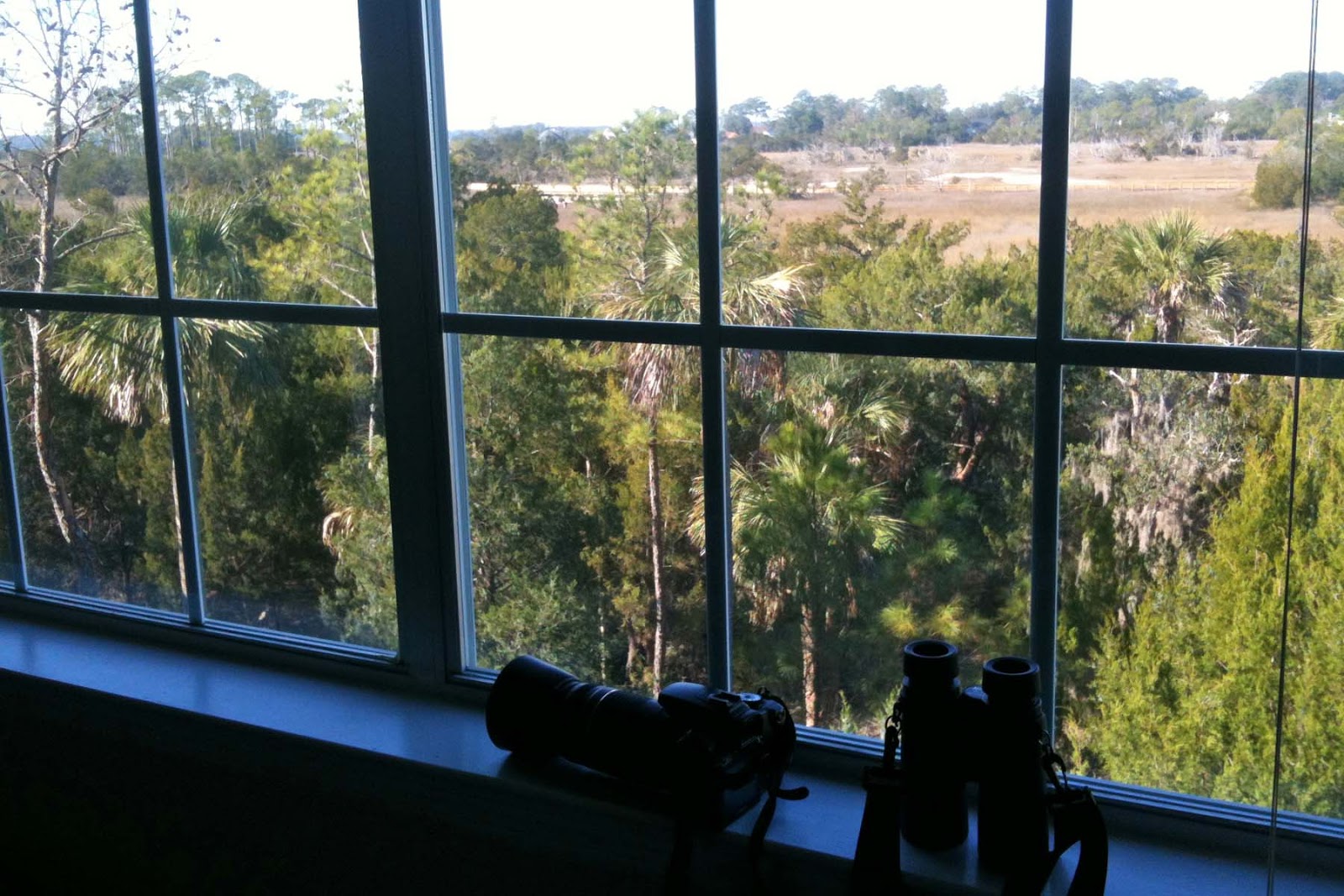
We knew right from the start that this would be our apartment. Not only do we have a bird’s eye view from the 3rd floor that overlooks a nice patch of trees and a big marsh, but we also have access to that marsh via a boardwalk. When we first visited the apartment complex, the trees and lawns were just coated in little passerines. And when we moved in, the birds didn’t let us down.

View from our Apartment. Always have camera and binoculars ready!

Walking through the marsh during low tide, which is really no tide in this area.

Northern Flicker

We have seen a plethora of birds and other critters since moving to this apartment. It’s been a little quiet recently, I suppose due to the birds nesting and keeping a low profile. Most of the passerines up until the past few weeks have been Yellow-rumped Warblers. We saw butter-butt after butter-butt all winter. And as you already know, we’ve had some great looks at some nest-building Brown-headed Nuthatches. But even before that, I showed you a look at our Cedar Waxwing visitors, who have stuck around until just this past week. We would see flocks and flocks of them whizzing by.

An odd sighting we've only seen once before - Yellow-rumped Warblers gleaning off of a tree trunk

Cedar Waxwings

Cedar Waxwings flying by

In the earlier part of the year, they were ravaging the juniper berries in the cypress trees right in front of our windows. I got plenty of shots of them devouring every berry in sight and of them taking siestas in the tall bare tree that is the highest post amongst the trees right outside. I didn’t mind their swooshing by and constant hissy whistling. I just didn’t like when they would disturb my poor little Bluebirds.

SOOOOO many waxwings!

Cedar Waxwing ravaging the Juniper Berries

Eastern Bluebirds tolerating the Cedar Waxwings

The Bluebirds would hold their ground pretty well, though. I had a family of a mating pair and what appeared to be a young male offspring of theirs. It always brought a smile on my face to see the three of them, especially together. Once, I even saw some strange behavior as they would flutter in front of a palm tree and chattering before swooshing into it and then back out. It was only one day that I saw them do this, and it was quite entertaining. And now that nesting season has arrived, the mating pair has stuck around, but the young male must have surely gone elsewhere to establish his own territory.

Male Eastern Bluebird in a Juniper tree

Eastern Bluebird fluttering by a palm tree

Raccoon in the marsh!

There would also be days in the late winter season where I would see and hear an incredible number of birds right outside my bedroom window. I would just take post in the mornings and note sightings of such an array of birds – from Ospreys to Wood Storks, Spotted Sandpipers to Pileated Woodpeckers. And when walking around the grounds, there are other little critters that catch my eye, such as funky moths, green and brown anoles, raccoons, and even little crabs!

What I believe to be an Honest Pero Moth

Cool angle of the Honest Pero Moth

Fiddler Crab in the marsh

Squareback Marsh Crab

Even the odd hours when most things aren’t visible can be entertaining. We’ve often heard an Eastern Screech Owl cooing in the trees at night. We also heard Chuck-will’s-widows calling its namesake call in the middle of the night for about a week. And one great early morning, we woke up when it should have been very dark outside, but instead, a full, glowing moon cast a beautiful light over the entire marsh making it appear almost like daylight.

Gorgeous full moon. Photo taken by digiscoping.

Full moon over the marsh.

Yup, we definitely picked the right place to live here in Savannah. I’m just dying to see what else will be passing through our neck of the marsh.

A Pileated Woodpecker comes over for a close visit.

Pileated Woodpecker

Thursday, March 1, 2012

So there's a Laughing Gull and a Seahorse…

The title sounds like a beginning to a joke, but there's no punchline here. A visit to Ft. De Soto last Spring left us thrilled with the amazing variety of birdlife that we observed. You may recall some of our encounters from here back in April 2011, including some randy Royal Terns and spunky Reddish Egrets. But there was one encounter that was especially bizarre, slightly disturbing, yet delightful all at the same time.

Laughing Gulls - "Brown chicken Brown Cow!"

On the shore of the beaches of Ft. De Soto, we ran into a typical visitor and one that we normally wouldn't get too excited about. Here we had a laughing gull, who did look dapper in his breeding plumage with the full black head and bright red bill. But it was what he was with that was most interesting. We all know gulls are quite the scavengers and seem to always be harassing people or other birds for food. So it's no surprise to see a gull munching on something. But this one Laughing Gull had something in his bill that he couldn't quite get down, and he was struggling to find a way to consume it. 

"Hmmm... How do I eat this?"

"Oops! That's not it."

I watched for a few minutes trying to figure out what this gull was playing with. Was it a fish? Was it a crab? What was this strange thing that the gull was having such a hard time with eating? Oh my gosh, it was a SEAHORSE! I've seen a number of seahorses in zoos and aquariums, but never in the wild. And I never would have expected to see one like THIS! 

"The head is a little oddly shaped..."

"Maybe if I start from the tail?"

The tough, spiny body and odd shape of this poor little seahorse made it quite difficult for the Laughing Gull to swallow. Once I alerted Nick to this strange sight, we watched the gull trying to gulp the seahorse for what seemed like about 20 to 30 minutes. The gull just kept tossing it up and trying to swallow it whole, but then he couldn't do it and would spit it back out. The gull just kept flipping around this seahorse, which was probably already dead for a while, and trying to eat it, but without success. The scene reminded me of when an acrobat in an old-timey circus tumbles another acrobat with his legs, flipping his partner back and forth landing on her hands, then her legs, and then back again. 

Laughing Gull STILL trying to eat a Seahorse

"Perhaps I can be of some assistance."

We couldn't believe our eyes that we were looking at an actual seahorse not enclosed in a glass aquarium. I'm still perplexed as to how the gull obtained the seahorse. Maybe it was already dead and floating on the water? And we couldn't believe the persistence of this gull! One other Laughing Gull did finally catch on that there was a morsel in the midst and tried to get in on the action. But he looked just as bewildered on how to eat this unwieldy thing as the first gull! 

"Mine, Mine, Mine, Mine, Mine!"

"Look what I got!"

The Laughing Gull let us get pretty close to him, just as long as we weren't going after his tasty meal. At one point, it even seemed like he was even flaunting his little treat. Or maybe he was trying to seek advice or help regarding how to eat it. 

"Ugh, you're no help. Anyone got a nutcracker?"

If I remember correctly, I believe the first Laughing Gull somehow did finally manage to just gulp the seahorse whole. Whether it stayed down after we left, who knows.

Monday, February 21, 2011

Galveston Birding Continued

This is a continuation of the great birding morning we had in Galveston, TX back in late December as described in my previous post.  We finally reached one of our planned destinations, the Galveston Island State Park. Here we added a couple more lifers to our list. In a parking lot, Nick spotted an American Pipit - our second lifer of this trip! (The first being the Eastern Meadowlark). We watched the Pipit for about 10 minutes as it moved towards the adjacent grass to forage for food, where we also saw more Savannah Sparrows and a couple of Killdeer. 

American Pipit

American Pipit

Killdeer

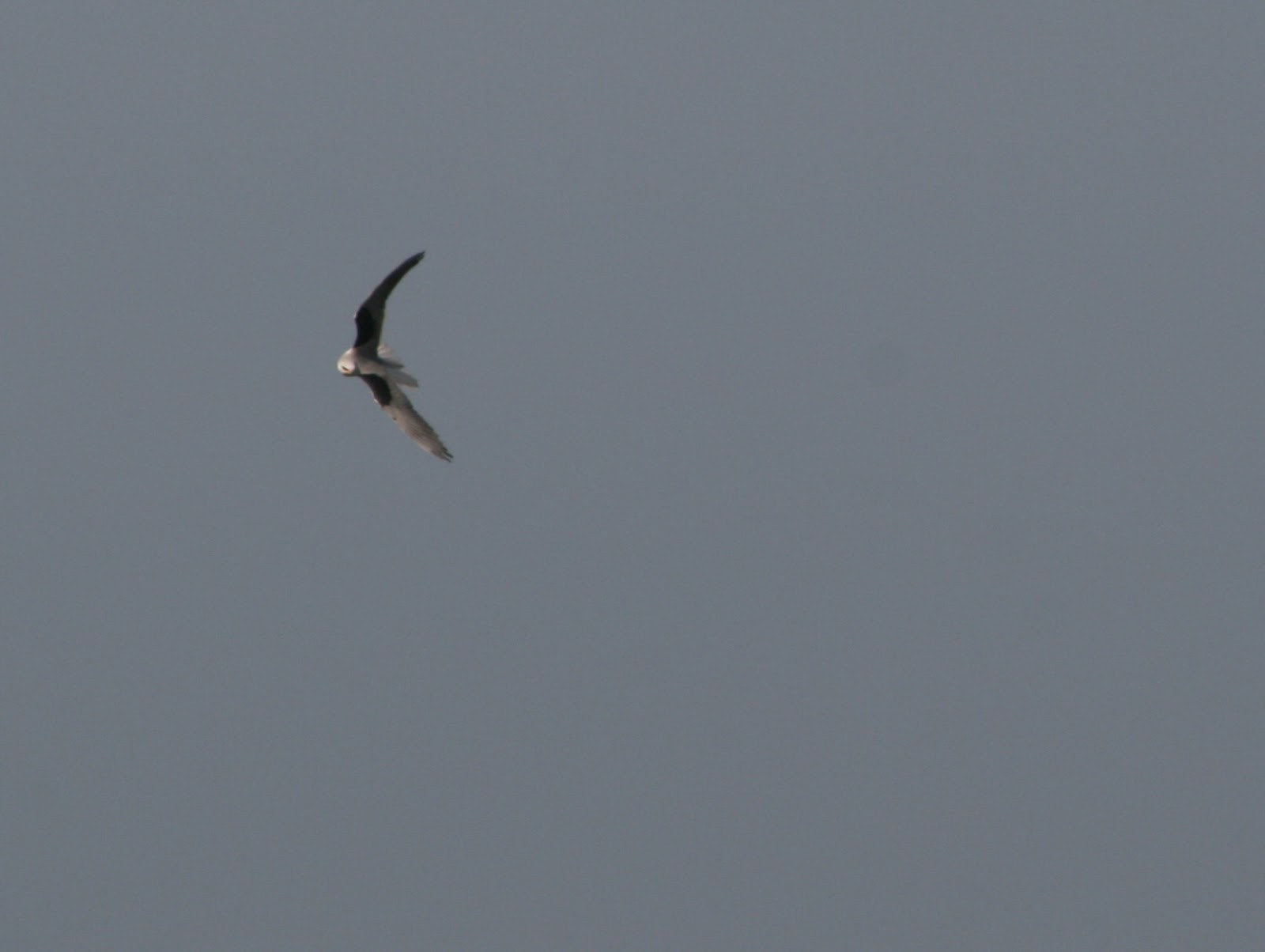
We walked a trail around the marshland a bit, and then happily came upon our first White-tailed Kite! We first saw it soaring and kiting about as it is known for doing. It was flying away from us, but we hurried through the footpath following it. In flight, we noticed its tell-tale dark wrist spots and black shoulders. We finally arrived at a bridge where we watched it land in a tree quite a ways away from us. We relished in its beauty and noticed it pumping its long white tail.


White-Tailed Kite kiting

White-Tailed Kite - Notice the black shoulders

White-Tailed Kite making a gorgeous turn, its head straight and wings vertical

We enjoyed the looks we got at that time, but it was when we were on our way out from the park that we noticed another White-tailed Kite hovering above a field, and with the blink of an eye, the Kite dropped straight down with such ease and grace. And when it came up from the tall grasses, it had a small mouse in its clutches! The Kite then flew over to what appeared to be its home base in a bare tree where it met with its mate. We watched them together, and then we watched as they would switch off from their post, seemingly to take turns gathering food. We were able to get much better looks at its gorgeous contrasting grey and black and white colors and its striking, darkly outlined red eyes. 


White-Tailed Kite with a Mouse

White-Tailed Kite spreading its beautiful tail feathers

White-Tailed Kite pumping its tail

White-Tailed Kite

White-Tailed Kite pair swapping places on their post

White-Tailed Kite Pair

Interestingly enough, we had been on a trail called "Clapper Rail Trail" and had not seen any clapper rails, to our disappointment. But driving a little ways to where there was beach camping, we stumbled upon none other than a Clapper Rail! This was not our first, but we did get a great look at it as it did not take notice of us at first. Then, sensing our presence, it scampered away and disappeared in the marshy grass. We walked over to where it had run off to see if we could find it, and the grasses weren't even that tall, but it had disappeared into the ether, as rails are so good at doing. 


Clapper Rail scampering away

Clapper Rail

We then saw another familiar face, a young Roseate Spoonbill, fly in front of us just as we were leaving the beach. 


Roseate Spoonbill in flight

We left the park feeling extremely satisfied. We were hoping to get a glimpse of some new waterfowl, possibly Snow Geese, but we had no luck there. We did happen upon some Gadwall (a lifer) and Green-winged Teal in a road-side pond. We also stopped at the drab beaches of Galveston, but all we found was a Sanderling foraging for food amongst what appeared to be lots of plastic bottles, but which on closer inspection were actually tons of Portuguese Man-of-War! 


Sanderling foraging amongst Man-of-War

Portuguese Man-of-War

On our way out of Galveston, Nick quickly saw a few Common Loons in the intercoastal waterways as i drove over a bridge, but even when we pulled over to a nearby empty lot to catch a glimpse, they were too far off at that point to get good looks at them. We were then shooed away by some construction workers across the way as we were apparently in an area where we didn't belong. Nevertheless, we left Galveston extremely satisfied and pleased with our findings. 

Tuesday, January 25, 2011

Merritt Island NWR, pt. 1

Unfortunately, Maureen and I will not be attending the Space Coast Birding Festival in Titusville this year. We made it last year, and had a really wonderful time attending lectures by the likes of Kenn Kaufman and David Sibley, going on field trips to lands that are normally off-limits, and just generally soaking in knowledge from other birders. We were especially excited by the prospect of (possibly) seeing the mythical Black Rail this year, but by the time we finally got around to registering, that and the other programs that had caught our eyes were already full. Fortunately, Titusville is a mere 2.5 hours north from us, and so we decided that we would drive up and have a look around on our own, since Maureen had a 3-day weekend for MLK day. For those of you are are able to attend this year, hopefully, this and the subsequent few posts can serve to highlight some of the options available to you.

By far, most of our time was either spent in or close-by to the Merritt Island National Wildlife Refuge. The refuge is a massive 140,000 acres and is comprised of myriad trails with a great diversity of habitats. We began with the Scrub Ridge Trail around sunrise, Saturday morning. We hoped that we might come across some Florida Scrub Jays, but were satisfied to find Eastern Towhees, Carolina Wrens, Swamp Sparrows, Savannah Sparrows, American White Pelicans, and a Blue-headed Vireo. This was also the start of our weekend's soundtrack, brought to us by the ever-present Yellow-rumped Warblers and the Gray Catbirds.

Savannah Sparrow

Although we had hoped for Florida Scrub-jays in the scrub habitat, we came up empty. We'd only seen them once before, which was last year at Space Coast Birding Festival. We had taken a guided tour onto restricted NASA land to find them, and we didn't have that option available to us this time around. As we drove from the scrub to the next trail, however, I caught a glimpse of pale blue out of the corner of my eye. I turned the car around right away, and we watched a group of three right from the side of the road. Scrub-jays use a sentinel system, and we were able to see the changing of the guard, as the on-duty jay was replaced by the next shift.

Florida Scrub-jay

A sentinel looking-out for trouble

A Florida Scrub-jay sentinel

Early in the day we decided - either out of hubris or from the sheer variety of birds - that it wouldn't be unreasonable to try for 100 species that day. We stayed on track throughout the morning, too. Next, we stopped in at the Merritt Island visitor's center, and immediately picked up the Painted Buntings at the feeder out back, where they can generally be found this time of year. We also had a White-eyed Vireo, and some American Robins flying overhead. By the time we left the visitor's center, we had already amassed 35 species for the trip, and still had several major areas to survey.

White-eyed Vireo

White-eyed Vireo

Painted Buntings at the feeder

From the visitor's center, we went straight for the Oak Hammock Trails, still buzzing with activity, even though the morning was growing late. We picked up some great songbirds in quick succession: Black-and-white Warbler, Tufted Titmouse, House Wren, and Ruby-crowned Kinglet. Farther in, we found a warbler that baffled us for a minute. High up in the canopy, we could just make out white underparts and a yellow face. We tracked it for several minutes before we saw an object plummet straight to the ground. It fell so quickly that it didn't even occur to us right away that it was the warbler. Once it was staring us right in the face, we saw that it was a Black-throated Green, right at the northernmost edge of its wintering range. We don't really chase target birds often enough for me to consider any bird a "nemesis bird," but it had occurred to me that we should have seen one of these before now. We were elated to be able to add this to our day's count.

Black-throated Green Warbler


Several Pileated Woodpeckers were very active for the remainder of our time in the trails, and seemed to follow us through the woods.

Pileated Woodpecker


We grabbed some lunch and ate it in the car, while we parked along a short stretch of shore to survey the gulls and shorebirds. The Ring-billed Gulls mobbed the car once they sensed there was food about. There was also a smaller number of Laughing Gulls, and a couple of sub-adult Herring Gulls. Horseshoe crabs lay strewn along the beach, both alive and dead and overturned. Among the shorebirds we counted Ruddy Turnstones, Sanderlings, and quite a few Dunlin. Just when we thought the shore was tapped, in flew an adult Great Black-backed Gull. We've seen these on pelagic trips, but never standing, and never directly in front of us. These are impressively huge gulls, towering over the Ring-billeds, and even dwarfing the Herring Gulls. It rested on the water for several minutes before flying back in to bathe in a small puddle.

Great Black-backed Gull

Great Black-backed Gull looking like he's in charge

Bathing in mixed company (w/ Herring Gulls and Ring-billed Gulls)

Dunlin, Sanderlings, and Ruddy Turnstones

Dunlin

Dunlin

Atlantic Horseshoe Crab (Limulus polyphemus)

By 2:15, we had 60 species for the day, and still had Black Point Drive ahead of us. Check back soon to see whether we were able to make our goal of 100!