This is a continuation of the great birding morning we had in Galveston, TX back in late December as described in my previous post. We finally reached one of our planned destinations, the Galveston Island State Park. Here we added a couple more lifers to our list. In a parking lot, Nick spotted an American Pipit - our second lifer of this trip! (The first being the Eastern Meadowlark). We watched the Pipit for about 10 minutes as it moved towards the adjacent grass to forage for food, where we also saw more Savannah Sparrows and a couple of Killdeer.
American Pipit
American Pipit
Killdeer
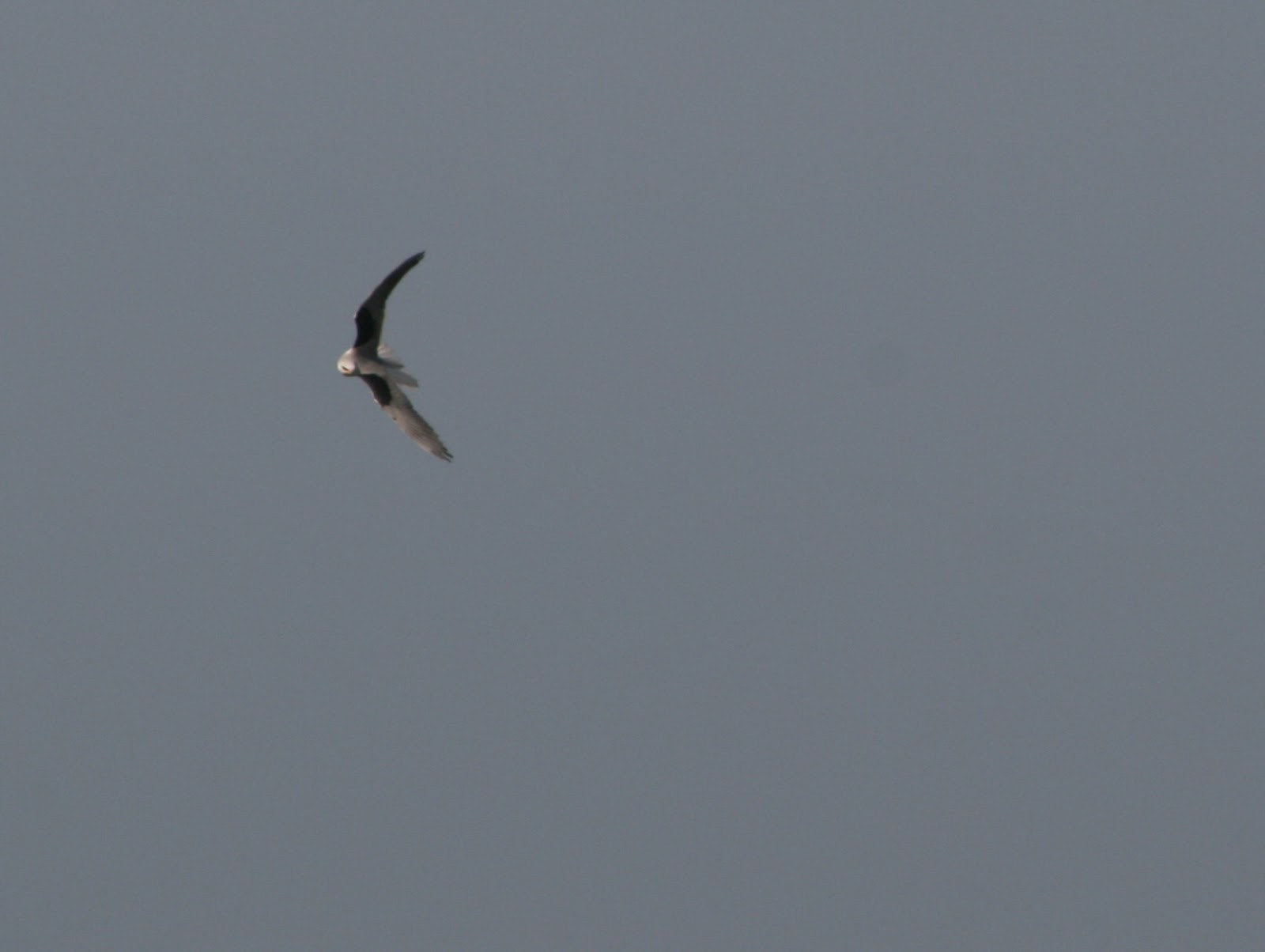
We walked a trail around the marshland a bit, and then happily came upon our first White-tailed Kite! We first saw it soaring and kiting about as it is known for doing. It was flying away from us, but we hurried through the footpath following it. In flight, we noticed its tell-tale dark wrist spots and black shoulders. We finally arrived at a bridge where we watched it land in a tree quite a ways away from us. We relished in its beauty and noticed it pumping its long white tail.
White-Tailed Kite kiting
White-Tailed Kite - Notice the black shoulders
White-Tailed Kite making a gorgeous turn, its head straight and wings vertical
We enjoyed the looks we got at that time, but it was when we were on our way out from the park that we noticed another White-tailed Kite hovering above a field, and with the blink of an eye, the Kite dropped straight down with such ease and grace. And when it came up from the tall grasses, it had a small mouse in its clutches! The Kite then flew over to what appeared to be its home base in a bare tree where it met with its mate. We watched them together, and then we watched as they would switch off from their post, seemingly to take turns gathering food. We were able to get much better looks at its gorgeous contrasting grey and black and white colors and its striking, darkly outlined red eyes.
White-Tailed Kite with a Mouse
White-Tailed Kite spreading its beautiful tail feathers
White-Tailed Kite pumping its tail
White-Tailed Kite
White-Tailed Kite pair swapping places on their post
White-Tailed Kite Pair
Interestingly enough, we had been on a trail called "Clapper Rail Trail" and had not seen any clapper rails, to our disappointment. But driving a little ways to where there was beach camping, we stumbled upon none other than a Clapper Rail! This was not our first, but we did get a great look at it as it did not take notice of us at first. Then, sensing our presence, it scampered away and disappeared in the marshy grass. We walked over to where it had run off to see if we could find it, and the grasses weren't even that tall, but it had disappeared into the ether, as rails are so good at doing.
Clapper Rail scampering away
Clapper Rail
We then saw another familiar face, a young Roseate Spoonbill, fly in front of us just as we were leaving the beach.
Roseate Spoonbill in flight
We left the park feeling extremely satisfied. We were hoping to get a glimpse of some new waterfowl, possibly Snow Geese, but we had no luck there. We did happen upon some Gadwall (a lifer) and Green-winged Teal in a road-side pond. We also stopped at the drab beaches of Galveston, but all we found was a Sanderling foraging for food amongst what appeared to be lots of plastic bottles, but which on closer inspection were actually tons of Portuguese Man-of-War!
Sanderling foraging amongst Man-of-War
Portuguese Man-of-War
On our way out of Galveston, Nick quickly saw a few Common Loons in the intercoastal waterways as i drove over a bridge, but even when we pulled over to a nearby empty lot to catch a glimpse, they were too far off at that point to get good looks at them. We were then shooed away by some construction workers across the way as we were apparently in an area where we didn't belong. Nevertheless, we left Galveston extremely satisfied and pleased with our findings.
As I noted in my previous post, we were well on the road to 100 species on our first day of our 3-day birding weekend in Titusville, FL. But we felt our Century Run slipping away from us as we headed into Black Point Wildlife Drive with only 60 birds under our belt. There seemed a glimmer of hope as we entered the drive, because when we've been down that way in the past we've found huge numbers of waterfowl and shorebirds. This time, however, the first thing we noticed was how dry it was, compared with our other visits.
Almost right off the bat, we saw large animals running together on the far side of some small trees. My gut wanted to say hippos (stupid gut, there are no hippos in Florida), but once we managed a better view, albeit a brief one, I cut myself some slack. It was a small group of feral pigs, one of which was massive! It all happened much too quickly for pictures, but fortunately, it was a memorable enough sight not to need them. Seeing them in person, it's easy to imagine the damage they can inflict, both on humans, and on their environment.
As we drove on, we did manage new trip birds, but they didn't come nearly as quickly as we'd hoped. Areas that we've seen jam-packed with ducks previously were devoid waterfowl, but did contain the occasional Pied-billed Grebe, Greater and Lesser Yellowlegs, White and Glossy Ibises, and an assortment of herons, including Reddish Egrets.
Greater Yellowlegs
When we came up to the first parking area, we joined a largish gathering of people to watch Roseate Spoonbills and Wood Storks feed. These two species feed similarly, but with obvious differences. As the videos below demonstrate, spoonbills are more active feeders, vigorously sweeping their bills from side to side. Wood Storks are more likely to open their bills and hope for the best, occasionally readjusting their position slightly. Doubling back toward the walking trail, Maureen found a Clapper Rail, which vanished before she could point it out. It did briefly reemerge, and I was able to see how much more dull the coloring was compared with it's Gulf Coast cousin, a Clapper Rail we recently saw in Galveston, TX. The good thing about the dull coloration is that it removes the trouble of trying to differentiate it from the nearly-identical King Rail.
Wood Storks, Roseate Spoonbills, White Ibises, and Snowy Egrets
Eventually, we did see large flocks of Lesser Scaup overhead, which ended up being our only ducks for the day. As we watched them fly in, formations of American White Pelicans also passed nearby. After watching flock after flock of Scaup vanish behind the same set of trees we were able to locate where they were gathering. The water almost seemed to be boiling, with all the bathing and splashing they were doing.
American White Pelicans
Flock of Lesser Scaup
Lesser Scaup
A rambunctious group of scaup
On the way out, we tried to locate a Bald Eagle, where her nest is known to be, but the nest was empty, and she was nowhere to be seen. As we met up with the main road again, we saw raptor perched on top of a telephone pole, and as we passed by, we were happy to see that it was her. Although we left Black Point significantly short of our goal, we were nevertheless glad for the great weather and for plenty of birds we don't find as easily at home, just a couple of hours south. With the sun fading, we returned to the shoreline where we ate lunch. A few minutes after we arrived, three Black Skimmers swept in and began skimming the shallow water along the shore. Even though we failed our ludicrous goal, we considered this a perfect end to a perfect day. 73 species is nothing to complain about, after all. Plus, we had two more days left of our weekend, and we had no intention of returning home without all 100.
We would like to introduce a new weekly feature here on our blog. As you may have noticed, I love taking bird photos. For me (Maureen), it really enhances my birding experience. To capture that perfect shot, especially of a life bird, gives me such an extreme feeling of accomplishment. So here we present to you “Featured Feathered Friend” where I can display one of my best bird photos and share a little story behind the shot. Since this is an intro post, I'll give a little background about myself and include 3 lovely pictures from the same event. But after this one, I'll keep them short and sweet ;-)
Really, our birding experience really started with me taking photos of birds to figure out what they were. Nick and I started out with a general Audubon Field Guide, a camera, and curiosity, and our love of birding took off from there. I had a long lens I wanted to learn to use, and we had birds all around us that we wanted to figure out and identify. We started with taking pictures of the “easy” birds – the ones that would stay still as long as you didn’t approach too closely, such as the array of herons and egrets here in South Florida. Then, the challenge would take on a new dimension as we started chasing down those little tweeting things high up in the trees, which we soon found out to be warblers.
Now everywhere we go birding, I have my camera around my neck looking to find a new lifer and to take that perfect shot. While no shot is perfect, I suppose that’s the thrill of the game – trying to get the best shot possible. And even with run-ins with birds we’ve seen before, I’m always trying to get a better shot than the last. And then there are also the times when I just see such a beautiful opportunity that I can’t pass it up - the bird is in perfect light, a raptor flies by me at just the right speed for me to snap a shot, a passerine is so close and so still that it feels like he’s posing...
But enough about me... Here is our first featured feathered friend. Here we have a young Roseate Spoonbill. So, in the first picture, I had the great fortune of having this pretty in pink bird take off right in front of me and towards me! Nick and I had been taking one of our many walks along the boardwalk of Green Cay Nature Center. We came around a bend and found a photographer standing there with tripod set up and camera positioned on this spoonbill standing on a snag. The man had told us that he’d been there about an hour waiting for this bird to take flight. I wasn’t sure if this was true, but I wouldn’t doubt it. So I decided to take my chances too and set up my tripod a few feet down the boardwalk and wait to see if I could get a nice take off/flight shot. Well, I got lucky and didn’t have to wait very long. After about 10 minutes or so, the spoonbill was turned towards me and took flight! I got off a couple of shots, and this was one of the prize ones. The light was coming through it’s wings so fantastically! The second picture is a continuation of the spoonbill's flight.
The spoonbill then landed in the shallow swampy water below and started feeding with other spoonbills that we hadn’t even realized were there. The spoonbills were now low and wading amongst the bald cypress trees. Like a true sport, I got down on my knees, and at some points, my elbows, and started snapping away, pointing my camera between the planks of the boardwalk. I believe I was even laying down at one point... All for that perfect shot, which leads me to my next picture. This juvenile Roseate Spoonbill (which you can tell is young by his fuzzy-ish white head rather than the bald head of the adult) paused in his frantic feeding long enough for me to snap away as he posed in the water, his creamy pink feathers contrasting with the lime green duckweed. And here, my friends, is our first featured feathered friend.
It seems like we've been traveling so much lately that we've hardly had time to do any birding locally. A few weeks ago we decided to change that and spent a long morning on the boardwalk at Green Cay. Now, I love Green Cay, and it's certainly the most reliable location for wading birds within a half hour's drive, but we always have to face the fact that lots of non-birders also visit, and their interests are often at odds with ours.
Little Blue Heron
Occasionally, birds fly up and perch on the railing, giving everyone with a camera a golden opportunity for photos. But the boardwalk is dominated by speed walking senior citizens throughout the morning, and they stop for nothing. On this particular morning, a Wood Stork landed just a few feet away from us. As a group of walkers approached from around a bend, Maureen snapped away, mindful that it was only a matter of seconds before they came near enough to flush it.
A little farther along, a Roseate Spoonbill prompted one of the most surreal conversations I've ever had.
Woman: Oh, look - a Flamingo!
Me: It's a Spoonbill.
Women (to me): Oh, it's a Spoonbill, not a Flamingo. I don't know why I believed you!
That's right - she attributed the words that came out of her mouth to me, and actually seemed annoyed. I didn't know what to say to that (and still don't), so I just gave her a nonplused look for several seconds and walked away, scratching my head.
Roseate Spoonbill -- NOT a Flamingo
It seems that most of the passing migrants have already made their way through, and more and more we're only seeing those warblers that we can reliably expect to see throughout the winter in South Florida. Among these was this Common Yellowthroat, but the Palms and Yellow-rumped (or is it Myrtle) Warblers were also out in big numbers.
Plenty of ducks were on the water, with a little more variety than just the Mottled Ducks, now that the Blue-winged Teal are back. We couldn't find any Green-winged Teal, although we'd seen them reported, but then, we've never never seen more than a few at a time at Green Cay, even when we have come across them.
As we approached the end of the boardwalk loop, we found a Sora that had ventured out of its hiding place in the reeds. Not long after discovering him, he disappeared back out of sight. It's nice to see the Soras every once and a while to reassure us that they're still around, even if we can't find them most of the time.