This past Memorial Day, we made the pilgrimage east to Malheur NWR to see what all the fuss is about. The birding in this part of Oregon gets nothing but rave reviews from anyone you might care to ask, and you can count us among the converted after spending four intense and exhausting days turning up lifers, state birds, and great looks almost nonstop. And we weren't the only ones: all up and down Highway 205 cars were pulled over to the roadside with binoculars poking out of the windows. Nearly everyone driving along was liable to pull up and ask what we were seeing. Why can't life always be like this?!
Our first intended stop of the morning was to be the refuge headquarters, but we were so distracted by all the Sandhill Cranes and Long-billed Curlews on the way, that we didn't make it there until after 7am. The very second we stepped out of the car, a Swainson's Hawk flew overhead and landed at the edge of the parking lot. So, by 7:10 Malheur had already secured our everlasting affection. By the time we left, we'd score another great encounter with the Swainson's and its mate… or should I say that the Swainson's Hawks were the ones that scored.
 |
| Swainson's Hawk |
 |
| Yellow Warbler |
Black-chinned Hummingbirds were super active at the hummingbird feeders just a few feet off the patio. During our
brief stop in Phoenix last year we left a female hummingbird unidentified, which, if I had to guess, was probably a Black-chinned. But there was no guessing involved at Malheur, and while Calliope had been reported within the last week we would have to content ourselves with only one lifer hummingbird, knowing that we'd
make up for it in Honduras in another two weeks.
 |
| Black-chinned Hummingbird |
There was plenty of drama around the feeders. Even if there were more than enough perches to go around, one of the male Black-chins wasn't going to let any other bird drink from
HIS nectar if he had anything to say about it.
Other feeder birds like Evening and Black-headed Grosbeaks were going to town on the sunflower seeds and probably spilling nearly as many as they ate. At another feeder station, Yellow-headed and Red-winged Blackbirds were doing their share of damage as well.
 |
| Evening Grosbeak (male) |
 |
| Evening Grosbeak (female) |
 |
| Black-headed Grosbeak |
 |
| Red-winged and Yellow-headed Blackbirds |
 |
| Bullock's Oriole |
The main beneficiaries of all this spillage were the Belding's Ground Squirrels, which are normally tiny and cute -- and some of them were. Others were monstrously huge, so big that we figured they had to be some other species (baby marmots?). Nope, just morbidly obese ground squirrels.
 |
| A cute, typical Belding's Ground Squirrel |
 |
| Belding's Ground-squirrel on a high protein diet |
 |
| Black-tailed Jackrabbit |
Down by the water was an assortment of swallows, and a number of beautiful Black Terns looking sharp in their breeding plumage, much nicer than the mostly basic plumaged birds we would occasionally see in Florida. The headquarters wasn't overflowing with ducks, but a quartet of Redheads were a nice surprise.
 |
| Black Tern |
 |
| Barn Swallow |
 |
| Redheads |
From the headquarters we drove over to the field station. Cliff Swallows were ubiquitous, and were busy building their mud nests. Swallows from all around the station were collecting from just a couple of mud puddles, making neat little clumps in their bills, and taking the greatest care not to dirty their wings in the slightest.
 |
| Cliff Swallows gathering mud |
 |
| California Quail |
On the way out we watched a huge pale hawk land on the ground. This juvenile didn't have its rusty leggings yet, but it had all of the menacing that you'd expect from a bird of prey that size. This was our lifer Ferruginous Hawk, but we'd see more before the trip (or day) was through.
 |
| Ferruginous Hawk |
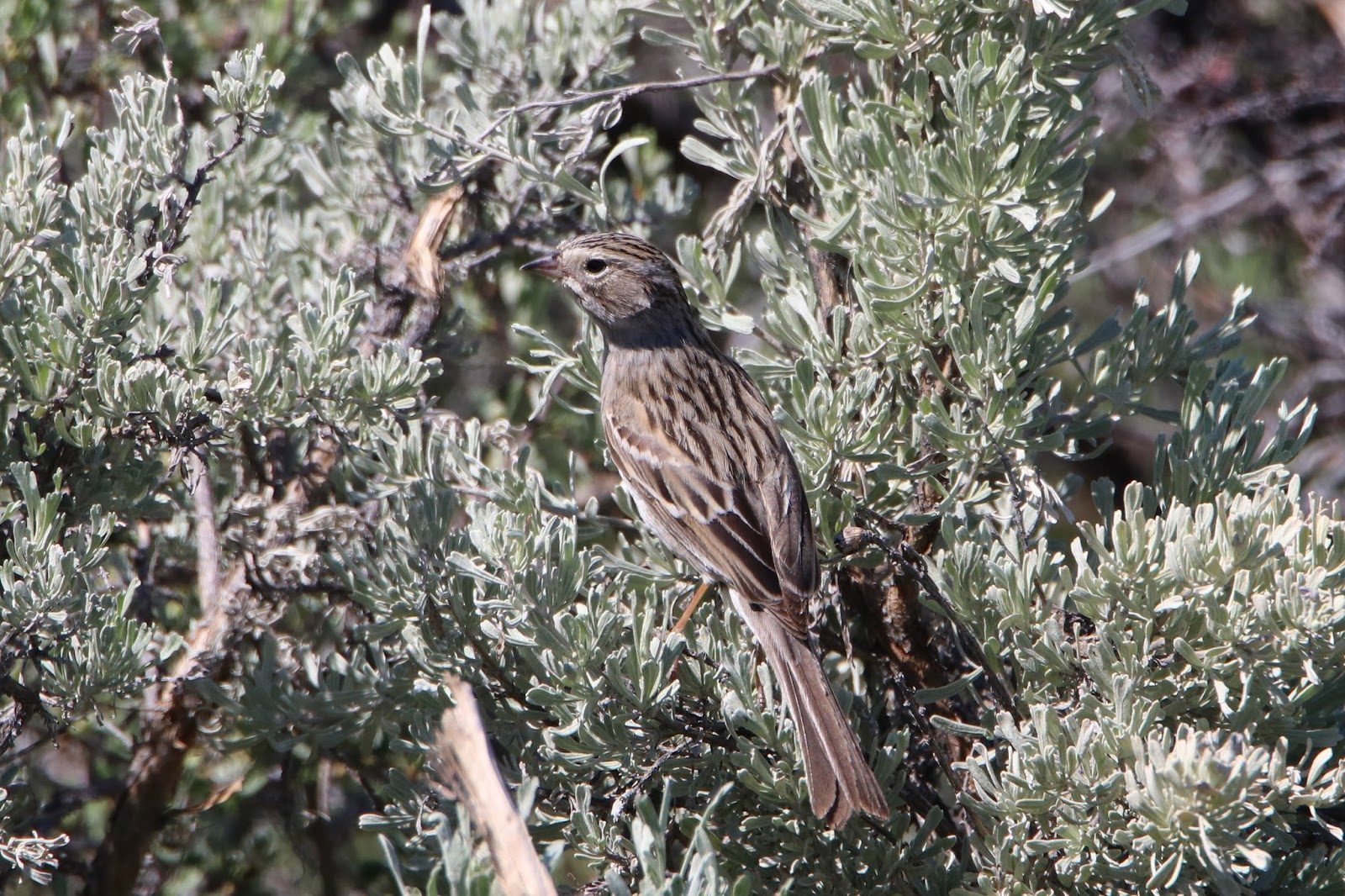
Next we stopped at Diamond Craters, where we hoped finally we'd cross paths with some of the sagebrush species we'd been looking forward to. Sure enough, we found our lifer Sage Thrasher, and a Brewer's Sparrow, but only one of each, and overall the park was pretty quiet. We still managed to have ourselves quite a lark, though -- as in, there were plenty of Horned Larks, Lark Sparrows, and Western Meadowlarks. The Horned Larks must be suicidal, because we only ever found them after they landed directly in from of the moving car.
 |
| Sage Thrasher |
 |
| Horned Lark |

There were some awesome non-birds around Diamond Craters, too. Of all non-birds, we most wanted to see Pronghorn, which turned out to be super easy, and they milled around the side of the highway, pretty closely, as we drove in the night before. Unfortunately, there weren't any good places to pull over, and I only really got to watch them out of my periphery while we passed them at 70 mph. We didn't get our best looks at Diamond Craters, but we did get the only picture of one we managed the whole trip. We also saw a pretty roughed-up looking Racer. I don't know if it had been hit by a car, but it was writhing and had an eye out of its socket, poor thing.
 |
| Pronghorn |
 |
| Racer |
We took Ruh-Red Rd. back to the campsite where there were a ton more Sage Thrashers (that's more like it!). And then began a cavalcade of epic raptors, up close. We passed one of our left, and a second later was able to process what it was. I reversed and angled the car across the dirt road so Maureen could snap away at the closest we will ever be to a Juvenile Swainson's Hawk.
 |
| baby Sage Thrasher |
 |
| Western Meadowlark |
 |
| Western Kingbird |
 |
| Juvenile Swainson's Hawk |
Back out onto Steens Hwy, and an adult Ferruginous Hawk was perched right across from us on a telephone pole. We pulled over, and were basking in its presence… until another car pulled up alongside asking if we needed help, which was more than the hawk could tolerate. Let that be a lesson, everyone: never try to help people! Lastly, a Golden Eagle, on another telephone pole, just a quarter mile farther down. Man, this place was chock full of raptors!
 |
| Ferruginous Hawk |
 |
| Home, sweet home. While we were in Malheur we stayed in a teepee… with a hot tub inside |