We woke up early in Phoenix, on only 3.5 hours’ sleep; we had ambitious plans for the day, and actually thought we would carry them out. This despite the 22 hours it took for us to reach Phoenix from Houston the day before. A cross-country drive is too full of new sights and new experiences to care only about getting from Point A to Point B (as
Maureen’s last post demonstrates), but we were determined not to waste an opportunity to see the Grand Canyon. Even if there weren’t time to do any proper exploring, we could drive up to it, see it, and then spend the rest of our lives trying to process it.
Clearly this was a silly plan. The Grand Canyon isn’t a mere roadside attraction. It deserves much more than the contemptuous bemusement usually reserved for the World’s Largest Artichoke. As soon as we hit the road we started having second thoughts, and fortunately, Laurence Butler (of
Butler’s Birds fame) gave us more than enough suggestions for birding the Phoenix area. Encanto Park, seemed particularly promising, tantalizing us with possible Harris’s Hawks and Rosy-faced Lovebirds.
 |
| Verdin |
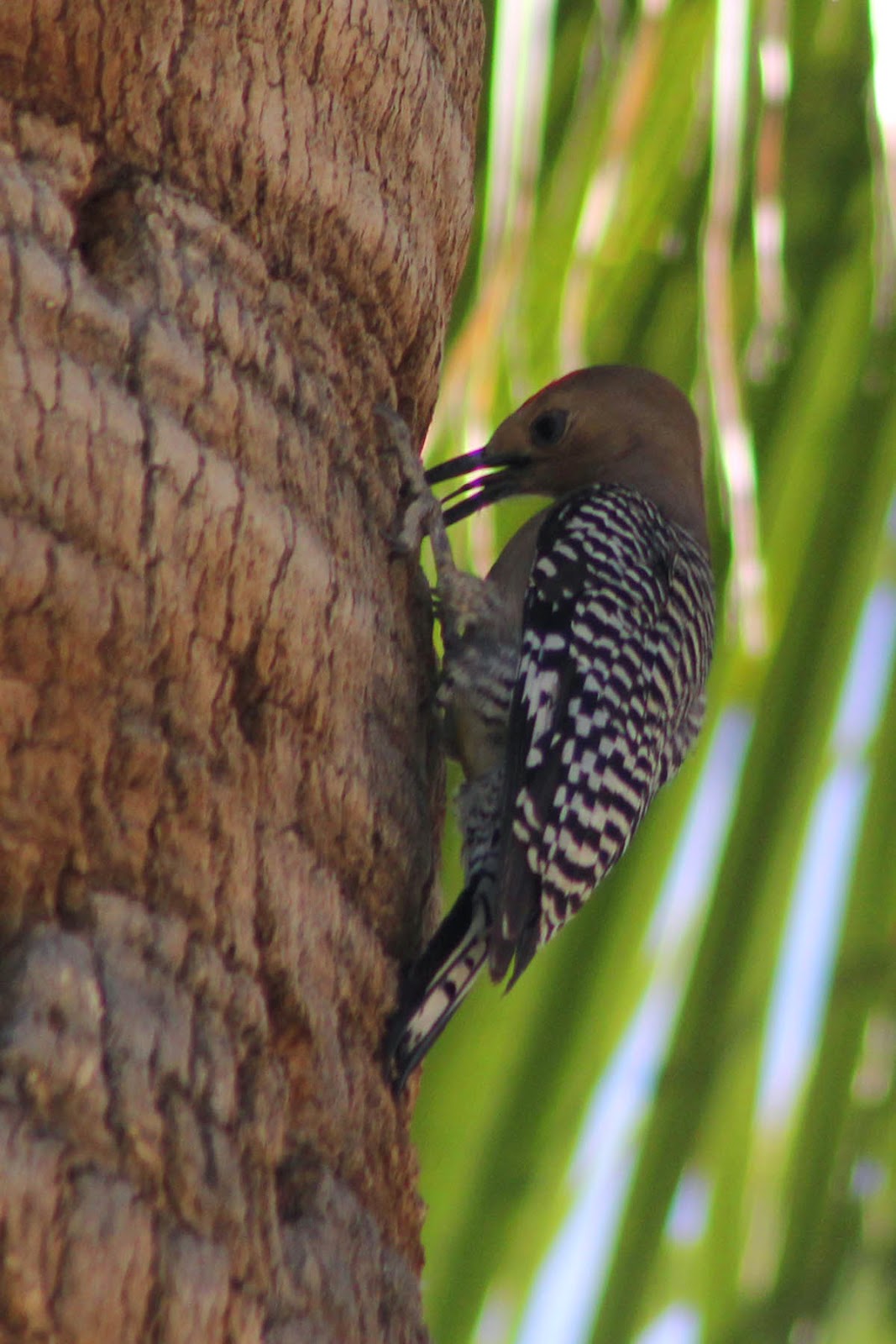
A singing male Verdin was the very first bird to catch our ear, and the first of many, many lifers we’d tally during the day. A couple of female hummingbirds buzzed by us, but this East Coaster won’t humiliate himself by pretending to know what they were. Gila Woodpeckers were omnipresent, and their call an easy one to learn being so similar to our familiar Red-bellies. It was a lot to take in without leaving the parking lot yet.
 |
| Female hummingbird. If you put a gun to my head, I might wager Black-chinned |
 |
| Gila Woodpecker - I realized I'd been pronouncing it wrong once I thought about Gila Monsters |
We’d eventually made it a tiny bit farther away from the car when the Lovebirds arrived in a raucous frenzy. I hate to admit it, but they’re damn cute. Maybe I only have a soft spot for these established exotics because I’m missing the Monk Parakeets that were everywhere in south Florida. In fact, we met a San Francisco couple here that came to see the Lovebirds, specifically because they love the parrots on Telegraph Hill so much. The heart wants what it wants, I guess — provenance be damned. In any case, it was fun watching them zip nonstop all across the park after the other birds quieted down a bit (the Lovebirds, not the San Francisco couple).
 |
| Rosy-faced Lovebird |
After Encanto, we grabbed some breakfast and plotted our next move. We really wanted to spend quality time with the Saguaro cacti, iconic succulents of the southwest. When we drove into Phoenix late the night before we could see them silhouetted on the tops of the hills, and it only made us more excited to see them in the daylight. A quick search turned up Cave Creek Regional Park as one of the more promising spots to get up close and personal. So, we expected to see Saguaros when we got there, but what we actually got was our minds blown.
 |
| Panorama of Cave Creek Regional Park |
 |
| Saguaros - iconic cacti of the Southwest |
 |
| Hipster Caryophyllalists? |
A pair of Black-throated Sparrows, most dapper of the Emberizidae, took no heed of us as they frolicked in the garden along the sidewalk. Again, this was while we were still standing by the car, because the birds in AZ are apparently just as happy to come to you. Once we started up the trail a quail started calling and set us looking hopelessly about to try and see it (yes, this would seem to contradict the point I just made about birds coming to you, but hang in there). We found out later, that the Cave Creek only hosts Gambel’s Quails, and we were happy to put a name to the call, even if we couldn’t experience the full Gambel’s package.
 |
| Black-throated Sparrow |
 |
| Black-throated Sparrow - King of the Cactus |
 |
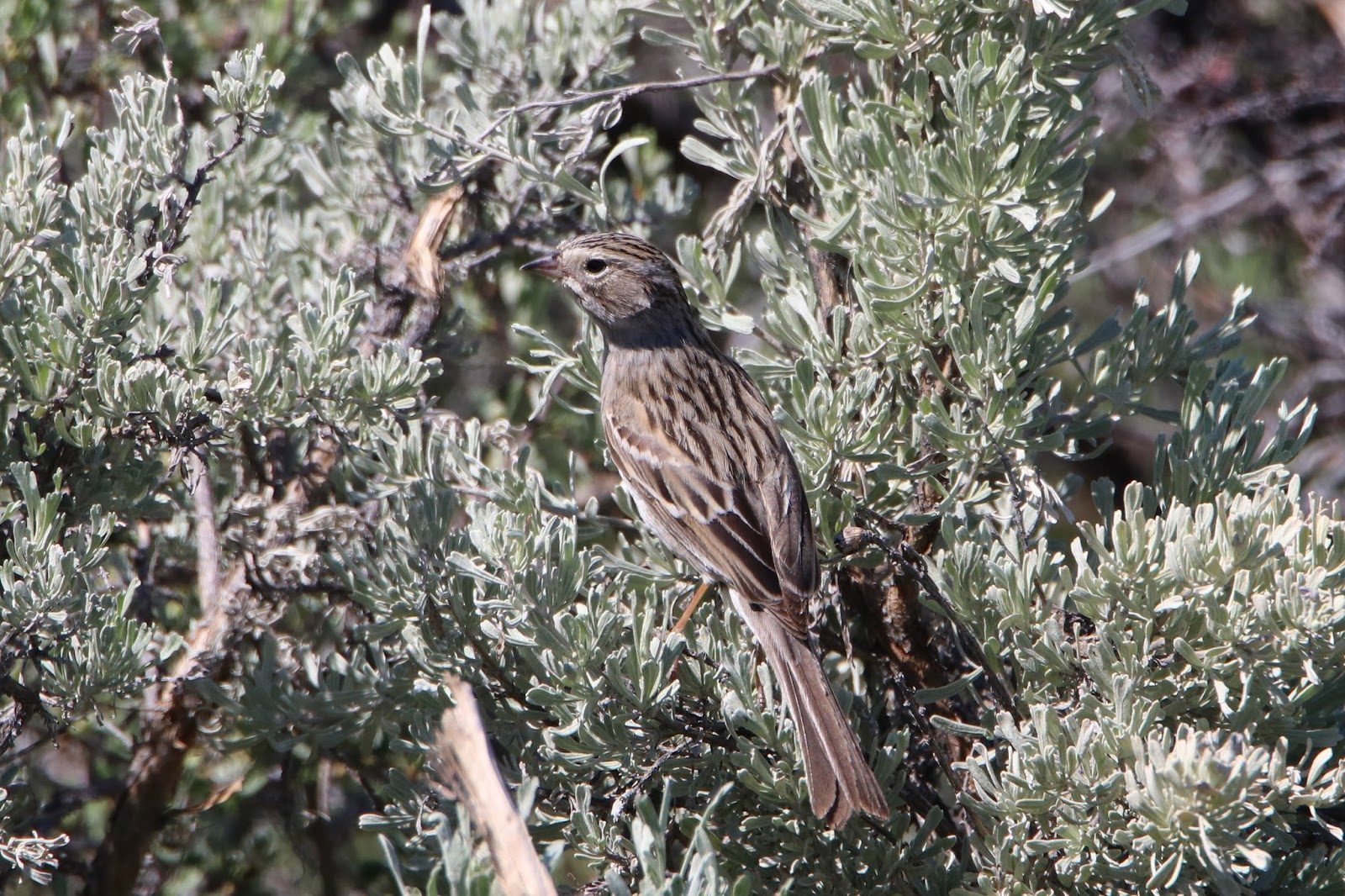
| I want to call this a Brewer's Sparrow, but when I told the naturalist on duty that we'd seen one, he looked doubtful |
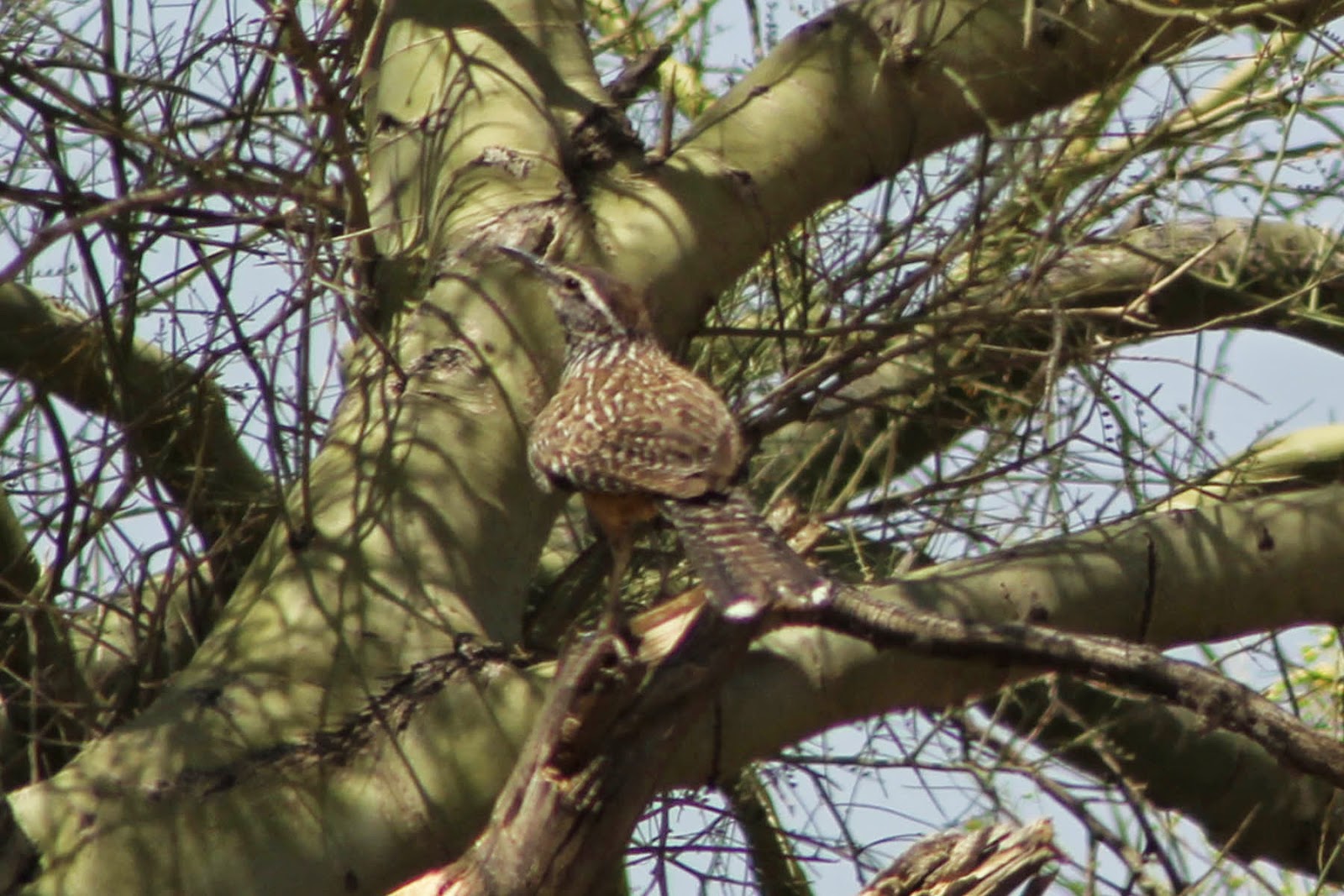
Under a tangled mass of roots and branches, a chunky bird started digging around a few feet in front of us, lifting his head long enough for us to know him as a Canyon Towhee. He was so intent on rummaging around that he hardly paid us any attention, and we watched him intently until far uphill a distant object passed swiftly through the landscape and landed briefly on a Saguaro. For some reason, I found myself stunned to find a Cactus Wren… on a cactus. I just hadn’t considered the possibility of seeing one here. After it ducked out of sight, we waited for quite a while for it to pop back up. The sun was beating down pretty hard, and we eventually decided to turn back… which is when Cactus Wrens started appearing EVERYWHERE. We’d stop and watch for a while, and then look at the time and push on. Get distracted again, look at the time and push on.
 |
| Canyon Towhee |
 |
| Cactus Wren playing peek-a-boo, and, more importantly, on a cactus |
 |
| Cactus Wren |
We hadn’t intended to spend nearly as much time birding as we did, but once we were there, it was nearly impossible to tear ourselves away. The plan was to make it to Reno that night to crash with my cousin, but our ETA was becoming later and later. Nevertheless, we wanted to pop into the nature center briefly. Right... briefly. We got to talking with the naturalist on duty, who pointed us to a male Costa’s Hummingbird sitting on his favorite branch tip, behind the building. Such a gorgeous bird, and a treat to ID a hummer besides Ruby-throated. We must have stared at him for 10 minutes before we went back inside again.
 |
| Costa's Hummingbird |
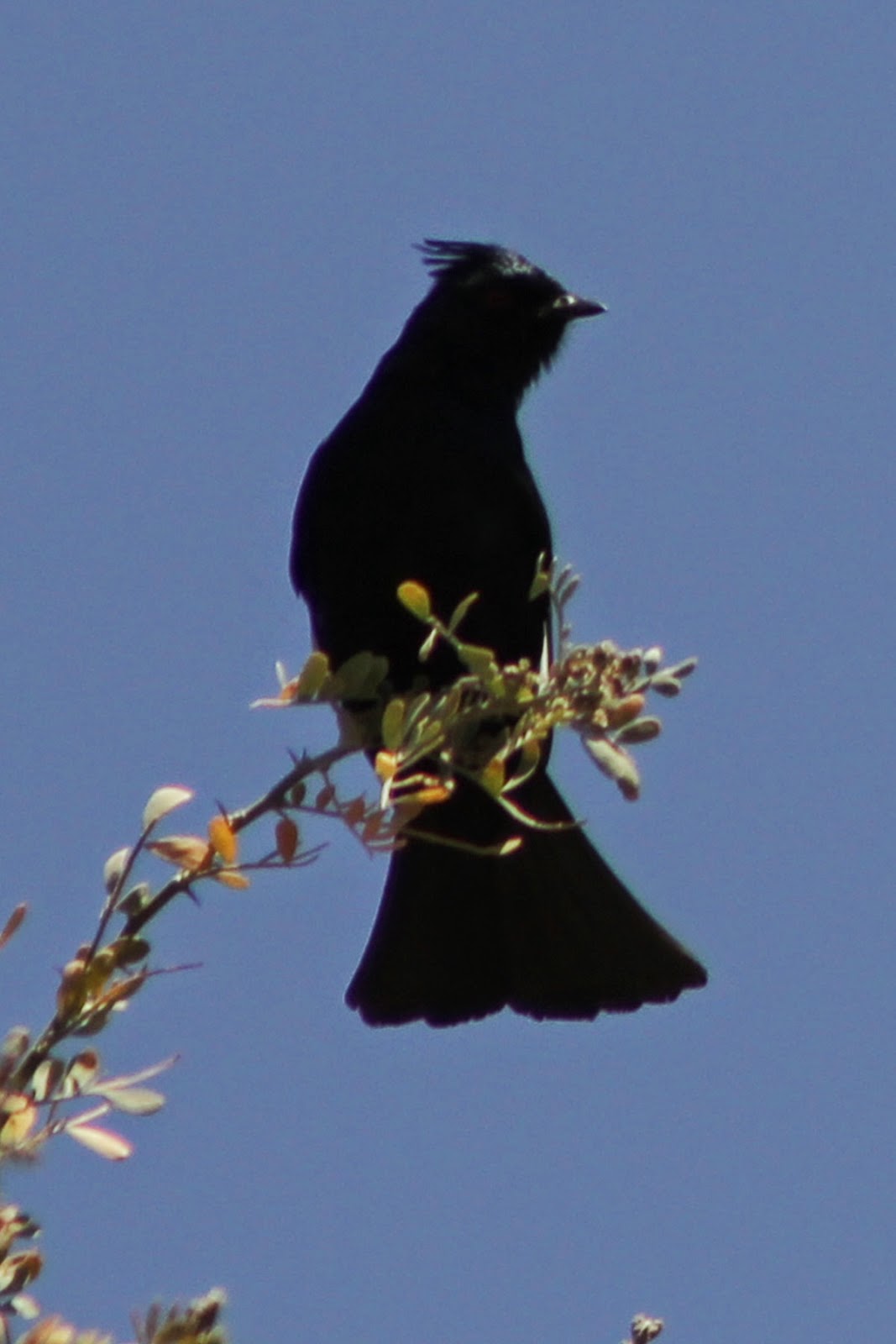
And then he told us where in the park we could drive to reliably see Phainopepla. PHAINOPEPLA?! Well, obviously we had to see those, and I don’t care how far away Reno is (~12 hours). We headed down to the campsite, and located the mistletoe indicated to us. We only had to wait a few minutes before we saw a flying black bird with a big white patch on each wing, and tracked it across the sky until it landed at the top of a tree. The male Phainopepla was every bit as incredible as we’d hoped. But something else was in the same tree: a Gambel’s Quail! We couldn’t believe our luck, having two amazing birds right there in front of us, and then a Canyon Towhee came out and started scratching around on the ground toward the base of that same tree. This was some magical tree.
 |
| Phainopepla |
 |
| Digiscoped shot of a Phainopepla |
 |
| Gambel's Quail |
 |
| Canyon Towhee |
It was difficult leaving the Arizona desert behind us, but we knew we’d have to come back someday soon. By the time we finally dragged ourselves away it was already 1pm. We were exhausted and sunburned, and we still had a long drive ahead of us. Even so, we could make it into Reno not too long after midnight… if we made directly for our destination, without letting ourselves get distracted again. Ha!
 |
| I'd have been mighty disappointed if we'd left the desert without seeing any lizards. This whiptail is the only one we got a decent look at |
 |
| Compass Barrel Cactus |